
Tribeca Resources Defines Priority Drill Targets Across Large-Scale Porphyry-Epithermal System at Jiguata, Chile
10 SEPTEMBER, 2026 – TheNewswire - VANCOUVER, BC - Tribeca Resources Corporation (TSXV: TRBC) (OTCQB: TRRCF) (“Tribeca Resources”, the “Company”) is pleased to report that integrated targeting and analysis of the 2026 geological, geochemical and geophysical exploration data from the Jiguata high sulphidation epithermal-porphyry copper exploration project in northern Chile (“Jiguata”, or the “Jiguata Project”) has defined multiple porphyry/epithermal exploration targets, including high-priority drill targets at La Soberana and Cetro Dorado.
Highlights:
-
Expanded and extended pre-drill program defined multiple high-priority conceptual Cu-Mo-Au porphyry and Au-Ag-Cu epithermal drill targets across the Jiguata Project
-
Drill targets supported by signatures derived from geological mapping, widespread hyperspectral alteration responses, surface geochemical anomalism and geophysical modelling
-
La Soberana is interpreted as a compelling 2.5km x 1.5km porphyry/epithermal target zone that combines porphyry style Mo-W-Bi ± Cu geochemical anomalism with an epithermal As-Sb-Te ± Ag-Au overprint. Advanced argillic alteration, hydrothermal breccias, coincident geophysical responses and a position at the intersection of two major structures support the interpreted exploration potential
-
Multiple priority epithermal/porphyry drill targets at Cetro Dorado, characterized by evidence of strong advanced argillic alteration with elevated As-Sb-Te ± Ag-Au epithermal pathfinder geochemistry, mapped hydrothermal brecciation, and supported by chargeability, resistivity and magnetic features
-
Preliminary results from the two additional targets to the west, Escudo Real and El Trono, provide encouraging indications in terms of alteration style, pathfinder geochemistry and geophysical signature that warrant follow-up surface work
The Company believes the integrated exploration results are consistent with preservation of the upper levels of a porphyry-epithermal hydrothermal system at Jiguata, where high sulphidation epithermal environments may occur above, adjacent to, or telescoped over Cu-Mo-Au porphyry intrusive centres.
Tribeca Resources CEO, Dr. Paul Gow commented:
“The integrated review of our 2026 field and geophysical datasets has significantly advanced the Jiguata exploration model and allowed us to define several high-priority targets for drill testing. La Soberana and Cetro Dorado are emerging as the two most advanced of the four identified alteration centres, based on their geological, geochemical, and geophysical characteristics, while El Trono and Escudo Real add important scale and optionality to the broader project. Although the targets remain conceptual until tested by drilling, the consistency of the results across multiple datasets provides a strong technical foundation for the next phase of systematic exploration and drilling activities at Jiguata.”
Click Image To View Full Size
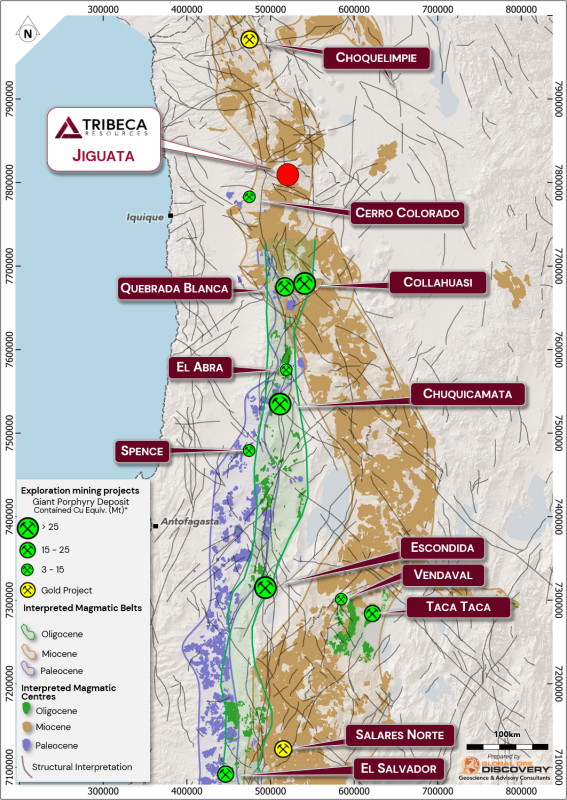
Figure 1 Location of the Jiguata Project and significant porphyry and epithermal projects of Northern Chile. References to nearby or regional deposits are provided for geological context only. The presence, size or grade of mineralization on other properties is not necessarily indicative of mineralization on the Jiguata Project.
Jiguata Porphyry Copper-Molybdenum Project
The Jiguata Project comprises a 10,000 hectare property located in the Tarapacá region in northern Chile. It is situated in the northern extension of the prolific Palaeocene and Eocene-Oligocene porphyry copper belts where it is overprinted by the younger Miocene Belt of magmatism that hosts recent large-scale high sulphidation epithermal gold and porphyry copper-gold discoveries further to the south, including the Vendaval Cu-Au Porphyry (First Quantum Minerals Plc) and the Salares Norte Au-Ag High Sulphidation Epithermal (Gold Fields Limited) deposits (Figure 1).
The 2026 exploration program at the Jiguata Project has substantially advanced the Company's exploration model through the integration of geological, geochemical, spectral and geophysical datasets (Error: Reference source not found). Results from 672 soil samples, 149 rock-chip samples, detailed alteration mapping, hyperspectral analysis, magnetic surveying, reprocessed IP data and MT surveying and modelling have defined multiple high-priority porphyry and epithermal targets and provided a strong technical foundation for proposed Phase 1 drill testing.
Community engagement has commenced in preparation for the proposed Phase 1 drill program to test the defined targets. Drill hole depths are planned to be +700m, with the drill platforms at elevations of approximately 4600m. Initial drilling is proposed to commence at targets within the La Soberana alteration centre.
Integrated exploration targeting model
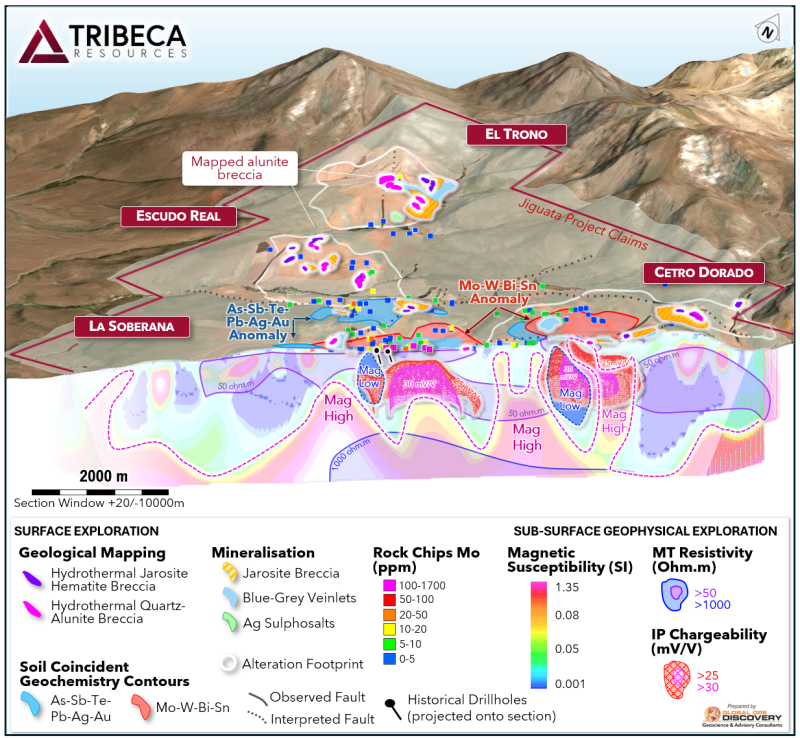
The integrated model of geological, geochemical, spectral and geophysical data is summarized in Figure 2 and highlights multiple target areas displaying characteristics consistent with the upper levels of a porphyry/epithermal system. Advanced argillic alteration associated with As-Sb-Te ± Ag-Au pathfinder geochemistry, hydrothermal brecciation and coincident geophysical responses support the potential for high sulphidation epithermal mineralisation. Mo-W-Bi ± Cu anomalism, chargeability features and magnetic/resistivity signatures provide indications of possible deeper porphyry affinity at multiple locations at Jiguata.
The oblique cross-sectional slice through the 3D model in Figure 2 represents an 8km long cross-section through the La Soberana and Cetro Dorado alteration centres, which contain the priority drill targets for the proposed Phase 1 drill program.
The key alteration, geophysical and geochemical characteristics of each target are provided in Table 1 and discussed below.
The integrated model of geological, geochemical, spectral and geophysical data highlights multiple target areas displaying characteristics interpreted to be consistent with the upper levels of a porphyry/epithermal system. Advanced argillic alteration associated with As-Sb-Te ± Ag-Au pathfinder geochemistry, hydrothermal brecciation and coincident geophysical responses support the interpretation of potential high sulphidation epithermal mineralisation, while Mo-W-Bi ± Cu anomalism, chargeability features and magnetic/resistivity signatures provide indications of possible deeper porphyry affinity at multiple locations at Jiguata.
Click Image To View Full Size
Figure 2. Overview of the integrated exploration model and key datasets at Jiguata. The image represents a northwest-directed oblique view of the project area.
Table 1. Summary of the four prominent alteration centres at Jiguata and key geological, geochemical and geophysical features supporting their exploration significance. The alteration assemblages listed are derived from a combination of geological mapping, WorldView-3 satellite spectral data and TerraSpec surface spectral data.
|
Alteration Centre |
Alteration Assemblage |
Geophysics |
Geochemistry |
Key Characteristics |
|
La Soberana |
Alunite - Kaolinite +/- Silica Jarosite |
Low resistivity feature between resistive surface and basement + chargeability |
As-Sb-Te ± Ag-Au |
AlOH composition trending towards Paragonite. Overlap of As-Sb-Te ± Ag-Au epithermal style and Mo-W-Bi ± Cu porphyry style anomalism pathfinders; advanced argillic alteration; hydrothermal breccias; Type B-style vein textures; nearby diatreme related features; chargeability feature associated with elevated geochemistry coincident with magnetic high |
|
Paragonite +/- Muscovite |
Magnetic lows peripheral to magnetic high core |
Mo-W-Bi ± Cu |
||
|
Cetro Dorado |
Alunite - Kaolinite +/- Silica Jarosite |
Resistivity high surface feature |
As-Sb-Te ± Ag-Au |
Strongest lithocap style geochemical and alteration expression identified with elevated As-Sb-Te ± Ag-Au; kaolinite-alunite-jarosite-hematite alteration; Type B- and Type D-style vein textures; diatreme outcrops; chargeability feature associated with magnetic low |
|
Illite-Sericite +/- Jarosite |
Magnetic low coincident with chargeability response |
Mo-W-Bi ± Cu |
||
|
Escudo Real |
Muscovite – Illite +/- Jarrosite |
Magnetic low associated with moderate resistivity feature |
As-Sb-Te ± Ag-Au |
As-Sb-Te ± Ag-Au coincident response correlating with Kaolinite ± alunite ± jarosite ± hematite/goethite alteration; elevated As-Sb-Te ± Ag-Au; local copper anomalism; broader propylitic and phyllic alteration responses; shallow magnetic low associated with moderate resistivity |
|
El Trono |
Alunite - Kaolinite +/- Silica Jarosite |
Isolated shallow magnetic high within broader magnetic low. Broad coincident conductivity |
Results pending |
Advanced argillic alteration; hydrothermal brecciation; residual silica; jarosite alteration; possible diatreme-related features; geochemical results pending with preliminary anomalous Cu-As-Ag-Au rock chip results - detailed geochemical analysis yet to be completed for this target |
La Soberana – Porphyry–Epithermal Targets
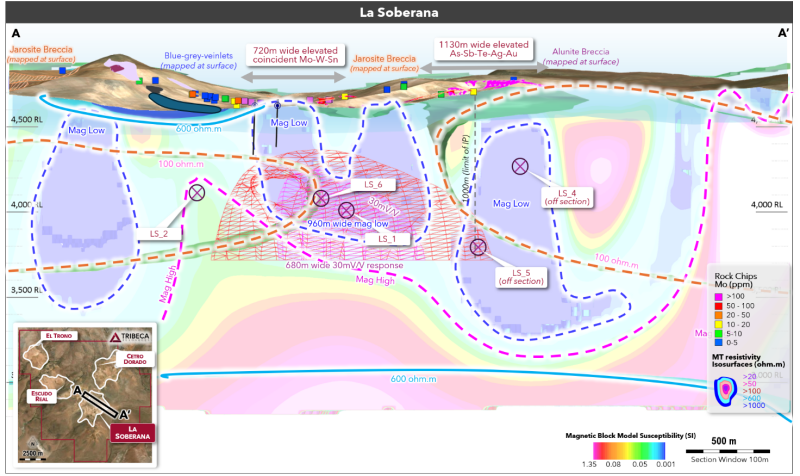
La Soberana is interpreted as one of the priority conceptual porphyry/epithermal target areas within the Jiguata Project (Figure 3). Integrated geological mapping, surface geochemistry and geophysical modelling have outlined a coincident alteration, geochemical and geophysical footprint that the Company believes supports it as a prospective porphyry/epithermal exploration drill target.
The La Soberana target is characterized by As-Sb-Te ± Ag-Au geochemical pathfinder anomalism, extensive advanced argillic alteration and multiple mapped hydrothermal breccia bodies, interpreted to represent the upper levels of a porphyry/epithermal hydrothermal system. The presence of alunite-kaolinite ± silica ± jarosite alteration, together with As-Sb-Te ± Ag-Au pathfinder anomalism, supports the interpretation of a lithocap. These features are potentially significant because lithocaps can form above, or adjacent to, high-sulphidation epithermal environments.
Importantly, La Soberana also displays overlapping Mo-W-Bi ± Cu anomalism, which is interpreted as a possible porphyry-style pathfinder association. The spatial overlap between this porphyry-style geochemical signature and the epithermal/lithocap pathfinder geochemical suite is considered a key targeting feature. This relationship may indicate vertical telescoping of the porphyry/epithermal system, where shallow epithermal mineralisation may overprint the earlier, deeper porphyry mineralisation.
Geophysical inversion modelling provides further support for priority targeting, where MT resistivity inversion modelling shows near surface resistive features that are linked to deeper, high-resistivity features that display “funne-like” geometries. These “funnel-like” features are interpreted at Jiguata to be associated with areas of magnetic lows along with elevated IP chargeability responses.
Click Image To View Full Size
Figure 3: Northwest-southeast cross-section through the La Soberana target, highlighting the coincident geophysical targets and surface geochemistry, and the presence of jarosite and alunite breccias and blue-grey veinlets mapped at surface.
The priority areas at La Soberana (Table 2) occur where the following features coincide:
-
Overlapping Mo-W-Bi ± Cu and As-Sb-Te ± Ag-Au anomalism
-
Mapped hydrothermal brecciation,
-
Advanced argillic alteration defined from spectral and mapping datasets,
-
Modelled magnetic lows,
-
Interpreted modelled MT resistivity “funnels”, and
-
Associated IP chargeability highs.
Targets identified at La Soberana are considered by the Company to be conceptually prospective for high sulphidation epithermal mineralisation and may also provide vectors toward a deeper or adjacent porphyry related source.
Table 2. Preliminary conceptual target areas and justification for investigation at La Soberana
|
Alteration Centre |
Target ID |
Target |
|
La Soberana |
LS_1 |
Porphyry target situated approximately 800m below well-developed coincident As-Sb-Te and Mo-W-Sn anomalism. Chargeability anomaly associated with a low magnetic feature developed within a greater than 100ohm.m resistivity “funnel”, and proximal to mapped jarosite breccia and interpreted advanced argillic alteration |
|
LS_4 |
High sulphidation epithermal target situated 400m below an interpreted approximately 1km long zone of Alunite-Kaolinite Pyrophyllite-Jarosite ± Opaline Silica alteration and a mapped 1.8km long alunite breccia. Area is defined by an approximately 500m wide coincident As-Sb-Te and Mo-W-Sn soil geochemical response. Target is within a moderate 100ohm.m resistivity feature situated 180m above a 20mV/V chargeability response in a zone of moderate 0.06 SI modelled magnetic susceptibility |
|
|
LS_6 |
Located at an interpreted core 370m wide 60ppm Cu soil geochemical anomaly within a broader 1km long Mo-Sn-W soil geochemical anomaly. Conceptual high sulphidation epithermal target located 600m beneath interpreted advanced argillic alteration features and situated within a moderately resistive 450m wide (100ohm.m) funnel and a 250m wide isolated magnetic low. Situated within an approximately 2km wide, 20mV/V chargeability response, offset 650m from the core of a 30mV/V chargeability centre. |
|
|
LS_2 |
Porphyry copper deposit target defined within a tuff unit adjacent to NNE structures proximal to an MT ~100ohm.m "funnel" feature beneath a shallow 600ohm.m MT resistive body. The target is characterized by high IP chargeability (20–25 mV/V), low to moderate IP resistivity, and a moderate to high magnetic response and is interpreted as a target for concealed potassic alteration and associated porphyry copper mineralisation beneath the advanced argillic lithocap. This is supported by a Mo–W–Sn soil geochemical anomaly overprinted by As–Sb–Te and WorldView-3-mapped Jarosite-Kaolinite (± Alunite) |
Cetro Dorado Priority Porphyry–Epithermal Targets
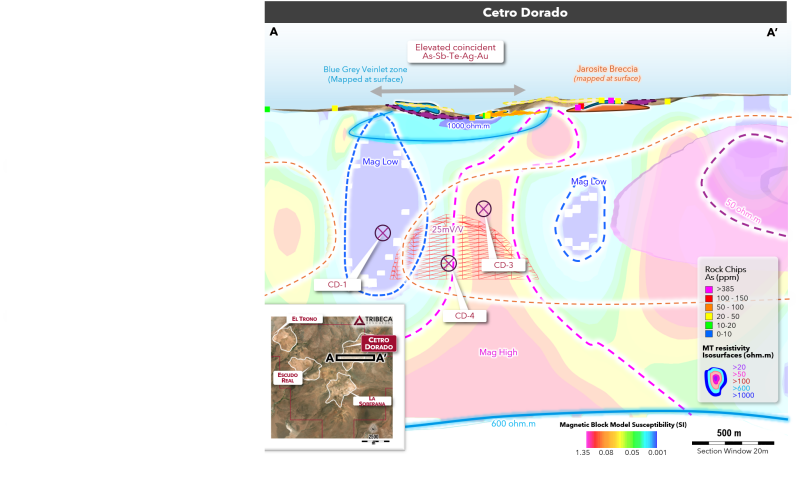
Cetro Dorado (Figure 4) displays the strongest lithocap-style geochemical and alteration expression identified at Jiguata to date. The area is characterized by elevated As-Sb-Te ± Ag-Au anomalism spatially associated with interpreted advanced argillic alteration defined by kaolinite-alunite-jarosite-hematite mineral alteration assemblages.
Elevated geochemical anomalism coincides with weathered Type-D quartz-sulphide veinlets, advanced argillic alteration and hydrothermal brecciation. The area also contains local stockwork vein networks interpreted as weathered Type-B porphyry-style veining, further supporting the prospectivity of the target.
Exploration mapping and elevated coincident geochemical responses correlate with a chargeability feature and a magnetic low located proximal to a magnetic high extending from interpreted magnetic basement. This relationship is considered relevant in a porphyry epithermal setting, where magnetic lows may reflect hydrothermal magnetite destruction associated with alteration by acidic fluids, while adjacent magnetic highs may indicate more magnetic intrusive or volcanic rocks or potassic alteration associated with the core of a porphyry stockwork. Chargeability responses may also provide indications of an alteration halo that may be associated with sulphide bearing alteration, clay-rich alteration or structurally controlled hydrothermal pathways.
The combination of lithocap-style geochemistry, advanced argillic alteration, porphyry-style vein textures, geochemical evidence of possible telescoping and coincident geophysical responses supports Cetro Dorado as a priority area for drilling.
The highest priority areas at Cetro Dorado (Table 3) are interpreted to occur where the following features coincide:
-
advanced argillic alteration identified from spectral datasets;
-
overlapping As-Sb-Te ± Ag-Au anomalism;
-
magnetic lows as well as magnetic highs;
-
interpreted MT resistivity ”funnel” features; and
-
associated IP chargeability highs.
Table 3. Preliminary conceptual target areas and justification for investigation at Cetro Dorado
|
Alteration Centre |
Target ID |
Target |
|
Cetro Dorado |
CD_1 |
Target situated 750m below surface and located beneath a 1km wide, 600ohm.m surface resistivity low that coincides with an approximate 750m wide, 1km long Ag-As-Sb soil geochemical anomaly. The target resides within a 500m wide, 800m deep 100ohm.m resistivity “funnel” feature that spatially correlates with a 450m wide, 1km deep magnetic high, and within a 1.7km wide, 20mV/V chargeability response. |
|
CD_3 |
1.0 SI magnetic high located 500m below surface situated beneath a 1km wide, 600ohm.m surface resistivity low that coincides with an approximate 750m wide, 1km long Ag-As-Sb soil geochemical anomaly. The target is situated within an elevated 20mV/V chargeability halo as well as a resistivity zone of <100ohm.m. |
|
|
CD_4 |
900m deep target sited in the core of a 30mV/V chargeability response developed proximal to a moderate 0.07SI vertical magnetic feature. The target is located beneath a 1km wide, 600ohm.m surface resistivity low that coincides with an approximate 750m wide, 1km long Ag-As-Sb soil geochemical anomaly. The target is 440m offset from a >100ohm.m resistivity funnel feature and situated within a zone of <100ohm.m. |
Click Image To View Full Size
Figure 4. Cetro Dorado Cross Section and targets
El Trono - Emerging Advanced Argillic Alteration Target Area
El Trono is located on a prominent topographic high and remains only partially evaluated due to challenging access conditions during the initial phase of exploration. Geological mapping identified extensive advanced argillic alteration, hydrothermal breccias containing grey quartz fragments, pervasive jarosite alteration, traces of banded quartz veining and clay rich alteration.
The area is characterized by an intense magnetic low coincident with a broad low resistivity feature in the MT data. Isolated near-surface magnetic highs are also present and correlate with elevated Ag-Cu geochemical values. In the context of the mapped alteration and brecciation, the Company considers these geophysical responses to be consistent with a possible subsurface alteration system. Magnetic depletion can be associated with hydrothermal alteration and magnetite destruction, while low resistivity may reflect clay rich alteration, conductive lithologies, groundwater bearing structures or sulphide bearing alteration.
While detailed interpretation of geochemical, spectral and geophysical datasets for El Trono is ongoing, the coincidence of mapped advanced argillic alteration, hydrothermal brecciation, possible diatreme-related features, anomalous preliminary geochemistry and supportive geophysical responses is considered encouraging. The Company considers these results warrant further evaluation of the El Trono alteration centre.
Table 4. Preliminary conceptual target areas and justification for investigation at El Trono
|
Alteration Centre |
Target ID |
Target |
|
El Trono |
ET_2 |
Early-stage conceptual target situated 200m below a mapped 800m long veinlet zone with associated rock chip values of 1.7g/t Ag and 224ppm Cu. Mapping also identified an approximately 300m long jarosite breccia with mapped coincident siliceous alteration features that coincide with a 600m-wide 600ohm.m resistivity high. |
Escudo Real – Advanced Argillic / Porphyry Target Area
Escudo Real is characterized by kaolinite ± alunite ± jarosite ± hematite/goethite alteration, with historic Ar-Ar geochronology indicating an age of 5.9 Ma for the alunite. The alteration is associated with elevated As-Sb-Te ± Ag-Au anomalism. Local copper anomalism provides additional evidence of hydrothermal activity, although the broader Mo-W-Bi ± Cu porphyry-style association is currently less well developed than at La Soberana.
The prospect features magnetic highs extending from interpreted magnetic basement that correlate with isolated resistivity high features. Chargeability responses occur proximal to magnetic highs and are situated beneath a flat-lying, 850m wide, 600ohm.m resistive response extending from surface to 200m depths. This geophysical setting is relevant in porphyry–epithermal exploration where resistive near-surface responses may reflect water table silicification or residual silica and underlying or adjacent chargeability features may indicate clay-rich disseminated sulphide-bearing alteration, breccia-hosted sulphides and/or structurally controlled sulphide mineralisation deposited in hydrothermal fluid pathways.
Escudo Real is interpreted by the Company as an advanced argillic alteration zone with evidence of oxidized hydrothermal activity and potential epithermal and/or porphyry affinity. The Company considers the coincident geophysical responses provide additional support for continued evaluation of Escudo Real within the broader Jiguata Project.
Table 5. Preliminary conceptual target areas and justification for investigation at Escudo Real
|
Alteration Centre |
Target ID |
Target |
|
Escudo Real |
ER_1 |
600m deep target area that resides within a prominent 1.4km wide 20mV/V chargeability response that is coincident with a 360m wide, >100ohm.m “funnel-like” resistivity feature. This area is the confluence between interpreted major NE-SW and NW-SE structures. The NW-SE structure is associated with the dominant alteration trend in this area. The location is situated below a 950m wide 600ohm.m resistive surface feature. |
Analysis and QA/QC Procedures
The geological interpretations described above for the four alteration centres are based on surface mapping, review of spectral datasets and geochemical statistical analysis. Only limited historic drilling has been completed to date, and there can be no assurance that the interpreted mineralized systems or target concepts will be confirmed through future exploration programs.
The technical information presented in this release is based on geological mapping, surface geochemical sampling, spectral analysis and geophysical surveys completed across the Jiguata Project during 2026 as well as analysis of previous soil and rock geochemical sampling. Geological mapping and surface sampling were completed by independent geological consultants Asesorias Geomineras, with sampling locations, geological observations and alteration features recorded in the field and subsequently compiled for interpretation.
Soil and rock chip samples collected during the field program were submitted to ALS Patagonia (“ALS”) in Copiapó, northern Chile, for multielement geochemical analysis. A suite of reference standards and duplicates were inserted and submitted with each batch, comprising approximately 10% of the total sample count. The soil samples were analyzed using the ME-MS61L method with gold analyzed by method Au-AA23. The rock samples were analyzed using the ME-MS61 method with gold analyzed by method Au-AA23. The rock chip and soil samples were subject to spectral analysis, also completed by ALS, using a TerraSpec instrument, with processing of the spectral data by consultant group GlobalOre Advisory Pty Limited (“GlobalOre”), based in Brisbane, Australia, using proprietary methods.
Geochemical and spectral datasets were compiled and reviewed using ioGAS software and were subject to internal QA/QC review, including checks of sample data, analytical results, spatial relationships and consistency with mapped geology and alteration observations. Areas interpreted as transported surface material or volcanic units with potential to mask underlying hydrothermal responses were considered separately during interpretation.
The Company's geochemical interpretations are based on analytical results from all 672 soil samples and 149 rock chip samples collected across the alteration system. These results form part of an integrated geological, geochemical and geophysical targeting process. As additional exploration data are acquired and interpreted, target rankings and exploration priorities may be refined.
Ground magnetic data collected over the Jiguata Project in early 2026 by Argali Geofísica were further processed using Vector Residual Magnetic Intensity filtering and analytic signal-based products, including the Vertical Integral of the Analytic Signal, to improve geological interpretation in the project’s low magnetic latitude setting. The processed magnetic data were used to support 3D magnetic inversion modelling and interpretation of magnetic basement architecture, magnetic depletion zones and potential lithological or alteration-related features.
The IP data at Jiguata were acquired in 2014 by Argali Geofísica using a pole-dipole array and a dipole spacing of 200m expanded through eight separations (n=1 to 8). A time-domain waveform with a frequency of 0.125Hz was employed on 1km-spaced lines. The data were reprocessed in December 2025 and a 3D inversion completed by GeoDiscovery Group of Brisbane, Australia.
The magnetotelluric survey completed over the Jiguata Project was conducted by Southern Rock Geoscience and finalized in May 2026. The MT data were processed and modelled using 3D inversion techniques to assess subsurface resistivity variations. MT responses are not diagnostic of mineralization and have been interpreted in the context of lithology, alteration, structure and potential hydrothermal fluid pathways.
Qualified Person
All scientific and technical information in this press release has been prepared by, or approved by, Dr. Paul Gow, who is the CEO of Tribeca Resources. He is a Member of the Australian Institute of Geoscientists (MAIG), a Member of the Australasian Institute of Mining and Metallurgy (MAusIMM) and a qualified person for the purposes of National Instrument 43-101 – Standards of Disclosure for Mineral Projects (“NI 43-101”). Dr. Gow has not verified any of the information regarding any of the properties or projects referred to herein other than the Jiguata Project. Mineralization on any other properties referred to herein is not necessarily indicative of mineralization on the Jiguata Project.
About Tribeca Resources
Tribeca Resources is a portfolio-driven copper explorer focused on northern Chile. Led by a team with a track-record of discovery and significant equity ownership, Tribeca Resources’ objective is to discover the mineral resources for the next generation of copper mines in Chile.
Tribeca Resources’ flagship La Higuera IOCG Project has seen approximately 10,000m of drilling with mineralization defined over a 1.4 kilometer strike length. Most of the La Higuera Project is held as 100%-owned properties, but with the properties overlying the Gaby target held under a purchase option agreement. The Chiricuto and Jiguata projects are earlier stage porphyry copper-gold-molybdenum targets, held under purchase option agreements.
On behalf of Tribeca Resources Corporation
|
Paul Gow |
Thomas Schmidt |
|
|
CEO and Director |
President and Director |
|
|
+1 604 685 9316 |
+1 604 685 9316 |
Cautionary Note
Neither the TSX Venture Exchange Inc. nor its Regulation Service Provider (as that term is defined in the policies of the TSX Venture Exchange Inc.) accepts responsibility for the adequacy or accuracy of this press release.
This press release does not constitute or form a part of any offer or solicitation to purchase or subscribe for securities in the United States. The securities referred to herein have not been and will not be registered under the Securities Act of 1933, as amended (the “Securities Act”), or with any securities regulatory authority of any state or other jurisdiction in the United States, and may not be offered or sold, directly or indirectly, within the United States or to, or for the account or benefit of, U.S. persons, as such term is defined in Regulation S under the Securities Act (“Regulation S”), except pursuant to an exemption from or in a transaction not subject to the registration requirements of the Securities Act.
Forward Looking Information
This press release contains forward-looking statements and information that are based on the beliefs of management and reflect the Company's current expectations. When used in this press release, the words "estimate", "project", "belief", "anticipate", "intend", "expect", "plan", "predict", "may" or "should" and the negative of these words or such variations thereon or comparable terminology are intended to identify forward-looking statements and information. The forward-looking statements and information in this press release include statements regarding the relationship between alteration and rock characteristics identified in geological mapping and potential mineralization, the relationship between geophysical and geochemical survey results and potential mineralization, the size and timing of the proposed 2026 drill programs, the integration of new and historic data to define drill targets, the anticipated completion of field activities and commencement of drilling (including the potential for weather-related delays), the ongoing engagement of GlobalOre and its impact on exploration outcomes, the use of proceeds from recently completed financings, the ability to secure and maintain necessary permits and approvals and the operations and future plans of the Company, including potential additional drilling and property acquisitions.
Such statements and information reflect the current view of the Company. By their nature, forward-looking statements involve known and unknown risks, uncertainties and other factors, which may cause our actual results, performance or achievements, or other future events, to be materially different from any future results, performance or achievements expressed or implied by such forward-looking statements. Such factors include, among others, the ability of the Company to pay the purchase price and make any other payments required under the Jiguata Option Agreement, as well as to complete its option to acquire the Gaby target, risks associated with mineral exploration, including the risk that actual results of exploration will be different from those expected by management and that geological, geophysical, geochemical and spectral interpretations may not be confirmed by drilling, risks of delays or interruptions to exploration activities due to weather, logistical or access issues, risks related to obtaining and maintaining necessary permits and approvals, risks related to the availability and retention of key personnel, the ability to raise additional capital, fluctuations in commodity prices and market conditions, the reliability of historic or third-party data, the risk that any targets identified may not result in the discovery of mineralization of economic significance, unanticipated costs or environmental liabilities and the risk that new laws or regulations could adversely affect the business and results of operations of the Company and anticipated work on the Company’s projects.
There are several important factors that could cause the Company’s actual results to differ materially from those indicated or implied by forward-looking statements and information. Such factors include, among others: reliance on key management; changes in the credit or securities markets; results of operating activities; unanticipated costs and expenses; fluctuations in commodity prices; and general market and industry conditions. The Company cautions that the foregoing list of material factors is not exhaustive. When relying on the Company's forward-looking statements and information to make decisions, investors and others should carefully consider the foregoing factors and other uncertainties and potential events.
The Company has assumed that the material factors referred to in the previous paragraph will not cause such forward-looking statements and information to differ materially from actual results or events. The forward-looking information contained in this press release represents the expectations of the Company as of the date of this press release and, accordingly, is subject to change after such date. Readers should not place undue importance on forward looking information and should not rely upon this information as of any other date. While the Company may elect to, it does not undertake to update this information at any particular time except as required in accordance with applicable laws.
Copyright (c) 2026 TheNewswire - All rights reserved.
