
Successful Stage 1 validation on SAGA’s titanium-vanadium-iron mineralization is a significant step toward advancing optimization and commercial deployment of Temas’ proprietary RCL technology
Highlights
• Temas Resources Corp. (“Temas”) and SAGA Metals Corp. (“SAGA”) have successfully completed an independent Stage 1 metallurgical validation program utilizing Temas’ proprietary Regenerative Chloride Leach (“RCL”) Platform Technology on representative samples from SAGA’s titanium-vanadium-iron mineralization.
• The results exceeded program objectives, achieving titanium recoveries of up to 90.8%, iron recoveries of up to 91.5%, and vanadium recoveries of up to 97.4% during two-stage RCL testing, demonstrating excellent extraction of critical minerals from multiple feed types.
• By meeting all Stage 1 objectives, the validation program supports a positive Gate 1 decision to advance into the Detailed Bench Optimization Program (Stage 2), representing an important next step toward pilot-scale demonstration and potential commercial deployment.
• The program validates the application of the RCL Platform on third-party titanium-vanadium-iron mineralization, providing further evidence of the commercial scalability of Temas’ proprietary processing technology.
• The ilmenite concentrate produced the strongest titanium extraction, achieving 90.8% recovery, while iron extraction remained consistently above 86% across all samples and vanadium extraction exceeded 94% in every test.
• Results demonstrate the versatility of the RCL Platform across multiple titanium-bearing feedstocks, supporting future commercial opportunities through technology licensing, strategic processing partnerships and joint venture arrangements.
• Stage 2 optimization will focus on further improving recoveries while advancing process design toward mini-pilot scale demonstration.
• The successful validation represents another important milestone in Temas’ strategy of building a global critical minerals technology business capable of providing environmentally responsible processing solutions for mining companies worldwide.
Why this Matters to Investors
1) Another Step Toward Commercializing the RCL Platform
This successful validation demonstrates that Temas’ proprietary RCL Platform can be successfully applied to third-party critical mineral deposits, supporting the Company’s strategy of developing a scalable technology licensing business in addition to its wholly owned mineral assets.
2) Independent Validation Demonstrates Strong Technical Performance
The RCL Platform achieved titanium recoveries of up to 90.8%, iron recoveries of up to 91.5%, and vanadium recoveries of 97.4%, further validating the effectiveness of the technology across multiple titanium-vanadium feed materials.
3) Clear Commercial Development Pathway
Completion of Stage 1 testing and advancement into Stage 2 optimization establishes a defined pathway toward pilot-scale demonstration and potential commercial deployment, creating opportunities for future technology licensing, processing partnerships and long-term recurring revenue.
Temas Resources Corp. (“Temas” or the “Company”) (ASX: TIO | CSE: TMAS | OTCQB: TMASF | FSE: 26P0) and SAGA Metals Corp. (“SAGA”) (TSXV: SAGA) are pleased to announce the successful completion of an independent Stage 1 metallurgical validation program evaluating Temas’ proprietary Regenerative Chloride Leach (“RCL”) Platform Technology on representative titanium-vanadium-iron mineralization supplied by SAGA Metals.
The validation program evaluated three representative feed materials, including a Run-of-Mine (“ROM”) Massive Oxide sample, a vanadiferous titanomagnetite (“VTM”) concentrate and an ilmenite concentrate, using the Temas RCL mixed chloride leaching process under standardized operating conditions. The program was designed to assess the extraction behaviour of titanium, vanadium and iron while determining the suitability of the RCL Platform for future commercial development on SAGA’s mineralization.
The results exceeded the objectives established for the Stage 1 validation program, producing titanium recoveries of up to 90.8%, iron recoveries of up to 91.5%, and vanadium recoveries of up to 97.4%. Most importantly, the independent technical assessment concluded that the program successfully satisfied all Stage 1 criteria and recommended advancement to the Detailed Bench Optimization Program (Stage 2), representing an important milestone toward pilot-scale testing and commercial implementation.
For Temas, the successful validation represents considerably more than a positive metallurgical test program. It demonstrates the broader commercial applicability of the Company’s proprietary RCL Platform beyond its wholly owned La Blache and Lac Brûlé projects and supports Temas’ long-term strategy of commercializing the technology through licensing agreements, strategic partnerships and deployment across third-party critical mineral projects globally. As demand continues to grow for secure Western supplies of titanium, vanadium and other critical minerals, innovative processing technologies capable of improving recoveries while reducing environmental impact are expected to become increasingly valuable throughout the global mining industry.
Tim Fernback, President & Chief Executive Officer, commented:
“Today’s announcement represents one of the most important commercial milestones achieved by Temas since acquiring the RCL Platform Technology. While we have consistently demonstrated the capabilities of the RCL process on our own mineral assets, successfully validating the technology on third-party mineralization is another significant step toward building a global critical minerals processing business.
Recoveries of up to 90.8% titanium and 97.4% vanadium show how well RCL adapts across different feedstocks and give us confidence it can offer miners a lower-cost, lower-impact route through complex critical mineral deposits. With Stage 1 complete and Stage 2 recommended, commercial deployment moves closer, and with it the licensing, processing partnerships and commercial agreements that build long-term shareholder value.”
Mike Stier, Chief Executive Officer and Director of SAGA Metals Corp., commented:
“Completing the Stage 1 bench-scale scoping test with Temas’ proprietary RCL technology marks an incredible milestone for SAGA and the future of the Radar Project. Achieving these recoveries, particularly the strong titanium, iron, and vanadium extractions at this early stage, without the benefit of detailed mineralogical analysis or process optimization, is significant.
These results provide a clear and encouraging path forward as we advance the stages of development, with the goal of further maximizing recoveries and unlocking the full potential of the Radar titanium-vanadium-iron project.
Unlike conventional processing routes that typically produce mid-stream saleable products, the RCL technology positions us to pursue the production of final downstream products for direct market access directly on site. With the Radar Project located less than 20 km from a deep-water port, this represents a compelling opportunity to develop a more integrated, value-added critical minerals operation in Labrador.”
Commercial Validation of the RCL Platform
The successful completion of the Stage 1 validation program represents another important step in the commercialization of Temas’ proprietary Regenerative Chloride Leach (“RCL”) Platform Technology. Unlike conventional metallurgical test work conducted solely on company-owned assets, this program was designed to evaluate the applicability of the RCL process on third-party titanium-vanadium mineralization under a structured stage-gate development framework.
The program assessed three representative feed materials supplied by SAGA, including Run-of-Mine (“ROM”) Massive Oxide material, a vanadiferous titanomagnetite (“VTM”) concentrate and an ilmenite concentrate. The objective was to validate the performance of the RCL Platform across varying mineralogical compositions while generating the technical data necessary to support future optimization and commercial process design.
Across all three feed materials, the RCL Platform consistently demonstrated strong extraction performance for titanium, vanadium and iron while maintaining stable operating conditions throughout the test program. Titanium extraction increased significantly with feed upgrading, culminating in recovery of up to 90.8% from the ilmenite concentrate. Vanadium recoveries remained exceptionally high across all samples, ranging from approximately 94% to 97.4%, while iron recoveries exceeded 86% in every test, reaching a maximum of 91.5%.
These results provide important validation that the RCL Platform is capable of efficiently processing multiple titanium-bearing feedstocks while producing high recoveries of critical minerals that are essential to aerospace, defence, renewable energy, infrastructure and advanced manufacturing industries.
Figure 1. Summary of Stage 1 RCL Validation Results (SAGA Metals Corp.)
| Feed Material | Titanium Recovery | Vanadium Recovery | Iron Recovery |
| ROM Massive Oxide | 78.1% | 97.4% | 91.5% |
| VTM Concentrate | 30.3% | 97.4% | 91.4% |
| Ilmenite Concentrate | 90.8% | 97.4% | 86.7% |
As noted in SAGA’s press release dated June 18, 2026, the Hawkeye Davis tube analytical interpretation indicated that the non-magnetic fraction (i.e. ilmenite) commonly contains approximately 86-92% of the head TiO2.
Stage-Gate Development Successfully Advances to Phase Two
Following completion of the validation program, the independent technical review concluded that all Stage 1 objectives had been successfully achieved. As a result, the project received a positive Gate 1 recommendation to immediately advance into the Detailed Bench Optimization Program (“Stage 2”), where process conditions will be further optimized to maximize recoveries, reduce reagent consumption and generate engineering data required for future pilot-scale development.
Stage 2 optimization is expected to focus on refining operating parameters including leach chemistry, residence time, reagent recycling, impurity management and downstream metal recovery. The resulting data will support future engineering studies and process scale-up while further demonstrating the commercial viability of the RCL Platform across a broader range of titanium-vanadium deposits.
For Temas, the successful completion of Stage 1 further validates the Company’s strategy of developing the RCL Platform as a scalable critical minerals processing technology that can be deployed across multiple projects through licensing, joint ventures and strategic commercial partnerships. Each successful third-party validation expands the potential addressable market for the technology while strengthening Temas’ position as a developer of innovative, environmentally responsible metallurgical solutions.
For SAGA Metals, the positive validation results provide an important technical foundation for evaluating alternative processing pathways for its titanium-vanadium mineralization. As global demand continues to accelerate for secure North American supplies of titanium, vanadium and other critical minerals, innovative extraction technologies capable of improving recoveries while reducing environmental impacts may offer significant advantages during future project development.
Building a Commercial Technology Platform
Temas believes the mining industry is entering a period of significant transformation, driven by growing demand for critical minerals, increasing environmental performance expectations and the need for secure domestic supply chains in North America and allied jurisdictions. Processing technologies capable of improving recoveries, reducing waste streams and lowering environmental impacts are expected to become increasingly valuable as mining companies seek to maximize the economic potential of complex ore bodies.
The RCL Platform has been developed to address many of these challenges through a proprietary regenerative mixed chloride process designed to improve metal extraction while reducing reagent consumption through continuous regeneration of the leach solution. By validating the technology on third-party mineralization, Temas is demonstrating that the RCL Platform has the potential to become a commercially deployable processing solution for a broad range of critical mineral projects, complementing the Company’s own mineral development portfolio and supporting the creation of a diversified technology licensing business.
Next Steps
Following the successful completion of the Stage 1 Validation Program, Temas and SAGA intend to advance to the Detailed Bench Optimization Program (“Stage 2”), which will focus on optimizing process conditions to further improve titanium recoveries, maximize reagent efficiency and generate the engineering data required for future scale-up. The Stage 2 program is expected to include optimization of leach chemistry, reagent regeneration, solid-liquid separation, impurity management and downstream metal recovery while continuing to evaluate the commercial applicability of the RCL Platform for SAGA’s titanium-vanadium mineralization at the Radar Project (Cartwright, Newfoundland and Labrador).
Upon completion of Stage 2, the parties anticipate evaluating the potential advancement of the process through mini-pilot and pilot-scale demonstration programs. These programs are expected to provide additional engineering data to support future commercial design and economic assessment of the RCL Platform on SAGA’s Radar Project.
The successful completion of the Stage 1 validation program further strengthens Temas’ strategy of establishing the RCL Platform as a commercially deployable metallurgical technology capable of supporting mining companies seeking efficient and environmentally responsible extraction of critical minerals.
Unlocking Value Through Technology
Temas believes that the future of the mining industry will increasingly depend upon innovative process technologies capable of unlocking greater value from complex ore bodies while reducing operating costs and environmental impacts. As governments throughout North America, Europe and allied nations continue to prioritize secure domestic supplies of titanium, vanadium and other critical minerals, demand is expected to increase for advanced metallurgical technologies capable of improving recoveries and reducing dependence on conventional processing methods.
Unlike traditional mineral development companies whose value is primarily derived from individual mining assets, Temas is executing a strategy that combines ownership of high-quality critical mineral projects with the commercialization of proprietary process technology. The Company believes that successful deployment of the RCL Platform across multiple third-party projects has the potential to generate recurring revenues through technology licensing, engineering services, strategic partnerships and future commercial processing agreements.
The successful validation of the RCL Platform on SAGA’s mineralization represents another important milestone in that strategy by demonstrating that the technology can be successfully applied beyond Temas’ wholly owned assets.
As additional validation programs are completed on a broader range of critical mineral deposits, Temas expects to further expand the commercial opportunities available for the RCL Platform while strengthening its position as an emerging provider of innovative processing technologies for the global critical minerals industry.
Technical Summary
The Stage 1 Validation Program evaluated three representative feed materials supplied by SAGA, including Run-of-Mine Massive Oxide material, Vanadium-Titanium Magnetite concentrate and ilmenite concentrate. The testing program successfully demonstrated increasing titanium recoveries as feed quality improved while maintaining consistently high recoveries of vanadium and iron throughout the evaluation. The ilmenite concentrate achieved the highest titanium extraction at 90.8%, while vanadium recoveries reached 97.4% and iron recoveries reached 91.5% under the test conditions evaluated.
The independent technical review concluded that all Stage 1 objectives had been successfully achieved and recommended advancement into the Detailed Bench Optimization Program. The report further noted that optimization of leaching conditions and downstream processing is expected to further improve process performance and provide the engineering information necessary to support future pilot-scale development.
Figure 2 – Commercial Development Roadmap for the RCL Platform
| Development Stage | Status |
| Laboratory Process Development | ✔ Completed |
| Internal Validation (Temas Projects) | ✔ Completed |
| Third-Party Validation (SAGA Metals) | ✔ Successfully Completed |
| Detailed Bench Optimization (Stage 2) | Next Phase |
| Mini-Pilot Demonstration | Planned |
| Pilot Plant Demonstration | Planned |
| Commercial Deployment / Licensing | Long-Term Commercial Objective |
About Temas Resources Corp.
Temas Resources Corp. (ASX: TIO | CSE: TMAS | OTCQB: TMASF | FSE: 26P0) is advancing the commercialization of its proprietary Regenerative Chloride Leach (“RCL”) Platform Technology while developing a portfolio of critical mineral assets in North America.
The Company’s RCL Platform is designed to recover titanium, vanadium, iron and other critical minerals using a regenerative mixed chloride leaching process intended to improve recoveries, reduce reagent consumption and provide an environmentally responsible alternative to conventional extraction technologies.
In addition to advancing its wholly owned La Blache Titanium-Vanadium Project in Québec and other strategic mineral assets, Temas is pursuing commercialization opportunities for the RCL Platform through technology licensing, strategic partnerships and collaborative development programs with mining companies seeking innovative processing solutions for complex critical mineral deposits.
For further information, please visit www.temasresources.com.
About SAGA Metals Corp.
SAGA Metals Corp. (TSXV: SAGA) is a North American mining company focused on the exploration and discovery of a diversified suite of critical minerals that support the North American transition to supply security. The Company is advancing exploration and technical evaluation of its 100% owned Radar titanium-vanadium-iron Project while assessing innovative processing technologies capable of maximizing resource value and supporting future project development.
For additional information regarding SAGA Metals Corp., please visit www.sagametals.com.
– ENDS –
Approved for Release by the Board of Directors
For further information, contact:
| Tim Fernback President & CEO [email protected] | Matt Worner Investor & Media Relations VECTOR Advisors [email protected] + 61 (0) 429 522 924 |
Follow us:
https://temasresources.com
https://x.com/TMASResources
https://www.linkedin.com/company/temas-resources-corp/
Competent Person’s / Qualified Person’s Statement
The information in this announcement that relates to Exploration Results and Mineral Resources for the La Blache and Lac Brûlé Titanium-Vanadium Projects in Québec, Canada, is based on, and fairly represents, information and supporting documentation prepared and compiled by Mr Blake Collins, BSc (Hons), MAIG, and Principal Consultant of Head Exploration Pty Ltd.
Mr Collins is a Member of the Australasian Institute of Geoscientists (MAIG). He has sufficient experience that is relevant to the style of mineralisation, the type of deposit under consideration, and the activity being undertaken to qualify as a Competent Person as defined in the 2012 Edition of the Australasian Code for Reporting of Exploration Results, Mineral Resources and Ore Reserves (JORC Code 2012) and as a Qualified Person as defined by NI 43-101.
Mr Collins is the Principal Consultant of Head Exploration Pty Ltd, which provides independent geological and technical advisory services to Temas Resources Corp. He has reviewed the information presented in this announcement and consents to the inclusion in the report of the matters based on his information in the form and context in which they appear. Head Exploration Pty Ltd is an independent geological and technical consultancy and has no direct or indirect interest in Temas Resources Corp.
Disclaimer
No representations or warranty, express or implied, is made by the Company that the material contained in this announcement will be achieved or proved correct. Except for the statutory liability which cannot be excluded, each of the Company, its directors, officers, employees, advisors, and agents expressly disclaims any responsibility for the accuracy, fairness, sufficiency or completeness of the material contained in this announcement and excludes all liability whatsoever (including in negligence) for an loss or damage which may be suffered by any person as a consequence of any information in this announcement or any effort or omission therefrom. The Company will not update of keep current the information contained in this announcement or to correct any inaccuracy or omission which may become apparent, or to furnish any person with any further information. Any opinions expressed in the announcement are subject to change without notice.
ABOUT TEMAS RESOURCES
Revolutionizing Metal Production
Proprietary IP. Global Licensing. Titanium & Critical Minerals.
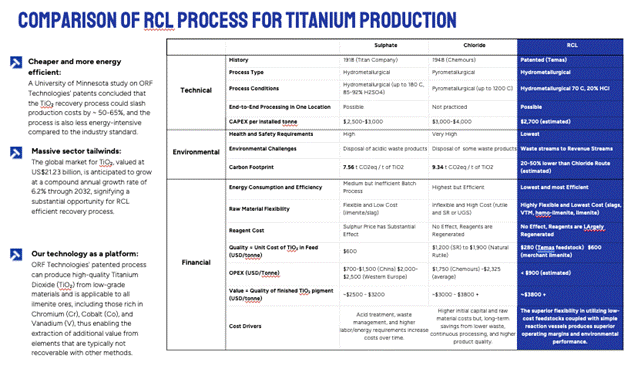
Temas Resources Corp. (ASX: TIO | CSE: TMAS | OTCQB: TMASF | FRA:26P0) is a technology-driven critical minerals company advancing a dual-business model built around proprietary processing innovation and strategic mineral ownership. The Company’s patented Regenerative Chloride Leach (RCL) technology platform delivers significant operational cost reductions — validated at up to 65% lower than traditional processing — while dramatically reducing energy use and environmental impact.
Temas’ RCL process is the foundation of its technology licensing and partnership business, enabling global mining and materials companies to adopt sustainable, high-margin metal extraction methods across a range of critical minerals including titanium, vanadium, nickel, and rare earth elements.
Complementing its technology division, Temas also owns 100% of two advanced titanium-vanadium-iron projects in Québec, Canada — La Blache and Lac Brûlé — which are strategically positioned to feed directly into the Company’s proprietary processing platform, creating a fully integrated mine-to-market supply chain for Western metals.
Through this combination of innovative IP commercialization and resource ownership, Temas Resources is positioned to deliver scalable, low-carbon solutions that strengthen Western critical-mineral independence and create long-term value for shareholders.
Benefits the ORF – RCL Technology:
The RCL platform technology involves the hydrometallurgical mineral extraction of concentrates, whole ores, slags and tailings to enhance recovery of critical metals, battery metals, Platinum Group Minerals (“PGMs”), precious and base metals and Rare Earth Element (“REE”) recovery at materially higher through-yields and lower capital and operating costs than many of the conventional approaches that are in use traditionally. This novel RCL technology is ideally suited to treat increasingly complex ores in an environmentally sensitive manner.
Pilot Testing Complete: The Company has completed a pilot test of approximately 1 ton of material from its La Blache TiO2 mineral property yielding 88 kgs of a 99.8% pure TiO2 commercial grade product. [1]
Validated Cost Reduction: A significant cost reduction of over 65%[2],3 is validated for TiO2 processing using the RCL platform technology (e.g., reagent recycling, potentially lower energy use, optimized recovery etc.). These fundamental process efficiencies are expected to translate into economic advantages when applying the platform to Nickel or other target minerals hosted in complex ores.
Environmental Performance: The closed-loop design and high reagent recycling rates are core to the RCL platform, irrespective of the target mineral. Over 69% lower operating costs compared to conventional processing due to its core features operating at near ambient temperatures.[3] This means the reduced environmental footprint and enhanced ESG profile are benefits that extend to ores and minerals previously noted, not just TiO2.
High Recovery Potential: Just as we’ve demonstrated high-quality, 99.8% TiO2 product from pilot testing1 the RCL platform is engineered for high recovery and purity of all target metals. Our metallurgical expertise focuses on optimizing these recoveries and maximizing margins for each specific mineral.
RCL results in a quicker and more complete liberation of the target metals using atmospheric pressure and lower temperatures than competing methods and improves the selectivity and efficiency of subsequent solvent extraction steps. Management believes that this novel metallurgical process can be applied to many complex resource deposits worldwide, enhancing both extraction and recovery for the operator.
Cautionary Note Regarding Forward-Looking Statements
Neither the Canadian Securities Exchange nor the Market Regulator (as that term is defined in the policies of the Canadian Securities Exchange) accepts responsibility for the adequacy or accuracy of this news release.
This press release contains forward looking statements within the meaning of applicable securities laws. The use of any of the words “anticipate”, “plan”, “continue”, “expect”, “estimate”, “objective”, “may”, “will”, “project”, “should”, “predict”, “potential” and similar expressions are intended to identify forward looking statements
Although the Company believes that the expectations and assumptions on which the forward-looking statements are based are reasonable, undue reliance should not be placed on the forward-looking statements because the Company cannot give any assurance that they will prove correct. Since forward looking statements address future events and conditions, they involve inherent assumptions, risks and uncertainties. Actual results could differ materially from those currently anticipated due to a number of assumptions, factors and risks. These assumptions and risks include, but are not limited to, assumptions and risks associated with mineral exploration generally and results from anticipated and proposed exploration programs, conditions in the equity financing markets, and assumptions and risks regarding receipt of regulatory and shareholder approvals.
Management has provided the above summary of risks and assumptions related to forward looking statements in this press release in order to provide readers with a more comprehensive perspective on the Company’s future operations. The Company’s actual results, performance or achievement could differ materially from those expressed in, or implied by, these forward-looking statements and, accordingly, no assurance can be given that any of the events anticipated by the forward-looking statements will transpire or occur, or if any of them do so, what benefits the Company will derive from them. These forward-looking statements are made as of the date of this press release, and, other than as required by applicable securities laws, the Company disclaims any intent or obligation to update publicly any forward-looking statements, whether as a result of new information, future events or results or otherwise.
CATIONARY STATEMENT – IMPORTANT QUALIFICATION REGARDING SAMPLE BASIS AND SCOPE OF CONCLUSIONS
Temas does not hold any mineral tenure or project interest in the Radar Project and has no ownership interest in the material from which the test samples were derived. The three feed materials were selected and supplied by SAGA Metals Corp. or its representatives for preliminary bench-scale RCL testwork. Temas did not undertake or supervise the original geological sampling and has not independently verified the geological provenance of the samples or their representativeness of the Radar Project, any mineralised domain, any Mineral Resource or any potential future process feed.
The results reported are limited to the specific samples tested and the stated laboratory conditions. They must not be interpreted as establishing project-wide metallurgical recoveries, product quality, economic viability or commercial-scale performance. Further mineralogical characterisation, appropriately designed variability testwork, process optimisation, downstream recovery and scale-up testing are required before broader project-level conclusions can be made.
Section 1 – Sampling Techniques and Data
Criteria in this section apply to all succeeding sections. Commentary is presented on an “if not, why not” basis and must be reviewed, amended and approved by the Competent Person.
| Criteria | JORC Code explanation | Commentary |
| Sampling techniques | • Nature and quality of sampling (eg cut channels, random chips, or specific specialised industry standard measurement tools appropriate to the minerals under investigation, such as down hole gamma sondes, or handheld XRF instruments, etc). These examples should not be taken as limiting the broad meaning of sampling. • Include reference to measures taken to ensure sample representivity and the appropriate calibration of any measurement tools or systems used. • Aspects of the determination of mineralisation that are Material to the Public Report. • In cases where ‘industry standard’ work has been done this would be relatively simple (eg ‘reverse circulation drilling was used to obtain 1 m samples from which 3 kg was pulverised to produce a 30 g charge for fire assay’). In other cases more explanation may be required, such as where there is coarse gold that has inherent sampling problems. Unusual commodities or mineralisation types (eg submarine nodules) may warrant disclosure of detailed information. | Three feed materials described as ROM Massive Oxide, a vanadium-titanium magnetite (VTM) concentrate and an ilmenite concentrate were selected and supplied by SAGA Metals Corp. or its representatives for preliminary bench-scale RCL testwork. Temas did not undertake or supervise the original geological sampling or the production of the supplied concentrates. The materials were accepted as supplied for the purpose of assessing their response to the RCL process. Temas has not independently verified their geological provenance or their representativeness of the Radar Project, any mineralised domain, any Mineral Resource or any potential future process feed. The reported results apply only to the specific test charges prepared from the material received. |
| Drilling techniques | • Drill type (eg core, reverse circulation, open-hole hammer, rotary air blast, auger, Bangka, sonic, etc) and details (eg core diameter, triple or standard tube, depth of diamond tails, face-sampling bit or other type, whether core is oriented and if so, by what method, etc). | No drilling was undertaken or supervised by Temas. Drilling details were not relied upon in conducting or interpreting the sample-specific metallurgical testwork. Any drilling information used to establish geological provenance or project-level representativeness must be reported by the project owner or an appropriately qualified Competent Person if broader project conclusions are made. |
| Drill sample recovery | • Method of recording and assessing core and chip sample recoveries and results assessed. • Measures taken to maximise sample recovery and ensure representative nature of the samples. • Whether a relationship exists between sample recovery and grade and whether sample bias may have occurred due to preferential loss/gain of fine/coarse material. | Drill-sample recovery is not applicable to the laboratory leach procedure and was not assessed by Temas. No conclusion is made regarding recovery-related bias or the representativeness of any original geological sample. |
| Logging | • Whether core and chip samples have been geologically and geotechnically logged to a level of detail to support appropriate Mineral Resource estimation, mining studies and metallurgical studies. • Whether logging is qualitative or quantitative in nature. Core (or costean, channel, etc) photography. • The total length and percentage of the relevant intersections logged. | The feed materials were described as ROM Massive Oxide, VTM concentrate and ilmenite concentrate based on the labels and information supplied with the samples and the measured head chemistry. Original geological or geotechnical logging and photography were not reviewed or relied upon by Temas. The feed descriptions apply only to the tested materials and are not interpreted as defining geological or metallurgical domains across the Radar Project. |
| Sub-sampling techniques and sample preparation | • If core, whether cut or sawn and whether quarter, half or all core taken. • If non-core, whether riffled, tube sampled, rotary split, etc and whether sampled wet or dry. • For all sample types, the nature, quality and appropriateness of the sample preparation technique. • Quality control procedures adopted for all sub-sampling stages to maximise representivity of samples. • Measures taken to ensure that the sampling is representative of the in situ material collected, including for instance results for field duplicate/second-half sampling. • Whether sample sizes are appropriate to the grain size of the material being sampled. | The ROM Massive Oxide, VTM concentrate and ilmenite concentrate were ground to D90 particle sizes of 32.4 µm, 38.6 µm and 44.5 µm, respectively, and split into test charges. Primary leach tests were conducted in 1 L glass reactors at 10 wt.% pulp density. The primary residues were then subjected to a second leach stage. Preparation after receipt was intended to produce internally consistent test charges from each supplied feed parcel. It does not establish that the original feed parcel was representative of the source deposit, a mineralised domain or potential future process feed. |
| Quality of assay data and laboratory tests | • The nature, quality and appropriateness of the assaying and laboratory procedures used and whether the technique is considered partial or total. • For geophysical tools, spectrometers, handheld XRF instruments, etc, the parameters used in determining the analysis including instrument make and model, reading times, calibrations factors applied and their derivation, etc. • Nature of quality control procedures adopted (eg standards, blanks, duplicates, external laboratory checks) and whether acceptable levels of accuracy (ie lack of bias) and precision have been established. | Head samples were analysed using ICP-OES and ICP-MS. Solid head-sample preparation used approximately 0.1205 g of sample fused with sodium peroxide and sodium hydroxide in a zirconium crucible. The melt was dissolved using hydrochloric and nitric acids, diluted with nitric acid and analysed by ICP-OES using a Thermo Fisher iCAP 6000. A method blank and standard reference materials were included. Leach filtrates and solid residues were weighed and analysed by ICP-OES. |
| Verification of sampling and assaying | • The verification of significant intersections by either independent or alternative company personnel. • The use of twinned holes. • Documentation of primary data, data entry procedures, data verification, data storage (physical and electronic) protocols. • Discuss any adjustment to assay data. | Elemental extraction was evaluated using material-balance calculations based on pregnant leach solution volume and concentration, residue mass and concentration, and head mass and grade. Separate material-balance, head/residue and solution/head relationships were calculated for the six leach tests. The ROM Fe2O3 head grade was corrected to 49.25% from an elemental iron grade of 34.45% using the standard Fe-to-Fe2O3 conversion factor. Head, solution and residue assays and the material-balance calculations verify the chemistry and reported extraction of the specific test charges. They do not verify the geological source or deposit-level representativeness of the supplied feed materials. |
| Location of data points | • Accuracy and quality of surveys used to locate drill holes (collar and down-hole surveys), trenches, mine workings and other locations used in Mineral Resource estimation. • Specification of the grid system used. • Quality and adequacy of topographic control. | The supplied materials were described as relating to the Radar Project near Cartwright, Newfoundland and Labrador. Precise source locations were not relied upon in the testwork and no spatial or project-wide inference is made from the results. |
| Data spacing and distribution | • Data spacing for reporting of Exploration Results. • Whether the data spacing and distribution is sufficient to establish the degree of geological and grade continuity appropriate for the Mineral Resource and Ore Reserve estimation procedure(s) and classifications applied. • Whether sample compositing has been applied. | The results relate to three supplied metallurgical feed parcels and are not used as a basis for Mineral Resource or Ore Reserve estimation. The lack of spatial coverage or a metallurgical variability program does not prevent reporting the sample-specific results, but it precludes project-level recovery conclusions. |
| Orientation of data in relation to geological structure | • Whether the orientation of sampling achieves unbiased sampling of possible structures and the extent to which this is known, considering the deposit type. • If the relationship between the drilling orientation and the orientation of key mineralised structures is considered to have introduced a sampling bias, this should be assessed and reported if material. | This criterion is not applicable to the sample-specific bench-scale leach testwork. No drill orientations, mineralised structures, source-sample geometry, mineralised widths or intercepts are reported or relied upon, and no project-wide inference is made. If the results are subsequently linked to particular drill or channel samples or used to support conclusions regarding a mineralised domain, the relationship between sample orientation and mineralisation geometry must be addressed by the project owner or its Competent Person. |
| Sample security | • The measures taken to ensure sample security. | The samples were supplied by IGS on behalf of SAGA Metals Corp., received by the testwork facility and prepared for leaching. |
| Audits or reviews | • The results of any audits or reviews of sampling techniques and data. | The testwork was conducted by Temas using its proprietary RCL process. Temas is the process owner and the performer of the metallurgical testwork; the testwork itself is therefore not independent of Temas. Any description of an independent review or independent validation must be limited to an identifiable third-party review, assay or verification activity and must state the reviewer, scope and relationship to Temas and SAGA. |
Section 2 – Reporting of Exploration Results
Criteria listed in Section 1 also apply to this section. The commentary addresses the sample-specific metallurgical testwork reported in this report. Project information is included only to identify the source project and is not relied upon to make geological or project-wide metallurgical conclusions.
| Criteria | JORC Code explanation | Commentary |
| Mineral tenement and land tenure status | • Type, reference name/number, location and ownership including agreements or material issues with third parties such as joint ventures, partnerships, overriding royalties, native title interests, historical sites, wilderness or national park and environmental settings. • The security of the tenure held at the time of reporting along with any known impediments to obtaining a licence to operate in the area. | Temas does not hold any mineral tenure or project interest in the Radar Project and has no ownership interest in the tested material. The material was supplied by SAGA Metals Corp. or its representatives solely for metallurgical testwork. The underlying tenure is not relied upon to report the sample-specific laboratory results, and Temas makes no representation regarding title, tenure security or the right to develop the Radar Project. |
| Exploration done by other parties | • Acknowledgment and appraisal of exploration by other parties. | Hawkeye Davis tube analytical interpretation indicated that the non-magnetic fraction, interpreted as ilmenite, commonly contains approximately 86%-92% of the head TiO2. Temas did not undertake or appraise the geological exploration of the Radar Project. Exploration information is not relied upon beyond the description of the supplied feed materials and does not form the basis of the sample-specific extraction results. |
| Geology | • Deposit type, geological setting and style of mineralisation. | The tested materials were described as titanium-vanadium-iron-bearing ROM Massive Oxide, a VTM or magnetite concentrate and an ilmenite concentrate based on the labels and information supplied and the measured head chemistry. The lower titanium extraction from the VTM concentrate may reflect depletion of free acid during the first-stage leach and/or a more refractory titanium mineral association. Project geology was not reviewed or relied upon by Temas, and the feed descriptions are not interpreted as defining the deposit type, mineralised domains or the distribution of mineral phases across the Radar Project. |
| Drill hole Information | • A summary of all information material to the understanding of the exploration results including a tabulation of the following information for all Material drill holes: • easting and northing of the drill hole collar • elevation or RL (Reduced Level – elevation above sea level in metres) of the drill hole collar • dip and azimuth of the hole • down hole length and interception depth • hole length. • If the exclusion of this information is justified on the basis that the information is not Material and this exclusion does not detract from the understanding of the report, the Competent Person should clearly explain why this is the case. | No drill-hole intersections are reported. The metallurgical results are presented by supplied feed material rather than by drill hole, and drill-hole information is not material to understanding the sample-specific laboratory results. If a project-level statement is made linking a feed material to a drill hole, interval or mineralised domain, the relevant drill-hole and compositing information must be provided and accepted by the project owner or its Competent Person. |
| Data aggregation methods | • In reporting Exploration Results, weighting averaging techniques, maximum and/or minimum grade truncations (eg cutting of high grades) and cut-off grades are usually Material and should be stated. • Where aggregate intercepts incorporate short lengths of high grade results and longer lengths of low grade results, the procedure used for such aggregation should be stated and some typical examples of such aggregations should be shown in detail. • The assumptions used for any reporting of metal equivalent values should be clearly stated. | Each feed underwent a six-hour primary leach followed by a six-hour secondary leach of the primary residue under the same nominal conditions: 5.8 N HCl, 225 g/L MgCl2, 10 wt.% pulp density, 70 °C and 450 rpm agitation. Combined extraction values represent elemental extraction across the primary and secondary stages. No cut-off grades, grade capping or metal-equivalent values were applied. The reported percentages are elemental extraction into solution from the specific test charges and are not recoveries to a final saleable product. |
| Relationship between mineralisation widths and intercept lengths | • These relationships are particularly important in the reporting of Exploration Results. • If the geometry of the mineralisation with respect to the drill hole angle is known, its nature should be reported. • If it is not known and only the down hole lengths are reported, there should be a clear statement to this effect (eg ‘down hole length, true width not known’). | This criterion is not applicable. No mineralised intercepts or widths are reported in connection with the sample-specific metallurgical results, and no conclusion is made regarding mineralisation geometry or true width. |
| Diagrams | • Appropriate maps and sections (with scales) and tabulations of intercepts should be included for any significant discovery being reported These should include, but not be limited to a plan view of drill hole collar locations and appropriate sectional views. | This report includes the process flow and a table of combined extraction results. No significant discovery, drill-hole result, mineralised width or geological interpretation is being reported; a project plan or section is therefore not required to understand the sample-specific laboratory results. Any diagram used to assert that the samples represent a particular geological or metallurgical domain must be supplied and supported by the project owner or its Competent Person. |
| Balanced reporting | • Where comprehensive reporting of all Exploration Results is not practicable, representative reporting of both low and high grades and/or widths should be practiced to avoid misleading reporting of Exploration Results. | Results are reported for all three feed materials, including combined titanium extraction of 30.3% from the VTM concentrate, 78.1% from the ROM Massive Oxide and 90.8% from the ilmenite concentrate. One primary/secondary test pair was completed for each feed, with no reported replicates or statistical uncertainty. The work was preliminary bench-scale scoping testwork intended to support process optimisation and did not constitute final process validation. The results apply only to the samples tested under the stated conditions. They do not establish that the samples are representative of the Radar Project or that the reported extraction values are achievable across a Mineral Resource, potential mine feed or commercial-scale operation. |
| Other substantive exploration data | • Other exploration data, if meaningful and material, should be reported including (but not limited to): geological observations; geophysical survey results; geochemical survey results; bulk samples – size and method of treatment; metallurgical test results; bulk density, groundwater, geotechnical and rock characteristics; potential deleterious or contaminating substances. | Substantive metallurgical data comprise head assays, D90 particle sizes, leach conditions, time-series solution sampling, two-stage material balances and combined Ti, Fe and V extraction results. The ilmenite concentrate returned the highest combined Ti extraction at 90.8%. Combined Fe extraction ranged from 86.7% to 91.5%. Solution samples were collected at 0.5, 1, 2 and 6 hours, and extraction continued to trend upward through the sampling period. Residence time and free-acid management require further optimisation. No final Ti, Fe or V products were produced or characterised, and downstream separation, reagent regeneration, product purity and saleability were not tested. The absence of deposit-level representativeness or variability assessment does not affect the validity of the reported results for the specific test charges, but it prevents the results from being used as project-wide metallurgical recovery assumptions. |
| Further work | • The nature and scale of planned further work (eg tests for lateral extensions or depth extensions or large-scale step-out drilling). • Diagrams clearly highlighting the areas of possible extensions, including the main geological interpretations and future drilling areas, provided this information is not commercially sensitive. | Stage 2 will optimise staged leaching, reagent conditions, residence time, temperature and pulp density; complete particle-size, XRD and SEM-EDS characterisation; and assess reagent regeneration, solid-liquid separation, impurity management and downstream recovery. Mini-pilot and pilot-scale work may follow. Before project-level recovery conclusions are made, the project owner or its Competent Person should design and document a variability program using material selected across the relevant geological, mineralogical and potential process-feed domains. |
Draft JORC Code 2012 Table 1 – Radar Project RCL Testwork
[1] Source: Temas Resources Corp. “Pilot Scale Evaluation of Temas La Blache Ilmenite – Final Report PRO 21-16,” 24 June 2022.
2 These metallurgical test results and cost-reduction data were first reported in the Company’s Canadian market announcement dated 13 April 2021, titled “Temas Resources Acquires 50 % of Green Mineral Process Developer ORF Technologies Inc.”
3 The cost-reduction figure is supported by independent evaluation conducted by the Natural Resources Research Institute (University of Minnesota, 2017) and subsequent pilot-scale validation by ORF Technologies Inc., as detailed in Temas Resources news releases of 2021 and 2022.