
Preferred fused-bead re-assays of original 2022 drill pulps confirm broad Fe-Ti-V oxide intercepts with gallium, scandium and chromium accessory metal values at the Farrell-Taylor deposit. Thick high-grade intercepts of both titanium and iron are confirmed.
Highlights
- Encouraging results to be used in future Regenerative Chloride Leach (RCL) testwork on vanadium, gallium and scandium.
- Temas has generated significant intercepts from the 2026 re-assay of 648 original 2022 drill pulps from the La Blache Project, using the Company’s preferred fused-bead assay protocol and a preferred assay hierarchy.
- Best intercepts include:
LB-22-07 with 88.1m @ 86.5% Fe₂O₃ + TiO₂, 0.40% V₂O₅ and
1,275 Cr, 60 g/t Ga and 18 ppm Sc from 180m,
LB-22-09 with 83.0m @ 86.8% Fe₂O₃ + TiO₂, 0.46% V₂O₅ and
1,569 ppm Cr, 62 g/t Ga and 19 ppm Sc from 281m
LB-22-06 with 66.2m @ 84.8% Fe₂O₃ + TiO₂, 0.50% V₂O₅ and
1,499 ppm Cr, 63 g/t Ga and 20 ppm Sc from 181.5m
LB-22-01 with 41.0m @ 86.5% Fe₂O₃ + TiO₂, 0.47% V₂O₅ and
1,369 ppm Cr, 60 g/t Ga and 20 ppm Sc from 283m
LB-22-08 with 40.1m @ 85.2% Fe₂O₃ + TiO₂, 0.47% V₂O₅ and
1,400 ppm Cr, 59 g/t Ga and 18 ppm Sc from 194m
LB-22-04 with 30.0m @ 82.8% Fe₂O₃ + TiO₂, 0.41% V₂O₅ and
1,225 ppm Cr, 56 g/t Ga and 19 ppm Sc from 159m
LB-22-05 with 19.1m @ 85.8% Fe₂O₃ + TiO₂, 0.44% V₂O₅ and
1,302 ppm Cr, 63 g/t Ga and 18 ppm Sc from 178m
LB-22-05 with 25.8m @ 85.2% Fe₂O₃ + TiO₂, 0.47% V₂O₅ and
1,497 ppm Cr, 64 g/t Ga and 20 ppm Sc from 202m
LB-22-03 with 9.8m @ 83.8% Fe₂O₃ + TiO₂, 0.42% V₂O₅ and
1,350 ppm Cr, 57 g/t Ga and 20 ppm Sc from 177m.
- The re-assay results provide a consistent basis for comparison of the 2022 LB-series drilling and further confirm broad, high-grade Fe-Ti-V oxide mineralisation within the Farrell-Taylor system.
- Matched 2026 re-assays show a material uplift in reported accessory critical metal grades relative to the original 2022 assays, with the mineralised oxide population returning increases of approximately 24% V₂O₅, 48% Cr, 12% Ga and 10% Sc when comparing the same 684 sample intervals, while Fe₂O₃ + TiO₂ remained broadly consistent between assay campaigns.
Mr. Tim Fernback, Temas Chief Executive Officer, commented:
“The 2022 re-assay results reinforce the scale and consistency of the Farrell-Taylor Fe-Ti-V oxide system and provide a stronger, internally consistent geochemical dataset for future resource and development work at La Blache. We will use these results to help guide the future deployment of our novel Regenerative Chloride Leach Technology, with testing to include the vanadium, gallium and scandium taken from this location.”
Temas Resources Corp. (“Temas” or the “Company”) (ASX: TIO | CSE: TMAS | OTCQB: TMASF | FSE: 26P0) is pleased to report significant intercepts generated from the 2026 re-assay of original 2022 drill pulps from the La Blache Project in Québec, Canada.
Table 1: Significant Drill Intercepts for 2022 Re-Assayed Drilling*
| Hole ID | From (m) | To (m) | Width (m) | Fe₂O₃ + TiO₂ + ≤ 4.5% MgO (%) | Fe₂O₃ + TiO₂ (%) | TiO₂ (%) | Fe₂O₃ (%) | MgO (%) | V₂O₅ (%) | Cr (ppm) | Ga (ppm) | Sc (ppm) | Mineral Domain | Total Mineralized Thickness (m) |
| LB-22-01 | 218 | 228.3 | 10.3 | 37.4 | 33.0 | 8.5 | 24.5 | 7.7 | 0.069 | 97 | 17 | 15 | SMO | 97.3 |
| 233.2 | 264 | 30.8 | 40.7 | 36.3 | 7.8 | 28.5 | 10.2 | 0.076 | 113 | 17 | 15 | SMO | ||
| 274 | 283 | 9 | 57.0 | 52.8 | 9.5 | 43.3 | 10.6 | 0.181 | 370 | 30 | 15 | SMO | ||
| 283 | 324 | 41 | 90.8 | 86.5 | 19.1 | 67.4 | 4.6 | 0.468 | 1369 | 60 | 20 | SMO | ||
| 324 | 330.2 | 6.2 | 43.1 | 40.5 | 8.5 | 32.0 | 2.7 | 0.215 | 756 | 35 | 9 | SMO | ||
| LB-22-03 | 114.65 | 121 | 6.3 | 37.3 | 33.2 | 6.3 | 26.9 | 8.6 | 0.090 | 160 | 19 | 10 | SMO | 65.2 |
| 122 | 137 | 15 | 39.8 | 35.6 | 8.8 | 26.8 | 8.4 | 0.074 | 113 | 18 | 14 | SMO | ||
| 140 | 146 | 6 | 35.0 | 30.8 | 7.7 | 23.1 | 8.5 | 0.050 | 74 | 15 | 14 | SMO | ||
| 149 | 177 | 28 | 42.9 | 38.6 | 7.8 | 30.9 | 9.0 | 0.117 | 217 | 23 | 12 | SMO | ||
| 177 | 186.85 | 9.8 | 88.1 | 83.8 | 19.6 | 64.3 | 4.9 | 0.419 | 1350 | 57 | 20 | SMO | ||
| LB-22-04 | 80 | 86 | 6 | 27.6 | 23.7 | 4.5 | 19.2 | 6.6 | 0.054 | 108 | 18 | 8 | SMO | 84.3 |
| 87 | 93 | 6 | 27.4 | 24.1 | 3.9 | 20.2 | 7.2 | 0.058 | 125 | 19 | 7 | SMO | ||
| 101 | 106.35 | 5.3 | 43.5 | 39.0 | 9.1 | 29.9 | 9.2 | 0.102 | 199 | 20 | 16 | SMO | ||
| 121 | 129 | 8 | 26.3 | 23.0 | 5.2 | 17.8 | 5.2 | 0.054 | 93 | 23 | 8 | SMO | ||
| 130 | 159 | 29 | 52.3 | 47.8 | 10.3 | 37.5 | 10.1 | 0.140 | 273 | 26 | 15 | SMO | ||
| 159 | 189 | 30 | 86.8 | 82.8 | 18.4 | 64.3 | 4.4 | 0.410 | 1225 | 56 | 19 | MO | ||
| LB-22-05 | 139 | 143 | 4 | 49.2 | 44.7 | 10.3 | 34.4 | 14.0 | 0.061 | 95 | 11 | 18 | SMO | 86 |
| 147 | 178 | 31 | 41.7 | 37.3 | 8.1 | 29.2 | 9.5 | 0.088 | 170 | 21 | 12 | SMO | ||
| 178 | 197.1 | 19.1 | 90.1 | 85.8 | 19.4 | 66.4 | 4.5 | 0.444 | 1302 | 63 | 18 | SMO | ||
| 202 | 227.8 | 25.8 | 89.6 | 85.2 | 19.8 | 65.4 | 4.7 | 0.466 | 1497 | 64 | 20 | SMO | ||
| 227.8 | 231 | 3.2 | 22.8 | 18.3 | 3.7 | 14.7 | 4.6 | 0.042 | 109 | 24 | 13 | SMO | ||
| 231 | 233.9 | 2.9 | 92.6 | 88.3 | 20.4 | 67.9 | 4.4 | 0.491 | 2016 | 66 | 20 | MO | ||
| LB-22-06 | 146 | 160 | 14 | 23.9 | 20.0 | 4.9 | 15.1 | 5.2 | 0.036 | 67 | 18 | 8 | SMO | 100.7 |
| 161 | 181.5 | 20.5 | 42.7 | 38.4 | 8.9 | 29.5 | 9.3 | 0.093 | 177 | 21 | 14 | SMO | ||
| 181.5 | 247.7 | 66.2 | 89.1 | 84.8 | 19.1 | 65.7 | 4.3 | 0.501 | 1499 | 63 | 20 | MO | ||
| LB-22-07 | 171 | 180 | 9 | 52.3 | 47.8 | 10.2 | 37.6 | 9.8 | 0.146 | 295 | 26 | 16 | SMO | 103.2 |
| 180 | 268.1 | 88.1 | 90.8 | 86.5 | 19.7 | 66.8 | 4.4 | 0.402 | 1275 | 60 | 18 | MO | ||
| 268.9 | 275 | 6.1 | 89.9 | 85.4 | 19.5 | 65.9 | 4.5 | 0.398 | 1460 | 53 | 17 | MO | ||
| LB-22-08 | 194 | 234.1 | 40.1 | 89.6 | 85.2 | 19.4 | 65.7 | 4.5 | 0.466 | 1400 | 59 | 18 | MO | 45.5 |
| 238.4 | 243.8 | 5.4 | 93.9 | 89.4 | 20.5 | 68.9 | 4.7 | 0.471 | 1561 | 60 | 18 | SMO | ||
| LB-22-09 | 248 | 253.1 | 5.1 | 47.0 | 44.0 | 10.0 | 34.0 | 4.6 | 0.200 | 412 | 36 | 15 | SMO | 105.1 |
| 262 | 265 | 3 | 29.9 | 26.6 | 6.0 | 20.6 | 4.7 | 0.081 | 159 | 25 | 10 | SMO | ||
| 267 | 281 | 14 | 42.4 | 38.7 | 8.5 | 30.3 | 8.2 | 0.111 | 207 | 25 | 15 | SMO | ||
| 281 | 364 | 83 | 91.2 | 86.8 | 19.9 | 67.0 | 4.5 | 0.464 | 1569 | 62 | 19 | MO |
* Cut-off grades for massive oxide classification are 78% Fe₂O₃ + TiO₂ + ≤4.5% MgO, with internal dilution of 2.9m and minimum composite of 2.5m. Massive oxide classification requires a maximum of 4.5% MgO. Cut-off grades for semi-massive oxide classification and determination of a significant intercept are 20% Fe₂O₃ + TiO₂ + ≤4.5% MgO, with internal dilution of 2.9m and minimum composite of 2.5m. V₂O₅ (%) has been recalculated from V (ppm) using the ALS oxide conversion factor of 1.785 for V to V₂O₅.
The 2022 drilling was completed using NQ diamond core and targeted the Farrell-Taylor area of the La Blache Fe-Ti-V oxide system. The current results do not relate to new drilling; they relate to re-analysis of selected original 2022 pulps using the Company’s preferred fused-bead assay protocol, combined with original 2022 assay data where required to fill internal gaps in the re-assay coverage.
The significant intercepts reported in Table 1 were calculated from the preferred re-assay dataset using length-weighted compositing. The table reports downhole intervals and does not imply true widths. All grades are length-weighted over the reported composite interval, including any internal dilution allowed under the stated criteria.
Drill Results Overview
The 2026 re-assay dataset confirms broad, high-grade Fe₂O₃ + TiO₂ intervals across the 2022 LB-series holes. The strongest width-grade combinations occur in LB-22-07, LB-22-09 and LB-22-06, with additional high-grade intervals reported in LB-22-01, LB-22-04, LB-22-05 and LB-22-08. LB-22-03 returned a narrower but high-grade intercept.
The mineralisation at La Blache is characterised by massive and semi-massive Fe-Ti-V oxide assemblages hosted within the La Blache Anorthosite Complex. For this announcement, the reported cut-off proxy is Fe₂O₃ + TiO₂ + capped MgO, with MgO capped at 4.5% in the cut-off calculation. Massive oxide classification requires both the ≥78% cut-off and a maximum MgO value of 4.5%; intervals that exceed the cut-off but have length-weighted MgO above 4.5% have been retained in the significant-intercept table and flagged as SMO for review.
Re-Assay Results Overview
To quantify the impact of the 2026 re-assay program, Temas compared only those samples where a direct one-to-one match exists between the original 2022 assay and the corresponding 2026 pulp re-assay. This comparison comprises 684 matched sample intervals, with all averages calculated on a length-weighted basis. Major oxide results were compared to a 2022 ME-ICP06 (fused bead digestion)/ ICP06 versus 2026 ME-ICP06 (identical fused bead digestion)/ ICP06 basis, while trace elements were compared on a 2022 ME-MS61 (4-acid digestion) versus 2026 ME-MS81 (fused bead digestion) basis.
As expected, the comparison between identical assay protocols indicates that the major oxide grades are broadly stable between assay campaigns. The trace metals also behaved as expected, with the uplift between the original 4-acid digestion and the near complete digestion of the fused bead protocol most pronounced within the MO domain, where matched samples increased from 0.37% V₂O₅ to 0.47% V₂O₅, 948 ppm Cr to 1,437 ppm Cr, 55 g/t Ga to 62 g/t Ga, and 17.6 ppm Sc to 19.5 ppm Sc. The SMO domain also returned consistent increases, with matched samples increasing from 0.22% V₂O₅ to 0.27% V₂O₅, 545 ppm Cr to 796 ppm Cr, 36 g/t Ga to 41 g/t Ga, and 15.0 ppm Sc to 16.4 ppm Sc. These results support the Company’s view that the 2026 assay protocol provides an improved basis for quantifying accessory critical metals within the La Blache oxide mineralisation.
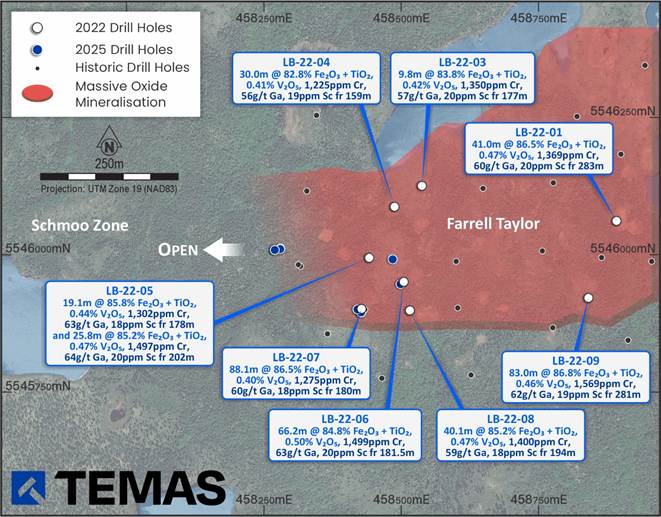
Figure 1: Collar Location Map for the 2022 drilling, with 2026 re-assay significant intercepts.
Table 2: Length-weighted comparison of 2022 original assay results and 2026 pulp re-assay results for matched La Blache drill intervals, grouped by interpreted mineral domain.
| Domain | Reported as | Unit | 2022 Method | 2026 Method | Matched Samples | Matched Metres | 2022 Avg Grade | 2026 Avg Grade | % Increase |
| All matched samples | TiO2 | % | ME-ICP06 | ME-ICP06 | 684 | 690.5 | 15.15 | 15.03 | -0.8% |
| All matched samples | V2O5 | % | ME-MS61 | ME-MS81 | 684 | 690.5 | 0.25 | 0.31 | 23.9% |
| All matched samples | Fe2O3 | % | ME-ICP06 | ME-ICP06 | 684 | 690.5 | 52.79 | 51.79 | -1.9% |
| All matched samples | Ga | g/t | ME-MS61 | ME-MS81 | 684 | 690.5 | 40.4 | 45.4 | 12.3% |
| All matched samples | Cr | ppm | ME-MS61 | ME-MS81 | 684 | 690.5 | 630.3 | 934.2 | 48.2% |
| All matched samples | Sc | ppm | ME-MS61 | ME-MS81 | 684 | 690.5 | 15.3 | 16.8 | 9.3% |
| MO | TiO2 | % | ME-ICP06 | ME-ICP06 | 180 | 181.3 | 19.82 | 19.75 | -0.4% |
| MO | V2O5 | % | ME-MS61 | ME-MS81 | 180 | 181.3 | 0.37 | 0.47 | 27.7% |
| MO | Fe2O3 | % | ME-ICP06 | ME-ICP06 | 180 | 181.3 | 68.82 | 67.31 | -2.2% |
| MO | Ga | g/t | ME-MS61 | ME-MS81 | 180 | 181.3 | 54.6 | 61.6 | 12.8% |
| MO | Cr | ppm | ME-MS61 | ME-MS81 | 180 | 181.3 | 947.6 | 1437.0 | 51.6% |
| MO | Sc | ppm | ME-MS61 | ME-MS81 | 180 | 181.3 | 17.6 | 19.5 | 10.8% |
| SMO | TiO2 | % | ME-ICP06 | ME-ICP06 | 475 | 480.0 | 14.09 | 13.99 | -0.7% |
| SMO | V2O5 | % | ME-MS61 | ME-MS81 | 475 | 480.0 | 0.22 | 0.27 | 21.7% |
| SMO | Fe2O3 | % | ME-ICP06 | ME-ICP06 | 475 | 480.0 | 49.18 | 48.41 | -1.6% |
| SMO | Ga | g/t | ME-MS61 | ME-MS81 | 475 | 480.0 | 36.2 | 40.7 | 12.3% |
| SMO | Cr | ppm | ME-MS61 | ME-MS81 | 475 | 480.0 | 545.1 | 796.3 | 46.1% |
| SMO | Sc | ppm | ME-MS61 | ME-MS81 | 475 | 480.0 | 15.0 | 16.4 | 9.0% |
| Anorthosite | TiO2 | % | ME-ICP06 | ME-ICP06 | 29 | 29.2 | 3.58 | 2.76 | -22.8% |
| Anorthosite | V2O5 | % | ME-MS61 | ME-MS81 | 29 | 29.2 | 0.03 | 0.03 | 7.2% |
| Anorthosite | Fe2O3 | % | ME-ICP06 | ME-ICP06 | 29 | 29.2 | 12.69 | 10.87 | -14.3% |
| Anorthosite | Ga | g/t | ME-MS61 | ME-MS81 | 29 | 29.2 | 22.0 | 23.3 | 5.9% |
| Anorthosite | Cr | ppm | ME-MS61 | ME-MS81 | 29 | 29.2 | 60.2 | 78.5 | 30.4% |
| Anorthosite | Sc | ppm | ME-MS61 | ME-MS81 | 29 | 29.2 | 6.1 | 5.9 | -3.4% |
Table 3: Collar Details for 2022 La Blache Drilling, Provided in NAD83/UTM Zone 19N.
| Hole ID | Prospect | Hole Type | EOH Depth (m) | Easting (m) | Northing (m) | RL (m) | Dip | Azimuth |
| LB-22-01 | La Blache | DD | 351 | 458892 | 5546063 | 495 | -90 | 0 |
| LB-22-03 | La Blache | DD | 276 | 458538 | 5546127 | 495 | -90 | 0 |
| LB-22-04 | La Blache | DD | 234 | 458498 | 5546089 | 491 | -90 | 0 |
| LB-22-05 | La Blache | DD | 291 | 458442 | 5545996 | 504 | -90 | 0 |
| LB-22-06 | La Blache | DD | 265 | 458505 | 5545952 | 511 | -90 | 0 |
| LB-22-07 | La Blache | DD | 282 | 458428 | 5545903 | 525 | -90 | 0 |
| LB-22-08 | La Blache | DD | 252 | 458516 | 5545900 | 508 | -90 | 0 |
| LB-22-09 | La Blache | DD | 375 | 458841 | 5545923 | 516 | -90 | 0 |
Next steps include continued integration of the 2022 re-assay data with the historical and recent drilling datasets, review of MO/SMO domaining, and assessment of implications for future resource work and technical studies.
A drill program is currently in design to test the western extent of Farell Taylor, as it’s interpreted to extend to surface toward the Schmoo Zone.
GRA Enterprises LLC Engagement Agreement Signed
In other news, the Company has engaged the services GRA Enterprises LLC DBA National Inflation Association (“NIA”) to provide ongoing investor relations and strategic communication services to the Company (the NIA Engagement).
Under the terms of the NIA Engagement, NIA will receive a retainer of US$50,000 for the initial three months term of the NIA Engagement and the NIA Engagement can be extended at the election of the Company for an additional 9-month term for an additional US$100,000. NIA will not receive shares or options as compensation. NIA proposes to deliver Temas corporate information and written material to its subscriber base. NIA’s address is 112 Argus Ln, Ste A PMB 113 Mooresville, NC 28117 (email: [email protected] and telephone: 1-888-996-4287). NIA and the Company are unrelated and unaffiliated entities.
NIA is a boutique corporate communication, investor relations and reputation management firm, servicing clients across North America and internationally. The NIA team has deep experience working with public companies of all sizes, across multiple sectors, including both mining exploration and technology industries.
Commenting on the engagement, Tim Fernback, President & CEO of Temas Resources, stated: “We are excited about the opportunity to work with such a well-respected and experienced communications and investor relations firm such as NIA. Their deep knowledge of the public markets in North America and internationally will come in handy as we build out the overall global communication strategy for our Company and our novel metallurgical RCL platform as a for-profit business. NIA has successfully worked with companies like Saga Metals Corp. (TSXV: SAGA, OTCQB: SAGMF) who are also in the critical mineral / titanium dioxide space to both get the word out and explain their business to new shareholders. NIA has done an excellent job at attracting the attention of a new audience. We are excited to have them join our team.”
The Company would also like to clarify the disclosure regarding the appointment of Vector Advisors, noting that the engagement with Vector Advisors commences immediately and is an ongoing engagement.
Semi-Annual Reporting Update:
Further to our news release of March 30, 2026, and as a result of Temas’ current listing on the Australian Stock Exchange, the Company does not meet the eligibility under the Coordinated Blanket Order 51-933 and therefore will revert to its quarterly financial reporting obligations and will resume filing unaudited interim financial statements and the related MD&A for the three-month period ending March 31, 2026 and all subsequent quarterly periods, in accordance with National Instrument 51–102 – Continuous Disclosure Obligations.
Authorised for release by the Board of Temas Resources Corp.
– ENDS –
For further information, contact:
| Tim Fernback President & CEO [email protected] | Jane Morgan Investor & Media Relations [email protected] + 61 (0) 405 555 618 |
Follow us:
https://temasresources.com
https://x.com/TMASResources
https://www.linkedin.com/company/temas-resources-corp/
Competent Person’s / Qualified Person’s Statement
The information in this announcement that relates to Exploration Results and Mineral Resources for the La Blache and Lac Brûlé Titanium-Vanadium Projects in Québec, Canada, is based on, and fairly represents, information and supporting documentation prepared and compiled by Mr Blake Collins, BSc (Hons), MAIG, and Principal Consultant of Head Exploration Pty Ltd.
Mr Collins is a Member of the Australasian Institute of Geoscientists (MAIG). He has sufficient experience that is relevant to the style of mineralisation, the type of deposit under consideration, and the activity being undertaken to qualify as a Competent Person as defined in the 2012 Edition of the Australasian Code for Reporting of Exploration Results, Mineral Resources and Ore Reserves (JORC Code 2012) and as a Qualified Person as defined by NI 43-101.
Mr Collins is the Principal Consultant of Head Exploration Pty Ltd, which provides independent geological and technical advisory services to Temas Resources Corp. He has reviewed the information presented in this announcement and consents to the inclusion in the report of the matters based on his information in the form and context in which they appear. Head Exploration Pty Ltd is an independent geological and technical consultancy and has no direct or indirect interest in Temas Resources Corp.
Disclaimer
No representations or warranty, express or implied, is made by the Company that the material contained in this announcement will be achieved or proved correct. Except for the statutory liability which cannot be excluded, each of the Company, its directors, officers, employees, advisors, and agents expressly disclaims any responsibility for the accuracy, fairness, sufficiency or completeness of the material contained in this announcement and excludes all liability whatsoever (including in negligence) for an loss or damage which may be suffered by any person as a consequence of any information in this announcement or any effort or omission therefrom. The Company will not update of keep current the information contained in this announcement or to correct any inaccuracy or omission which may become apparent, or to furnish any person with any further information. Any opinions expressed in the announcement are subject to change without notice.
ABOUT TEMAS RESOURCES
Revolutionizing Metal Production
Proprietary IP. Global Licensing. Titanium & Critical Minerals.
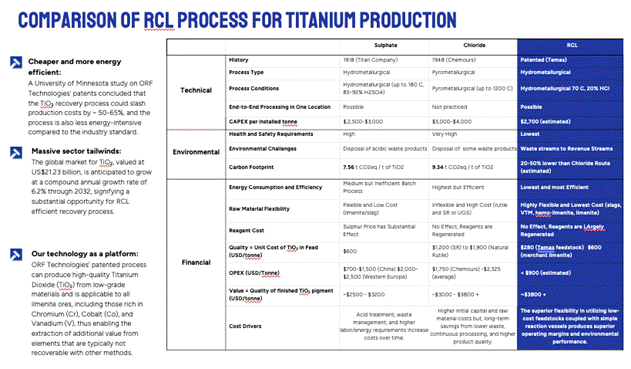
Temas Resources Corp. (ASX: TIO | CSE: TMAS | OTCQB: TMASF | FRA:26P0) is a technology-driven critical minerals company advancing a dual-business model built around proprietary processing innovation and strategic mineral ownership. The Company’s patented Regenerative Chloride Leach (RCL) technology platform delivers significant operational cost reductions — validated at up to 65% lower than traditional processing — while dramatically reducing energy use and environmental impact.
Temas’ RCL process is the foundation of its technology licensing and partnership business, enabling global mining and materials companies to adopt sustainable, high-margin metal extraction methods across a range of critical minerals including titanium, vanadium, nickel, and rare earth elements.
Complementing its technology division, Temas also owns 100% of two advanced titanium-vanadium-iron projects in Québec, Canada — La Blache and Lac Brûlé — which are strategically positioned to feed directly into the Company’s proprietary processing platform, creating a fully integrated mine-to-market supply chain for Western metals.
Through this combination of innovative IP commercialization and resource ownership, Temas Resources is positioned to deliver scalable, low-carbon solutions that strengthen Western critical-mineral independence and create long-term value for shareholders.
Benefits the ORF – RCL Technology:
The RCL platform technology involves the hydrometallurgical mineral extraction of concentrates, whole ores, slags and tailings to enhance recovery of critical metals, battery metals, Platinum Group Minerals (“PGMs”), precious and base metals and Rare Earth Element (“REE”) recovery at materially higher through-yields and lower capital and operating costs than many of the conventional approaches that are in use traditionally. This novel RCL technology is ideally suited to treat increasingly complex ores in an environmentally sensitive manner.
Pilot Testing Complete: The Company has completed a pilot test of approximately 1 ton of material from its La Blache TiO2 mineral property yielding 88 kgs of a 99.8% pure TiO2 commercial grade product. [1]
Validated Cost Reduction: A significant cost reduction of over 65%[2],3 is validated for TiO2 processing using the RCL platform technology (e.g., reagent recycling, potentially lower energy use, optimized recovery etc.). These fundamental process efficiencies are expected to translate into economic advantages when applying the platform to Nickel or other target minerals hosted in complex ores.
Environmental Performance: The closed-loop design and high reagent recycling rates are core to the RCL platform, irrespective of the target mineral. Over 69% lower operating costs compared to conventional processing due to its core features operating at near ambient temperatures.[3] This means the reduced environmental footprint and enhanced ESG profile are benefits that extend to ores and minerals previously noted, not just TiO2.
High Recovery Potential: Just as we’ve demonstrated high-quality, 99.8% TiO2 product from pilot testing1 the RCL platform is engineered for high recovery and purity of all target metals. Our metallurgical expertise focuses on optimizing these recoveries and maximizing margins for each specific mineral.
RCL results in a quicker and more complete liberation of the target metals using atmospheric pressure and lower temperatures than competing methods and improves the selectivity and efficiency of subsequent solvent extraction steps. Management believes that this novel metallurgical process can be applied to many complex resource deposits worldwide, enhancing both extraction and recovery for the operator.
Cautionary Note Regarding Forward-Looking Statements
Neither the Canadian Securities Exchange nor the Market Regulator (as that term is defined in the policies of the Canadian Securities Exchange) accepts responsibility for the adequacy or accuracy of this news release.
This press release contains forward looking statements within the meaning of applicable securities laws. The use of any of the words “anticipate”, “plan”, “continue”, “expect”, “estimate”, “objective”, “may”, “will”, “project”, “should”, “predict”, “potential” and similar expressions are intended to identify forward looking statements
Although the Company believes that the expectations and assumptions on which the forward-looking statements are based are reasonable, undue reliance should not be placed on the forward-looking statements because the Company cannot give any assurance that they will prove correct. Since forward looking statements address future events and conditions, they involve inherent assumptions, risks and uncertainties. Actual results could differ materially from those currently anticipated due to a number of assumptions, factors and risks. These assumptions and risks include, but are not limited to, assumptions and risks associated with mineral exploration generally and results from anticipated and proposed exploration programs, conditions in the equity financing markets, and assumptions and risks regarding receipt of regulatory and shareholder approvals.
Management has provided the above summary of risks and assumptions related to forward looking statements in this press release in order to provide readers with a more comprehensive perspective on the Company’s future operations. The Company’s actual results, performance or achievement could differ materially from those expressed in, or implied by, these forward-looking statements and, accordingly, no assurance can be given that any of the events anticipated by the forward-looking statements will transpire or occur, or if any of them do so, what benefits the Company will derive from them. These forward-looking statements are made as of the date of this press release, and, other than as required by applicable securities laws, the Company disclaims any intent or obligation to update publicly any forward-looking statements, whether as a result of new information, future events or results or otherwise.
| Criteria | JORC Code Explanation | Commentary |
| Sampling techniques | • Nature and quality of sampling (e.g. cut channels, random chips, or specific specialised industry standard measurement tools appropriate to the minerals under investigation, such as down hole gamma sondes, or handheld XRF instruments, etc.). These examples should not be taken as limiting the broad meaning of sampling. | The results relate to Temas’ 2022 NQ diamond drill core from the Farrell-Taylor area of the La Blache Project and 2026 re-assays of original 2022 sample pulps. The 2022 drill core was sampled using conventional diamond-core sampling practices, with intervals generally selected to honour geological contacts and mineralisation boundaries. |
| • Include reference to measures taken to ensure sample representivity and the appropriate calibration of any measurement tools or systems used. | ||
| • Aspects of the determination of mineralisation that are Material to the Public Report. In cases where ‘industry standard’ work has been done this would be relatively simple (e.g. ‘reverse circulation drilling was used to obtain 1 m samples from which 3 kg was pulverised to produce a 30 g charge for fire assay’). In other cases more explanation may be required, such as where there is coarse gold that has inherent sampling problems. Unusual commodities or mineralisation types (e.g. submarine nodules) may warrant disclosure of detailed information. | The 2026 program did not involve new drilling or new core sampling. It comprised re-analysis of selected original 2022 pulps using fused-bead/lithium-borate fusion methods for major oxides and trace elements. For this release, 2026 results are treated as the preferred results where available. Internal assay gaps within the reassayed interval coverage were filled from the corresponding 2022 assay result in the equivalent analytical column only; 2022-only external intervals outside the reassayed depth envelope were not used in the reported composite dataset. | |
| Drilling techniques | • Drill type (e.g. core, reverse circulation, open-hole hammer, rotary air blast, auger, Bangka, sonic, etc.) and details (e.g. core diameter, triple or standard tube, depth of diamond tails, face-sampling bit or other type, whether core is oriented and if so, by what method, etc.). | The 2022 program comprised eight helicopter-supported NQ diamond drill holes (LB-22-01, LB-22-03, LB-22-04, LB-22-05, LB-22-06, LB-22-07, LB-22-08 and LB-22-09) for a total of approximately 2,326.25 m. Holes were drilled vertically at -90 degrees, with azimuth recorded as 0 degrees, and were focused on the Farrell-Taylor lens. The program was managed by Magnor Exploration. Downhole surveys were completed using a Reflex Easy Gyro to confirm hole direction and monitor deviation. The 2026 work comprised re-assay of original 2022 pulps only and involved no additional drilling. |
| Drill sample recovery | • Method of recording and assessing core and chip sample recoveries and results assessed. | Core recovery was recorded during logging and was reported as consistently 90% or better. Core loss, where present, was recorded by driller’s blocks and captured during logging. |
| • Measures taken to maximise sample recovery and ensure representative nature of the samples. | ||
| • Whether a relationship exists between sample recovery and grade and whether sample bias may have occurred due to preferential loss/gain of fine/coarse material. | No material relationship between recovery and grade has been identified from the reviewed material. | |
| Logging | • Whether core and chip samples have been geologically and geotechnically logged to a level of detail to support appropriate Mineral Resource estimation, mining studies and metallurgical studies. | The 2022 drill core was geologically logged, including lithology and mineralisation, and the core was photographed. Logging recorded the transition from anorthosite host rock into semi-massive and massive Fe-Ti-V oxide mineralisation, with local dykes and anorthosite enclaves noted. . |
| • Whether logging is qualitative or quantitative in nature. Core (or costean, channel, etc.) photography. | Logging is predominantly qualitative, while MO/SMO/anorthosite domaining for the current reporting is supported by geochemical data and can therefore be considered semi-quantitative | |
| • The total length and percentage of the relevant intersections logged. | All relevant drill intervals were logged. | |
| Sub-sampling techniques and sample preparation | If core, whether cut or sawn and whether quarter, half or all core taken. If non-core, whether riffled, tube sampled, rotary split, etc. and whether sampled wet or dry. For all sample types, the nature, quality and appropriateness of the sample preparation technique. Quality control procedures adopted for all sub-sampling stages to maximise representivity of samples. Measures taken to ensure that the sampling is representative of the in situ material collected, including for instance results for field duplicate/second-half sampling. Whether sample sizes are appropriate to the grain size of the material being sampled. | For the 2022 program, drill core was split in half, with half retained and half submitted for analysis. Sample intervals averaged approximately 1 m, with minimum intervals of about 0.20 m and maximum intervals of about 2 m; variations from nominal interval length were guided by lithological boundaries and other geological features. 2022 samples were sent to ALS Laboratories, weighed, logged, crushed and pulverised to 85% passing <75 microns. The 2026 results are from re-assay of the original 2022 pulps; no new core sub-sampling was completed for the 2026 re-assay program |
| Quality of assay data and laboratory tests | • The nature, quality and appropriateness of the assaying and laboratory procedures used and whether the technique is considered partial or total. | The original 2022 assay program used ALS methods including ME-ICP06 for whole-rock major oxide analysis, ME-MS61 for multi-element trace analysis, and OA-GRA05 for specific gravity where applicable. These methods are considered appropriate for whole-rock and multi-element characterisation of Fe-Ti-V oxide mineralisation. |
| • For geophysical tools, spectrometers, handheld XRF instruments, etc., the parameters used in determining the analysis including instrument make and model, reading times, calibrations factors applied and their derivation, etc. | The 2026 re-assay program used ME-ICP06 for major oxides and ME-MS81 for trace elements on the original 2022 pulps. The 2026 ME-MS81 method is treated as the preferred trace-element dataset for V, Cr, Ga and Sc where available. V2O5 values reported in the announcement are calculated from V using the factor 1.785. | |
| • Nature of quality control procedures adopted (e.g. standards, blanks, duplicates, external laboratory checks) and whether acceptable levels of accuracy (i.e. lack of bias) and precision have been established. | QA/QC included company-inserted control samples and ALS internal quality controls. Prior review of standards, blanks and duplicates was reported as satisfactory for the 2022 dataset. | |
| Verification of sampling and assaying | • The verification of significant intersections by either independent or alternative company personnel. | Significant intersections were generated from the compiled master assay database using matched 2022 sample intervals and 2026 re-assay results. The 2026 result supersedes the 2022 result where both are available, while equivalent 2022 results were used only to fill internal gaps in the reassayed interval coverage. |
| • The use of twinned holes. | No new twinned holes are reported in this announcement. No assay adjustments were made other than unit conversion of V to V2O5 using the standard oxide conversion factor and calculation of composite grades by length-weighted averaging. | |
| • Documentation of primary data, data entry procedures, data verification, data storage (physical and electronic) protocols. | ||
| • Discuss any adjustment to assay data. | ||
| Location of data points | • Accuracy and quality of surveys used to locate drill holes (collar and down-hole surveys), trenches, mine workings and other locations used in Mineral Resource estimation. | The 2022 drill collars were surveyed using handheld GPS. Collar coordinates are reported in NAD83 / UTM Zone 19N. Downhole surveys were completed using a Reflex Easy Gyro to verify direction and monitor deviation in the vertical drill holes. |
| • Specification of the grid system used. | RL/topographic control is based on the collar survey information available for the 2022 drill program and project-scale topographic data used in prior project reporting. | |
| • Quality and adequacy of topographic control. | ||
| Data spacing and distribution | • Data spacing for reporting of Exploration Results. | The 2022 drilling was designed to validate and expand understanding of the Farrell-Taylor lens and successfully intersected the massive oxide lens at expected depths. |
| • Whether the data spacing and distribution is sufficient to establish the degree of geological and grade continuity appropriate for the Mineral Resource and Ore Reserve estimation procedure(s) and classifications applied. | The spacing is sufficient for reporting Exploration Results and geological interpretation in this announcement, but no new Mineral Resource classification is being reported from this work. | |
| • Whether sample compositing has been applied. | Compositing has been applied for reporting MO and SMO significant intercepts. Composite parameters are described under Section 2 – Data aggregation methods. | |
| Orientation of data in relation to geological structure | • Whether the orientation of sampling achieves unbiased sampling of possible structures and the extent to which this is known, considering the deposit type. | The 2022 holes were drilled vertically through a shallow-dipping tabular lens that dips approximately 20 degrees ENE. Prior project reporting estimates true thickness at approximately 94% of downhole sample width for these holes. |
| • If the relationship between the drilling orientation and the orientation of key mineralised structures is considered to have introduced a sampling bias, this should be assessed and reported if material. | The relationship between drilling orientation and mineralisation geometry is considered adequate for reporting Exploration Results; downhole lengths are reported unless otherwise stated. | |
| Sample security | • The measures taken to ensure sample security. | For the 2022 program, core was transported to a logging facility in La Baie, Quebec, logged and sampled, and samples were sent to ALS Laboratories. The 2026 program used original pulps generated from the 2022 sample submissions and re-submitted for analysis. |
| Audits or reviews | • The results of any audits or reviews of sampling techniques and data. | The assay database, significant intercepts and 2022-versus-2026 comparison have been reviewed by the competent person for the purpose of this announcement. Previous independent technical reporting reviewed the 2022 drilling and assay dataset in the context of La Blache project reporting. |
(Criteria listed in the preceding section also apply to this section.)
| Criteria | Explanation | Commentary |
| Mineral tenement and land tenure status | • Type, reference name/number, location and ownership including agreements or material issues with third parties such as joint ventures, partnerships, overriding royalties, native title interests, historical sites, wilderness or national park and environmental settings. | The La Blache Project sits over 122 active mining claims 100% held by Temas Resources Corp, totalling approximately 8944 ha. A detailed list of these claims are provided in the Company Prospectus, released on the ASX 23/10/2025. The project is located in the Côte-Nord region of Quebec, Canada, approximately 130 km northwest of Baie-Comeau. The claims are active and in good standing |
| • The security of the tenure held at the time of reporting along with any known impediments to obtaining a licence to operate in the area. | ||
| Exploration done by other parties | • Acknowledgment and appraisal of exploration by other parties. | Exploration in the area began in the 1950s with discovery of iron-titanium mineralisation. Previous work included airborne geophysics, prospecting, sampling and drilling. In 2010–2011 Nevado Resources completed approximately 12,600 m of diamond drilling including drilling on the Farrell-Taylor deposit. A NI 43-101 foreign estimate was completed in 2012. |
| Geology | • Deposit type, geological setting and style of mineralisation. | The property lies within the Grenville Geological Province of the Canadian Shield. Mineralisation occurs within the La Blache Anorthosite Complex, an intrusive body approximately 35 km by 20 km in size. Mineralisation comprises titaniferous magnetite and ilmenite occurring as lenses, veins, dykes and tabular bodies within anorthosite. At Farrell-Taylor, the massive oxide lens is a shallow-dipping tabular body, dipping approximately 20 degrees ENE. Semi-massive oxide commonly occurs above or adjacent to the massive oxide lens and contains greater mafic silicate/gangue contribution, reflected partly by elevated MgO. |
| Drill hole Information | • A summary of all information material to the understanding of the exploration results including a tabulation of the following information for all Material drill holes: | Material drill hole details for LB-22-01, LB-22-03, LB-22-04, LB-22-05, LB-22-06, LB-22-07, LB-22-08 and LB-22-09 are provided in the body of the announcement, including collar coordinates, RL, dip, azimuth and end-of-hole depth. |
| easting and northing of the drill hole collar | Intercept depths and downhole widths are provided in the significant intercept table. | |
| elevation or RL (Reduced Level – elevation above sea level in metres) of the drill hole collar | ||
| dip and azimuth of the hole | ||
| down hole length and interception depth | ||
| hole length. | ||
| • If the exclusion of this information is justified on the basis that the information is not Material and this exclusion does not detract from the understanding of the report, the Competent Person should clearly explain why this is the case. | No material drill hole information has been intentionally excluded from the announcement. | |
| Data aggregation methods | • In reporting Exploration Results, weighting averaging techniques, maximum and/or minimum grade truncations (e.g. cutting of high grades) and cut-off grades are usually Material and should be stated. | Reported intercept grades have been calculated as length-weighted averages of individual assay intervals, weighted by sample interval length. Simple arithmetic averages have not been used for reported composite grades. Intercepts are generated from the preferred assay dataset: 2026 ME-ICP06 / ME-MS81 results are used where available, and equivalent 2022 ME-ICP06 / ME-MS61 results are used only to fill internal gaps in the 2026 reassayed coverage. V2O5 is calculated from V using a conversion factor of 1.785. Massive oxide (MO) intercepts use a cut-off of 78% Fe2O3 + TiO2 + capped MgO, with MgO capped at a maximum contribution of 4.5%. MO classification requires actual MgO of not more than 4.5%. Semi-massive oxide (SMO) / significant intercepts use a cut-off of 20% Fe2O3 + TiO2 + capped MgO. A maximum internal dilution of 2.9 m and minimum composite width of 2.5 m were applied. |
| • Where aggregate intercepts incorporate short lengths of high grade results and longer lengths of low grade results, the procedure used for such aggregation should be stated and some typical examples of such aggregations should be shown in detail. | Comparisons between the original 2022 assays and 2026 reassays are based only on matched sample intervals and are reported as length-weighted average grades by domain. Domain statistics are reported for MO, SMO and anorthosite populations, and by hole/domain where used for balanced reporting. | |
| • The assumptions used for any reporting of metal equivalent values should be clearly stated. | No metal-equivalent grades are reported. Fe2O3 + TiO2 and Fe2O3 + TiO2 + capped MgO are compositing/reporting parameters only and should not be read as metal-equivalent grades. | |
| Relationship between mineralisation widths and intercept lengths | • These relationships are particularly important in the reporting of Exploration Results. | The 2022 holes were vertical and the Farrell-Taylor lens dips approximately 20 degrees ENE. Based on prior project interpretation, true width is estimated at approximately 94% of downhole interval length for the 2022 holes. |
| • If the geometry of the mineralisation with respect to the drill hole angle is known, its nature should be reported. | Unless specifically stated, intercept lengths in the announcement are reported as downhole lengths. | |
| • If it is not known and only the down hole lengths are reported, there should be a clear statement to this effect (e.g. ‘down hole length, true width not known’). | ||
| Diagrams | • Appropriate maps and sections (with scales) and tabulations of intercepts should be included for any significant discovery being reported These should include, but not be limited to a plan view of drill hole collar locations and appropriate sectional views. | Appropriate maps and sections are provided in the body of this report. |
| Balanced reporting | • Where comprehensive reporting of all Exploration Results is not practicable, representative reporting of both low and high grades and/or widths should be practiced to avoid misleading reporting of Exploration Results. | All significant intercepts meeting the stated MO and SMO cut-off, internal dilution and minimum composite criteria are reported. Where no significant intercept is generated under those criteria, this is disclosed as NSI if applicable. The announcement also presents 2022 versus 2026 assay comparison statistics using the matched-sample population only, with length-weighted averages reported by MO, SMO and anorthosite domains and by hole/domain. This provides context for both the mineralised oxide populations and the less-mineralised host-rock population. |
| Other substantive exploration data | • Other exploration data, if meaningful and material, should be reported including (but not limited to): geological observations; geophysical survey results; geochemical survey results; bulk samples – size and method of treatment; metallurgical test results; bulk density, groundwater, geotechnical and rock characteristics; potential deleterious or contaminating substances. | The announcement reports reassay-derived geochemistry for Ti, V, Fe, Ga, Cr and Sc in the context of the known Fe-Ti-V oxide system. Previous project reporting includes geological observations, historical drilling, resource estimates, metallurgical test work and density data relevant to the La Blache Project. No new metallurgical, geotechnical, groundwater or bulk-density results are reported in this announcement unless expressly included in the body of the release. |
| Further work | • The nature and scale of planned further work (e.g. tests for lateral extensions or depth extensions or large-scale step-out drilling). | Further work is expected to include continued reassay and verification of historical/sample-pulp datasets, integration of reassay results into geological and resource models, and further drilling/metallurgical studies as required to support future project studies. |
| • Diagrams clearly highlighting the areas of possible extensions, including the main geological interpretations and future drilling areas, provided this information is not commercially sensitive. |
[1] Source: Temas Resources Corp. “Pilot Scale Evaluation of Temas La Blache Ilmenite – Final Report PRO 21-16,” 24 June 2022.
2 These metallurgical test results and cost-reduction data were first reported in the Company’s Canadian market announcement dated 13 April 2021, titled “Temas Resources Acquires 50 % of Green Mineral Process Developer ORF Technologies Inc.”
3 The cost-reduction figure is supported by independent evaluation conducted by the Natural Resources Research Institute (University of Minnesota, 2017) and subsequent pilot-scale validation by ORF Technologies Inc., as detailed in Temas Resources news releases of 2021 and 2022.