
–
Multiple headspace H2 readings exceed instrument range with cross-check values up to 8,961 ppmV; system remains open at depth toward 900 m
Key Highlights – DDH-26-03 (300-543 m Interval)
- 163 metres of continuous elevated natural hydrogen headspace geochemistry from approximately 380 m to 543 m downhole
- 243-metre anomalous hydrogen-bearing zone identified between 300 m and 543 m, representing the most extensive interval intersected to date
- Multiple headspace H₂ readings exceeded the 1,000 ppm instrument range, with selected secondary cross-check values up to 8,961 ppmV
- Strongest and most continuous hydrogen response observed to date within QIMC’s 2026 West Advocate drilling program
- Mineralization hosted within a structurally complex fault breccia corridor, including intrusive dykes, silicification and fracture networks
- System remains open at depth, with drilling ongoing toward a planned total depth of approximately 900 m
Montreal, Quebec–(Newsfile Corp. – May 6, 2026) – Québec Innovative Materials Corp. (CSE: QIMC) (OTCQB: QIMCF) (FSE: 7FJ) (“QIMC” or the “Company”) is pleased to report that the Company has intersected a 243-metre anomalous hydrogen-bearing interval (300-543 m), including a 163-metre continuous elevated hydrogen zone (380-543 m), representing the strongest and most continuous field geochemical response observed to date at the project.
The deeper interval in DDH-26-03 is characterized by repeated elevated hydrogen readings, including multiple measurements exceeding the upper detection limit of the primary GA5000 field instrument, with selected cross-check values up to 8,961 ppmV confirmed using a secondary Eagle II analyzer. These results expand the known vertical extent and intensity of hydrogen mineralization at West Advocate and are consistent with the Company’s interpretation of a structurally controlled system that remains open at depth as drilling continues toward a planned total depth of approximately 900 m. Concurrently, ISOJAR mud gas sampling at 3-metres intervals throughout DDH-26-03 is being processed and interpreted by Prof Marc Richer-Laflèche of INRS, adding an independent scientific layer to the Company’s integrated program.
CEO Commentary
“DDH-26-03 has delivered the strongest and most continuous natural hydrogen geochemical response observed to date at West Advocate, significantly advancing our understanding of the system.
The drill hole intersected over 163 metres of continuous elevated hydrogen headspace geochemistry within a broader 243-metre anomalous interval, with selected cross-check values reaching up to 8,961 ppmV. These results are hosted within a structurally complex zone characterized by fault brecciation, intrusive dykes, silicification and fracture networks, supporting our interpretation of an extensive structurally controlled hydrogen system.
This interval represents a meaningful advancement relative to prior drilling, with greater continuity, intensity and geological coherence observed at depth. Ongoing ISOJAR mud gas sampling and integrated geological analysis with INRS continue to refine our understanding of the system.
Current results are consistent with a hydrogen system that remains open at depth, and we will continue to evaluate its continuity and scale as drilling progresses toward the planned 900-metre target.”
– John Karagiannidis, President & CEO, Québec Innovative Materials Corp.
Results – DDH-26-03
The new zone identified in DDH-26-03 from approximately 300 m to 543 m downhole is characterized by repeated elevated field headspace hydrogen responses, including several intervals where the primary GA5000 instrument exceeded its upper H₂ measurement range.
SCIENTIFIC COMMENTARY BY PROF MARC RICHER-LAFLECHE
Between 300 and 540 m, the data from the DDH-26-03 borehole show a clear increase in the intensity of the hydrogen background approaching 1000 ppmV (Fig. 1). Values of more than 3000 ppmV were observed at 380 m (3239 ppmV), 476 m (8961 ppmV) and 521 m (3537 ppmV). This trend points to a potential for natural hydrogen that increases with depth and moves northwards. Notably, median hydrogen concentrations increase from 357 ppmV (3-300 m) to 820 ppmV (300-540 m), indicating a statistically significant upward shift in hydrogen intensity with depth.
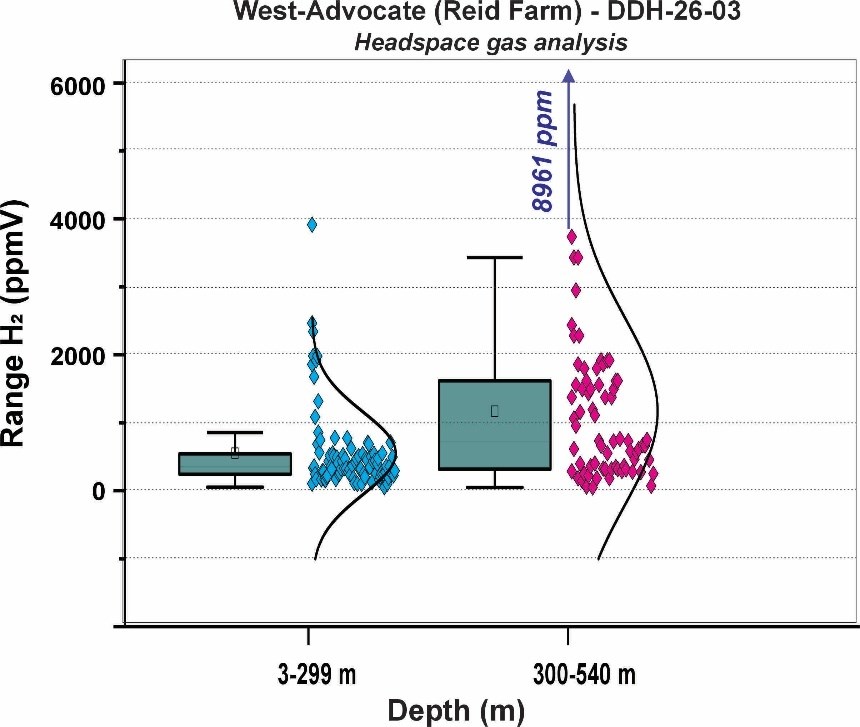
Figure 1. Comparative distribution of hydrogen analyses (H2 ppmV) of water samples from the DDH-26-03 borehole taken between 3 m and 299 m and between 300 m and 540 (headspace fraction). Data measured at atmospheric pressure and normalized to a reference temperature of 22°C.
To view an enhanced version of this graphic, please visit:
https://images.newsfilecorp.com/files/7968/296156_62987d9b34881b41_001full.jpg
Figure 2 highlights the importance of increasing H2 ppmV concentrations with depth measured along hole DDH-26-03. A quick examination of the figure shows that, despite its recognized importance, the RQD values do not fully explain the variability of hydrogen observed in the hole. For example, the highest values from hole DDH-26-03 are observed in areas of moderate RQD values and the lowest RQD values in an area with low H2 concentrations. This observation is important because it underlines the importance of other parameters such as the tectonic brecciation of the rocks which is clearly observed on the section between 400 and 510 m. This process appears to be the mechanism that produces the permeability necessary for hydrogen transport in the Devonian rocks of the area.
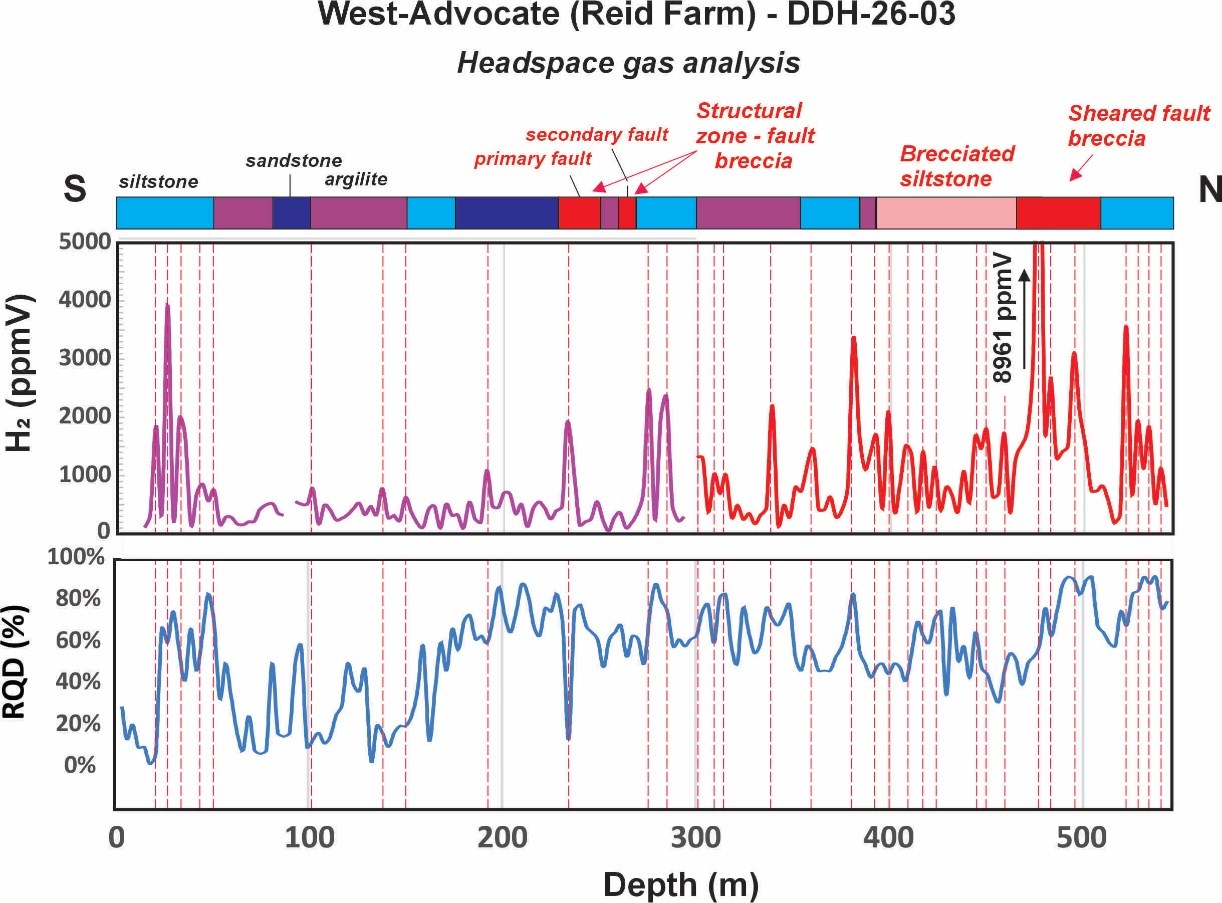
Figure 2. Diagram showing the variability of H2 concentrations (ppmV) and RQD (%) as a function of depth measured along hole DDH-26-03 located in the Reid Farm area (West Advocate).
To view an enhanced version of this graphic, please visit:
https://images.newsfilecorp.com/files/7968/296156_62987d9b34881b41_002full.jpg
Geological Significance of the 300-543 m Zone
The geological architecture of the 300-543 m interval differs from the zones previously described in DDH-26-01, DDH-26-02 and the upper portion of DDH-26-03. The new deeper interval is characterized by more intense structural deformation, alteration and fracture-related features, which the Company interprets as potentially important controls on hydrogen migration and accumulation.
The 300-543 m interval is defined by a structurally intensified zone characterized by:
- Major sheared fault breccia from approximately 478-509 m
A 31-metre interval of black, moderate to strongly foliated fault breccia was observed, with angular crushed quartz-vein and siltstone fragments hosted in a fine-grained matrix. The interval is interpreted as a major structural zone and potential fluid migration pathway. - Intrusive felsic dykes near the peak hydrogen response
Pink-orange quartz and K-feldspar felsic dykes were logged within or adjacent to the broader fault breccia interval. Their spatial association with elevated hydrogen readings is geologically notable and will be evaluated as part of the Company’s ongoing structural and geochemical interpretation. - Hematite and sericite alteration
The interval includes reddish-brown hematite overprinting, sericite-altered breccia and sericite-bearing quartz veins. These alteration features are consistent with a chemically reactive structural system. - Silicification and minor disseminated pyrite
Strongly brecciated and silicified siltstone with approximately 1-2% finely disseminated pyrite was logged near the lower portion of the reported interval. The Company considers this feature relevant to its continuing evaluation of redox conditions and hydrogen preservation potential. - Quartz pebble conglomerate horizons
Quartz pebble conglomerates were observed near the lower portion of the interval. These lithological horizons may be relevant to permeability, storage or fluid-flow pathways and will be assessed through ongoing geological interpretation. - Calcite fracture-fill stockwork
A zone of calcite-filled fractures and veinlets was observed in the lower portion of the interval, indicating a developed fracture network and prior fluid movement.
Comparison to Previously Released DDH-26-01, DDH-26-02 and Upper DDH-26-03 Results
Previously announced results from DDH-26-01, DDH-26-02 and the upper portion of DDH-26-03 identified anomalous natural hydrogen field headspace readings in shallower and structurally controlled zones.
The newly reported 380-543 m interval in DDH-26-03 represents a notable increase in:
- interval length;
- frequency of elevated readings;
- number of over-range primary instrument responses;
- selected secondary cross-check values; and
- structural complexity of the host interval.
R2G2™ Model and Structural Interpretation
QIMC’s ongoing interpretation at West Advocate is being integrated with the Company’s proprietary R2G2™ — Reactivated Rift and Graben Geostructure — framework, developed in collaboration with INRS. The R2G2™ model is used to evaluate deep structural corridors, fault reactivation, lithological contrasts and geochemical anomalies that may be relevant to natural hydrogen generation, migration and preservation.
The new 380-543 m DDH-26-03 interval is interpreted by the Company as being consistent with the type of structurally complex setting targeted by the R2G2™ framework. This interval represents a material expansion in both thickness and intensity of hydrogen-bearing zones observed to date and supports the Company’s evolving model of depth-controlled hydrogen systems.
NEXT STEPS
QIMC’s immediate technical priorities include completing verification and compilation of all DDH-26-03 ISOJAR mud data, integrating the hydrogen results with detailed lithological and structural logging, correlating the 380-543 m interval with downhole geophysical and structural data, and updating the Company’s geological model for the West Advocate natural hydrogen system as drilling continues toward the 900 m depth.
About Québec Innovative Materials Corp.
Québec Innovative Materials Corp. is a North American exploration and development company advancing a portfolio of natural hydrogen and critical mineral projects. The Company is advancing its district-scale hydrogen exploration model across Québec, Ontario, Nova Scotia and Minnesota, leveraging its proprietary R2G2™ framework.
QIMC is committed to responsible exploration, technical innovation and sustainable development, with the objective of supporting clean energy and decarbonization initiatives.
For Further Information:
QUÉBEC INNOVATIVE MATERIALS CORP.
John Karagiannidis
President & Chief Executive Officer
Email: [email protected]
Tel: +1 514-726-7058
Disclaimer
Neither the Canadian Securities Exchange nor its Regulation Services Provider accepts responsibility for the adequacy or accuracy of this release.
Cautionary Note Regarding Forward-Looking Statements
This press release contains forward-looking statements within the meaning of applicable Canadian securities legislation, including statements regarding exploration plans, the interpretation of geological observations, anticipated gas geochemistry results, the Company’s R2G2™ exploration model, planned drilling activities, laboratory analysis, downhole testing and the potential significance of natural hydrogen occurrences at West Advocate.
Forward-looking statements are based on the assumptions and judgments of the Company’s management and involve known and unknown risks and uncertainties. Actual results may differ materially from those anticipated.
Field headspace gas measurements are preliminary geochemical indicators and should not be interpreted as evidence of commercial production, recoverable resources or reserves. There is no assurance that the exploration results described herein will translate into the discovery of commercial quantities of natural hydrogen.
Although the Company believes that the forward-looking information contained herein is reasonable as of the date of this press release, such information is subject to change, and no assurance can be given that future results will be achieved. The Company does not undertake any obligation to update forward-looking statements except as required by applicable securities legislation. The hydrogen values reported in this news release are field headspace gas geochemical measurements. They do not represent in-situ concentrations, reservoir-scale concentrations, flow rates, pressure data, recoverable volumes, resources or reserves. No hydraulic fracturing or reservoir stimulation has been used in any borehole in the 2026 West Advocate drilling program. “Over range” readings indicate that the primary GA5000 field instrument exceeded its upper H₂ measurement limit of 1,000 ppm. These values were cross-checked in selected cases using a secondary Eagle II instrument. Headspace measurements are field-based geochemical indicators only and do not represent in-situ gas concentrations, reservoir-scale flow rates, recoverable volumes, resources or reserves. Formal laboratory analysis of selected gas samples collected in aluminium foil composite sampling bags is ongoing.