
Manhattan Uranium and Fortune Bay Commence Drilling at the Murmac Uranium Project, Athabasca Basin, Saskatchewan
Vancouver, British Columbia--(Newsfile Corp. - June 16, 2026) - Manhattan Uranium Discovery Corp. (TSXV: MANU) (OTC Pink: MAUUF) (FSE: JB50) ("Manhattan") and Fortune Bay Corp. (TSXV: FOR) (FSE: 5QN) (OTCQB: FTBYF) ("Fortune Bay") are pleased to announce that diamond drilling has commenced at the Murmac uranium project ("Murmac"), located near Uranium City in northern Saskatchewan. The program is targeting high-grade, basement-hosted uranium mineralization related to the Athabasca Basin.
The drilling forms part of the previously announced fully funded program at Murmac and the Strike uranium project, located near Uranium City in northern Saskatchewan ("Strike"), which is funded by Manhattan and operated by Fortune Bay pursuant to their option agreement December 15, 2023, as amended on November 13, 2025 (the "Option Agreement"). The program comprises approximately 5,000 metres of drilling across up to 25 targets, with drilling now underway on 15 priority targets at Murmac.
Program Highlights
Drilling Now Underway: Diamond drilling has commenced at Murmac, testing 15 priority targets selected from integrated geological, geophysical and geochemical datasets.
Follow-Up and New Targets: The program includes both follow-up targets near previous uranium results and new targets that have not been tested.
Multiple Discovery Criteria: Target selection considered favourable graphitic host rocks, electromagnetic conductor features, structural settings, gravity lows, alteration and uranium anomalism, with priority given to areas where multiple criteria are present.
Significant Scale and Scope: The fully funded program comprises approximately 5,000 metres of drilling across up to 25 targets at Murmac and Strike, with initial focus on Murmac followed by Strike.
High-Grade Uranium Potential: The targets are designed to test for shallow, high-grade basement-hosted uranium mineralization in a proven district, building directly on previous intercepts such as 13.80% U₃O₈ over 0.10 m in hole M24-017.1 2
Strategic Portfolio Management: This drill program represents another key milestone for Manhattan as it actively advances its high-grade Athabasca Basin assets in parallel with its extensive U.S. uranium portfolio of 25 projects including 15 past-producing mines.
"The commencement of drilling at Murmac marks a significant milestone for Manhattan. The Athabasca Basin is the world's premier high-grade uranium jurisdiction, home to some of the largest and highest-grade deposits ever discovered, and our position at Murmac gives Manhattan meaningful exposure to the kind of discovery potential that can define a company. Combined with our extensive U.S. portfolio of 25 projects including 15 past-producing mines, we believe Manhattan is uniquely positioned as one of the most compelling North American uranium exploration stories in the market today," stated William Sheriff, Chairman of Manhattan.
"Manhattan's first drill program in the Athabasca Basin is now underway. We have identified 15 priority targets selected from a strategic integration of datasets, the same criteria that define high-grade basement-hosted deposits elsewhere in the Athabasca Basin. Our 2024 discovery hole returned 8.40 metres grading 0.30% U₃O₈, including 1.20 metres at 1.79% U₃O₈ with individual assays up to 13.80% U₃O₈, confirming that high-grade uranium exists at shallow depths on this property. We now have a fully funded 5,000 metre program across up to 25 targets at Murmac and Strike, and we look forward to reporting results as drilling advances," stated Galen McNamara, CEO & Director of Manhattan.1 2
Murmac Drill Targets
The Murmac targets were selected from current and historical exploration datasets, including VTEM™ electromagnetic and magnetic surveying, ground gravity surveying, structural interpretation, prospecting, and previous drilling results. Target selection prioritized electromagnetic conductor breaks, inflections and highs where coincident with gravity lows and potentially dilational cross-fault settings, particularly along the extensive Armbruster and Howland graphitic conductor corridors.
The staged program will initially test priority targets at Murmac before moving to Strike, allowing time to review results and plan follow-up drilling as warranted. Approximately 5,000 metres of drilling is planned to test up to 25 targets at Murmac and Strike, with any positive results to be prioritized for follow-up during the current program.
Table 1 and Figure 1 summarize the 15 priority Murmac drill targets selected for testing during the current program.
Table 1: Priority Murmac drill targets selected for testing during the current program.
| Corridor/ Conductor | Target ID | Description |
| Armbruster | A1 | Defined by an electromagnetic low, magnetic low and strong gravity low at a cross-fault intersection on the Armbruster conductor. |
| Armbruster | A5 | Located beneath the southern end of a small lake at a minor break on the Armbruster conductor, where it intersects a minor cross-fault. Nearby previous drill holes M22-015 and M22-002 returned 0.12% U₃O₈ over 0.10 metres and 0.18% U₃O₈ over 0.10 metres, respectively. |
| Armbruster | A8 | Gravity-low target on the shoulder of a small electromagnetic high at a fault intersection with the Armbruster conductor. The target is located near a radioactive spring, with reported readings up to 15,000 cps, and strong hematization close to resistant hangingwall conglomerate and quartzite. |
| Armbruster | A12 | Located on the shoulder of an electromagnetic high where the Armbruster conductor is intersected by a uranium-bearing cross-fault. Historical drilling tested the resistant footwall amphibolite and identified strong hydrothermal alteration associated with anomalous radioactivity; however, the nearby intersection of the fault with the graphitic conductor was not tested. |
| Armbruster | A23 | Located at an electromagnetic break/low on the Armbruster conductor, on the shoulder of a magnetic high and gravity low, in proximity to a cross-fault intersection. |
| Armbruster | A24 | Conductor-inflection target on the Armbruster conductor, located on the shoulder of an electromagnetic high and magnetic high at a cross-fault intersection. |
| Armbruster | A25 | Characterized by an electromagnetic low, magnetic low and gravity low at a cross-fault intersection on the Armbruster conductor. |
| Armbruster | A26 | Conductor-inflection target associated with an electromagnetic high, strong magnetic low and gravity low at a cross-fault intersection on the Armbruster conductor. |
| Armbruster | A27 | Defined by an electromagnetic low, magnetic low and gravity low at a cross-fault intersection on the Armbruster conductor. |
| Howland | H14 | Located on the shoulder of an electromagnetic high, associated with a magnetic low and gravity low at a cross-fault intersection on the Howland conductor. |
| Howland | H19 | Located at an electromagnetic high near the termination of the Howland conductor, associated with a strong magnetic low and cross-fault intersection. |
| Howland | H3 | Located at an electromagnetic termination on the Howland conductor, associated with a strong magnetic low, strong gravity low and cross-fault intersection. |
| Howland East | HE1 | Located at a conductor break on the Howland East conductor, associated with an electromagnetic low, magnetic low and cross-fault intersection. |
| Pitchvein | P4 | Located under the edge of a lake at a break on the Pitchvein conductor where it intersects the major cross fault which, at the Howland Conductor, hosts a 2024 drill intercept of 13.80 % U3O8 over 0.1 m hosted in 0.30 % U3O8 over 8.4 m. P4 is also located approximately 550 m along strike from holes M22-013 and -014, which in 2022 returned a best result of 448 ppm U over 0.3 m from the Pitchvein conductor. |
| Pitchvein | P8 | Situated at a broad inflection point on an extension of the southwestern Pitchvein conductor trend, at the intersection of a major northeast-southwest fault that displays extensive radioactive surface showings over an approximately five-kilometre trend through the Pitchvein, Armbruster and Howland conductor corridors. |
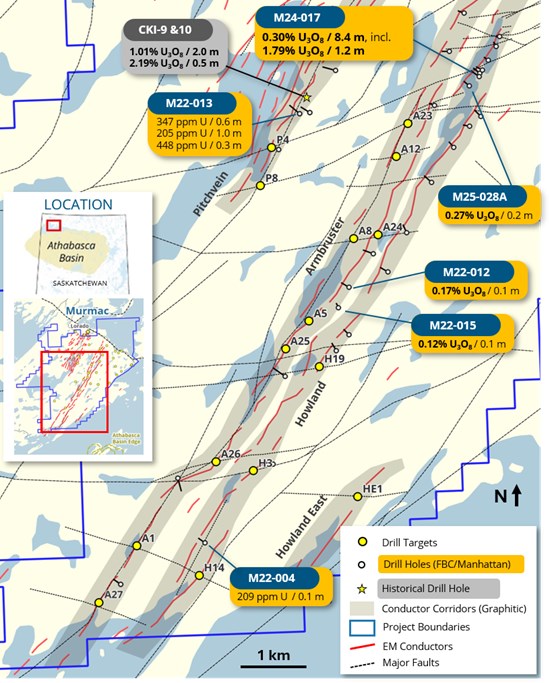
Figure 1: Priority Murmac drill targets selected for testing during the current program.
To view an enhanced version of this graphic, please visit:
https://images.newsfilecorp.com/files/8126/301652_c48dff561438c86b_001full.jpg
Murmac Project Overview
Murmac is located near Uranium City in northern Saskatchewan, on the northern margin of the Athabasca Basin. The project is prospective for high-grade, basement-hosted uranium deposits associated with graphitic electromagnetic conductor corridors, structural reactivation, hydrothermal alteration and uranium-bearing mineralizing systems related to the Athabasca Basin.
Previous exploration by Fortune Bay and Manhattan at Murmac has included compilation of historical exploration data, modern airborne electromagnetic and magnetic surveying, ground gravity surveying, prospecting, radon-in-water surveying and diamond drilling. This work has confirmed favourable host rocks, prospective structures, uranium mineralization and multiple target areas warranting follow-up drilling.
Previous drilling at Murmac has confirmed shallow uranium mineralization associated with structured graphitic rocks. Drill hole M24-017, completed at Howland Lake North, intersected 8.40 metres grading 0.30% U₃O₈, including 1.20 metres grading 1.79% U₃O₈, with individual assays up to 13.80% U₃O₈ over 0.10 metres and 4.54% U₃O₈ over 0.10 metres. This high-grade mineralization was intersected at approximately 64 metres below surface.1 2
Option Agreement
Murmac and Strike are subject to the Option Agreement, under which Manhattan has the right to acquire up to a 70% interest in Murmac and Strike by funding an aggregate of C$6 million in exploration expenditures, making cash payments of an aggregate of C$1.35 million, and an aggregate of C$2.15 million in common shares. Fortune Bay is the operator during the option period and is entitled to charge a 10% management fee on exploration expenditures.
Technical Disclosure
Fortune Bay's drill results refer to drill core and surface grab samples submitted to the Saskatchewan Research Council ("SRC") Geoanalytical Laboratories (ISO/IEC 17025:2005 accredited) for uranium assay and multi-element characterization. Sample preparation for all samples included drying, jaw crushing to 60% passing -2 mm, and pulverizing to 90% passing -106 microns. Multi-element characterization was carried out by partial digestion (HNO3:HCl), using ICP-OES and ICP-MS analytical methods. For selected samples U3O8 weight % was determined separately through partial digest (HCl:HNO3) and ICP-OES (ISO/IEC 17025 accredited method).
Further details regarding the historical exploration/drilling and exploration results noted in this news release can be found within the Saskatchewan Mineral Assessment Database (SMAD) and the Saskatchewan Mineral Deposit Index (SMDI). Fortune Bay has verified several of these occurrences through field prospecting and sampling, however there is a risk that any future confirmation work and exploration may produce results that substantially differ from the unverified historical results. Historical drill hole locations, captured from georeferenced assessment report maps, are subject to uncertainty (considered accurate to +/-50 metres). Manhattan and Fortune Bay consider these unverified historical results relevant to assess the mineralization and economic potential of Murmac and Strike. The historical information referenced derives from SMAD references 74N07-0011, 74N07-0173, 74N07-0277, 74N11-SE-0016 and 74N11-0052.
Qualified Person