High-grade copper and gold intersections extend known mineralisation at FireFly’s Green Bay by 650m
ASX: FFM | TSX: FFM
Company Announcement 16 October 2025
Green Bay Copper-Gold Project, Canada High-grade copper and gold intersections extend known mineralisation at FireFly’s Green Bay by 650m
The furthest intersection returns 49m at 6.1% CuEq1 and remains open at depth; These results will form part of the Mineral Resource Estimate update set for this quarter
KEY POINTS
- Drilling from the end of the Ming mine exploration drive has extended the known
mineralisation by 430m beyond previous drilling and more than 650m beyond the October 2024 Mineral Resource Estimate
- The strength of the mineralisation (i.e. the combination of grade and width) appears to be
increasing at depth with the furthest hole returning one of the best intersections drilled in the deposit to date:
- 49.0m @ 6.1% copper equivalent (CuEq)1 (4.9% Cu & 1.3g/t Au) in hole MUG25-202 (~39.2m true thickness), including
- 14.3m @ 13.7% CuEq (10.6% Cu & 3.2% Au)
- Importantly, these drillholes confirm that the previously reported ~700m long downhole electromagnetic (DHEM) geophysical anomaly (see ASX announcement dated 7 May 2025)
is the result of confirmed copper-gold bearing mineralisation. This anomaly indicates mineralisation is likely to continue well beyond this step-out hole
- Other step-out holes demonstrate that the upper high-grade copper and gold rich
Volcanogenic Massive Sulphide (VMS) zones continue, with key intersections including:
- 7.0m @ 3.9% CuEq (2.1% Cu & 1.9g/t Au) in hole MUG25-208 (~ true thickness)
- 14.1m @ 3.7% CuEq (0.9% Cu & 3.2g/t Au) in hole MUG25-190 (~ true thickness), including
- 1.8m @ 15.2% CuEq (1.8% Cu & 15.9g/t Au) and
- 4.4m @ 4.4% CuEq (1.8% Cu & 2.8g/t Au)
- The drilling also confirms the presence of broad copper-rich Footwall Zone (FWZ) style
copper mineralisation below the upper VMS zone. Intersections include:
- 33.9m @ 1.9% CuEq (1.8% Cu & 0.1g/t Au) in hole MUG25-179 (~ true thickness)
- 30.0m @ 1.9% CuEq (1.8% Cu & 0.1g/t Au) in hole MUG25-208 (~ true thickness)
- 27.0m @ 1.9% CuEq (1.8% Cu & 0.1g/t Au) in hole MUG25-190 (~ true thickness)
1 Metal equivalent for drill results reported in this announcement have been calculated at a copper price of US$8,750/t, gold price of US$2,500/oz, silver price of US$25/oz and zinc price of US$2,500/t. Metallurgical recoveries have been set at 95% for copper, 85% for precious metals and 50% for zinc. CuEq(%) = Cu(%) + (Au(g/t) x 0.82190) + (Ag(g/t) x 0.00822) + (Zn(%) x 0.15038). In the opinion of the Company, all elements included in the metal equivalent calculation have a reasonable potential to be sold and recovered based on current market conditions, metallurgical test work, and historical performance achieved at the Green Bay project whilst in operation.
FireFly Metals Ltd
+61 8 9220 9030 ACN 110 336 733 [email protected] Principal & Registered Office:
www.fireflymetals.com.au Level 2/8 Richardson Street West Perth WA 6005
- The current Mineral Resource Estimate for Green Bay totals 24.4Mt at 1.9% for 460Kt CuEq of
Measured & Indicated Resources and 34.5Mt at 2.0% for 690Kt CuEq of Inferred Resources (see ASX announcement dated 29 October 2024)
- Eight diamond rigs continue operating (six underground and two on surface) to upgrade the
current Mineral Resource, extend known mineralisation and make new regional discoveries
- Regional exploration is well underway, with drill rigs systematically testing conductive geophysical anomalies in the central Green Bay leases (see ASX announcement dated 24 July 2025). A VTEM survey is being completed over the Company’s Tilt Cove Project
- FireFly has a strong balance sheet with cash and liquid investments of ~A$145M2 following
successful completion of the recent equity raise. These funds will be used to accelerate exploration activities and complete the feasibility study on the upscaled Green Bay Project
FireFly Managing Director Steve Parsons said: “These results are truly world-class, with widths and grades which any copper miner would be delighted to have.
“To extend the known mineralisation by 650m beyond the Mineral Resource with such a spectacular intersection as 49m at 6.1% CuEq demonstrates the exceptional growth outlook at Green Bay and shows why it is one of the best undeveloped copper projects in the world. The mineralisation remains open, and we are continuing to drill in pursuit of more growth.
“The spectacular results in this announcement combined with the recent infill drill results set the scene for a Mineral Resource update later this quarter.”
FireFly Metals Ltd (ASX: FFM, TSX: FFM) (Company or FireFly) is pleased to announce exceptional drill results which extend the known mineralisation by more than 650m beyond the Mineral Resource at its Green Bay Copper-Gold Project.
The furthest drillhole recently completed from the northern end of the 805L exploration drive intersected 49.0m @ 6.1% CuEq (~39.2m true thickness). This included an internal massive sulphide zone grading a significant 14.3m @ 13.7% CuEq.
This is one of the best intersections ever recorded at the Ming deposit within Green Bay and provides more firm evidence that the grade of mineralisation is increasing at depth.
The step-out drilling in this announcement extends the mineralisation more than 650m beyond the October 2024 Mineral Resource Estimate. These holes will form an important part of the updated estimate planned for later this quarter.3
The Mineral Resource Estimate currently stands at 24.4Mt @ 1.9% for 460Kt CuEq of Measured and Indicated Resources and a further 34.5Mt @ 2.0% for 690Kt CuEq of Inferred Resources.4
2 Cash, receivables and liquid investment position at 30 June 2025, plus A$10 million gross proceeds received from the Share Purchase Plan first announced on 5 June 2025 and completed on 14 July 2025, plus net proceeds of ~A$26.6 million from the second tranche of the institutional placement first announced on 5 June 2025 and completed on 3 September 2025. 3 Timeframes are indicative and may be subject to change.
4 See ASX announcement dated 29 October 2024.
There are two distinct styles of mineralisation at the Ming underground mine at Green Bay. One comprises the upper copper-gold rich Volcanogenic Massive Sulphide (VMS) lenses. The VMS lenses sit above a broad copper stringer zone known as the Footwall Zone (FWZ). The step-out
drilling confirms both styles of mineralisation continue at depth and remain open.
Strong copper and gold mineralisation was also defined in the upper VMS zones with intersections including 7.0m @ 3.9% CuEq and 14.1m @ 3.7% CuEq which included an internal gold-dominated zone grading 1.8m @ 15.9g/t Au and 1.8%Cu. The FWZ mineralisation identified exhibited consistent grades and widths with results including 33.9m @ 1.9% CuEq and 30.0m @ 1.9% CuEq.
Importantly these drillholes confirms that the 700m long downhole electromagnetic (DHEM) geophysical anomaly reported in the ASX announcement dated 7 May 2025 (Figure 1) is the result of copper-gold bearing sulphide mineralisation. This anomaly indicates mineralisation is likely to continue well beyond the step-out hole reported in this announcement.
The extensive six-rig underground drill campaign continues at the Ming Mine with the dual objectives of growing the current Mineral Resource and, most importantly, upgrading more of the Inferred Resources to the comparatively more valuable Measured and Indicated (M&I) Mineral Resource categories.
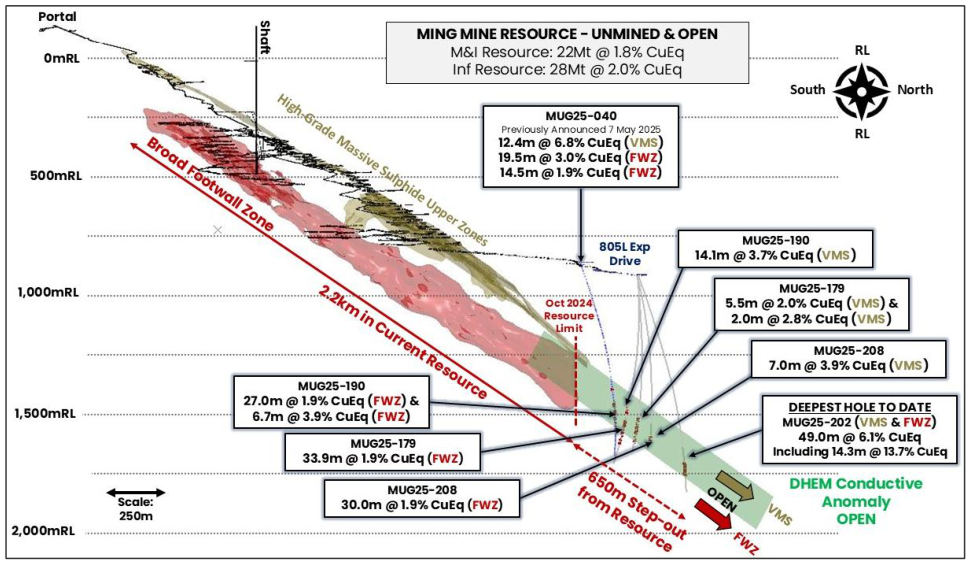
Figure 1: Long section through the Green Bay Ming underground mine showing the location of select drill results from this announcement showing the 650m step-out from the previously released October 2024 Mineral Resource Estimate. The green shape is a modelled DHEM anomaly demonstrating the mineralisation remains open beyond this deepest drill hole (see ASX announcement dated 7 May 2025 for further details). Drill assays >0.5% copper are shown in red. Refer to Appendix B for all drill results and locations in this ASX announcement.
Regionally, exploration programmes are also well underway, following the North American summer break period, with two diamond drill rigs now on site and ready to accelerate the regional discovery campaign. Geophysical data collection continues, with a detailed helimagnetic survey being conducted over the central Green Bay leases. A comprehensive VTEM survey is being completed over the entire 115km2 of the adjacent Tilt Cove Project to the east of the Ming Mine. The new geophysical data is expected to be available in the coming weeks. The rigs will systematically test geophysical anomalies generated by this new data and the Company’s previous airborne VTEM surveys.
FireFly is well funded to accelerate its growth campaign and engineering studies with a recent well supported equity raising which has strengthened the Company’s balance sheet, with cash and liquid investments of ~A$145 million.5
About the Drilling Results
Drilling at the Ming underground copper-gold mine recommenced following the acquisition of the Green Bay Copper-Gold Project by FireFly in October 2023. In total, FireFly has completed 245 underground holes for a total of ~126,877m of underground diamond drilling to 11 October 2025.
This announcement contains the results of 4 drill holes. The drilling results reported in this announcement are step-out holes targeting down-plunge extensions of the Ming Mine mineralisation drilled from the northern extent of the 805L exploration drive. Logging and analysis of additional drill holes is ongoing, and further details will be reported as results are received.
There are two distinct styles of mineralisation present at the Green Bay Ming Mine, consisting of a series of upper copper-gold rich VMS lenses underlain by a broad copper-rich stringer zone, known as the Footwall Zone (or FWZ).
The Footwall Zone is extensive, with the copper stringer mineralisation observed over thicknesses of ~150m and widths exceeding 200m. The known strike of the mineralisation defined to date is 2.3km and it remains open down-plunge.
Six drill rigs are currently operating underground, with the focus split between both step-out extension and exploration (two rigs) and infill Resource conversion drilling (four rigs).
Significant assay results are presented in Appendix B of this announcement.
Step-out Drilling from the 805L Exploration Drive
FireFly commenced mining the 805L exploration drive in late 2023. These are the first results received for the holes drilled at the most northern end of the 805L (Crosscuts 5 and 6).
5 Cash, receivables and liquid investment position at 30 June 2025, plus A$10 million gross proceeds received from the Share
Hole MUG25-202 Intersected thick and continuous mineralisation consisting of copper-gold VMS zone immediately transitioning into FWZ stringer-style mineralisation (Figure 2). This hole is the furthest drilling down-plunge in the deposit to date and is more than 650m from the boundary of the October 2024 Mineral Resource Estimate. Key intersections include:
- 49m @ 4.9% Cu, 1.3g/t Au, 13.4g/t Ag, 0.85% Zn (6.1% CuEq) from 820m (VMS merging into FWZ-style mineralisation) and includes a higher grade zone of (~39.2m true thickness):
- 14.3m @ 10.6% Cu, 3.2g/t Au, 33.4g/t Ag, 1.67% Zn (13.7% CuEq) from 827m (VMS-style)
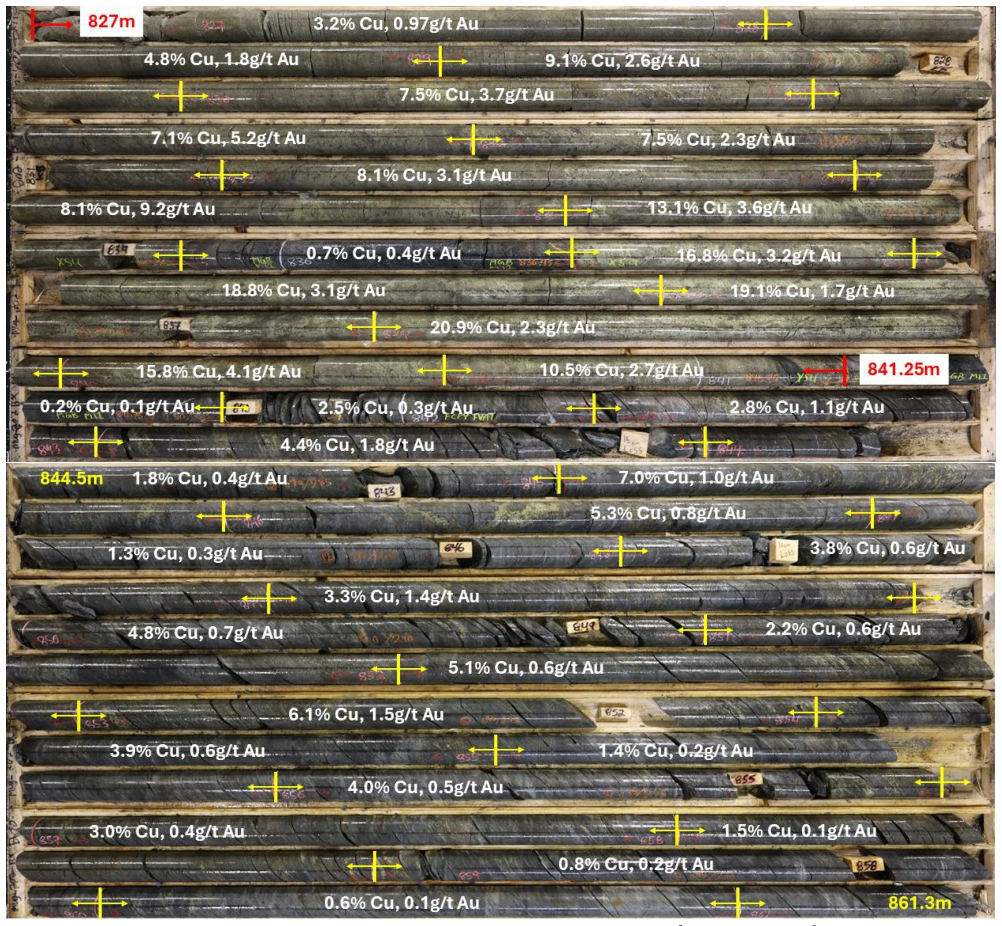
Figure 2: Core photographs for drillhole MUG25-202, showing the upper VMS (827m-841.25m) that grades 14.3m @ 13.7% CuEq and the adjacent broad FWZ stringer-style mineralisation. This is part of the broader step-out intersection of 49.0m @ 6.1% CuEq.
Hole MUG25-208 contained an upper copper and gold rich VMS zone with a thick FWZ approximately 20 metres below the VMS zone. Key intersections include (All ~ true thickness):
- 7.0m @ 2.1% Cu, 1.9g/t Au, 11.5g/t Ag, 1.15% Zn (3.9% CuEq) from 641m (VMS-style) and
- 30.0m @ 1.8% Cu, 0.1g/t Au, 1.5g/t Ag, 0.02% Zn (1.9% CuEq) from 668m (FW Stringer-style)
Hole MUG25-179 intersected two VMS zones separated by a post-mineral mafic dyke. FWZ style stringer mineralisation commenced ~12m beneath the VMS zones. Key intersections include (All ~ true thickness):
- 5.5m @ 1.0% Cu, 0.9g/t Au, 9.2g/t Ag, 0.8% Zn (2.0% CuEq) from 604m (VMS-style) and
- 2.0m @ 1.4% Cu, 1.4g/t Au, 10.9g/t Ag, 1.2% Zn (2.8% CuEq) from 612m (VMS-style) and
- 33.9m @ 1.8% Cu, 0.1g/t Au, 1.9g/t Ag, 0.02% Zn (1.9% CuEq) from 636m (FW Stringer-style) and
- 4m @ 1.5% Cu, 0.2g/t Au, 2.4g/t Ag, 0.12% Zn (1.7% CuEq) from 695m (FW Stringer-style)
Hole MUG25-190 returned a thick gold-dominated VMS intersection at the margins of the channel underlain by multiple zones footwall-style stringer mineralisation. Key intersections include (All ~ true thickness):
- 14.1m @ 0.9% Cu, 3.2g/t Au, 11.9g/t Ag, 0.74% Zn (3.7% CuEq) from 567.1m (VMS-style) including:
- 1.8m @ 1.8% Cu, 15.9g/t Au, 39.4g/t Ag, 0.78% Zn (15.2% CuEq) from 567.1m
- 4.4m @ 1.8% Cu, 2.8g/t Au, 18.9g/t Ag, 1.1% Zn (4.4% CuEq) from 574.1m
- 27.0m @ 1.8% Cu, 0.1g/t Au, 1.9g/t Ag, 0.08% Zn (1.9% CuEq) from 614m (FW Stringer-style) and
- 6.7m @ 3.6% Cu, 0.2g/t Au, 3.7g/t Ag, 0.3% Zn (3.9% CuEq) from 663.3m (FW Stringer-style)and
- 5m @ 1.3% Cu, 0.1g/t Au, 1.2g/t Ag, 0.16% Zn (1.4% CuEq) from 690.1m (FW Stringer-style) and
- 6.8m @ 1.5% Cu, 0.1g/t Au, 1.4g/t Ag, 0.07% Zn (1.7% CuEq) from 708.2m (FW Stringer-style)
Forward Work Plans
Near-term drilling activities at the Green Bay Copper-Gold Project will continue to focus on three key areas: Upgrading the Mineral Resource (with infill drilling results), Mineral Resource Growth, and New Discoveries from both underground and surface. As at 11 October 2025, the Company had completed ~126,877m metres of underground diamond drilling. Six underground rigs will continue to advance the underground Mineral Resource growth and extension activities.
Green Bay (Ming Mine) Resource Growth
The low-cost Mineral Resource growth strategy is underpinned by the 805L exploration drill drive at the Ming Mine. The second phase of 805L exploration drive has been completed, providing locations for both infill drilling and further down-plunge Mineral Resource extension. The exploration development is positioned to enable utilisation in potential future upscaled mining operations. Drilling is ongoing with further results due in the coming weeks.
Development of additional platforms for further ongoing exploration and infill drilling will continue at Ming Mine throughout 2025.
Upgrading the Mineral Resource Estimate remains a key priority for the Company’s plans to resume upscaled mining at Green Bay. Infill drilling will upgrade the Inferred Resource (34.5Mt @ 2.0%
CuEq) to the higher quality Measured and Indicated (M&I) Resource category which currently stands at 24.4Mt @ 1.9% CuEq.6
Based on results to date, it is likely that the amount of mineralisation classified as M&I will increase in the Mineral Resource Estimate update planned to be released later in the current quarter. This is important because only M&I Mineral Resources can be considered in future feasibility studies.
Green Bay (Ming Mine) Upscaled Project Development
Economic evaluations for the rescaled resumption of production at Green Bay are continuing with the first preliminary study planned for completion in Q1 2026. The study will be underpinned by the updated Mineral Resource Estimate planned to be released later this quarter.
Following the announcement of metallurgical testwork results in August (see ASX announcement dated 5 August 2025, in which it was reported that copper recoveries of 98% were returned and preliminary work on gold extraction demonstrated gold recovery of up to 85%), gold forms an important economic component of the deposit with, so far, 550koz of gold as a byproduct in the current Mineral Resource.
Various scenarios for an upscaled restart to operations are being evaluated. With the huge success of the drilling programs to date, the Company wishes to avoid unnecessarily limiting the size of any future potential upscaled mining operation until it has completed the next phase of growth drilling.
Following the recent conditional release from further Environmental Assessment by the Province of Newfoundland and Labrador for a start-up mining and processing operation (see ASX announcement dated 5 August 2025), the Company has now commenced the application for permits to commence early works and construction. The Company intends to commence selective low-cost seasonal early works in the coming months to prepare the Project for future development and construction.
Green Bay (Ming Mine) Regional Discovery
Regional exploration is underway with two surface drill rigs testing high-priority targets across the Company’s 346km2 surface exploration claims.
One of the drill rigs will continue to test high-priority targets close to the Ming Mine. The second drill rig will systematically test early-stage greenfields targets generated by airborne VTEM and magnetic surveys completed in 2024 and 2025.
FireFly has continued to invest in regional-scale geophysics as a key exploration tool. The Company is completing a detailed VTEM survey over the 115km2 Tilt Cove Project. A detailed helicopter magnetic survey is also being completed over the central Green Bay leases.
6 Refer to ASX announcement dated 29 October 2024 and Appendix A of this announcement for further details on the Mineral Resource Estimate.
Funding and Corporate Activities
FireFly is well funded to complete its large-scale accelerated growth campaign at Green Bay. As originally announced on 5 June 2025, the Company has undertaken and completed an ~A$98.1M7 equity raising in conjunction with a A$10M Share Purchase Plan. As a result, the Company has strengthened its balance sheet, with cash and liquid investments of ~A$145 million8.
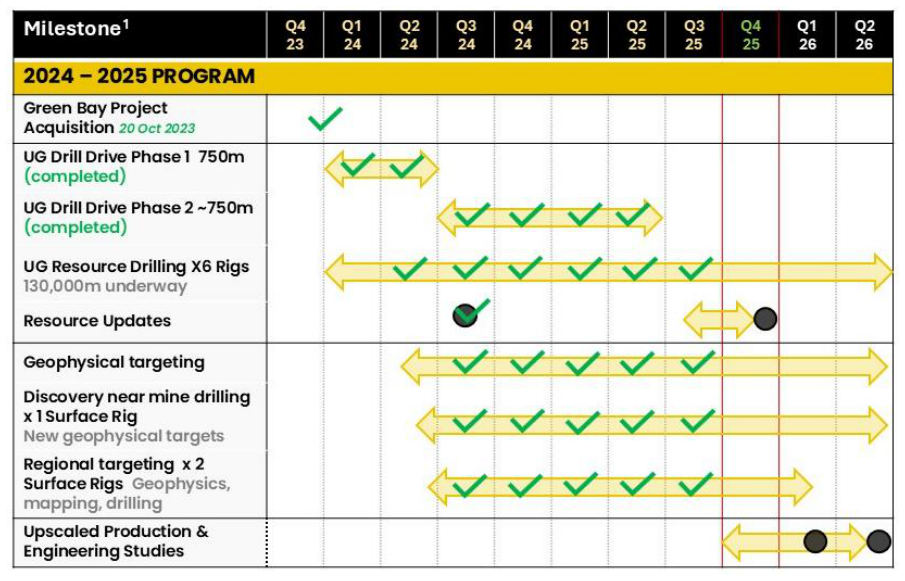
Figure 3: Key 2024-2025 milestones for the Green Bay Copper-Gold Project.
1. Timelines are indicative and may be subject to change.
Steve Parsons Jessie Liu-Ernsting Media
Managing Director Chief Development Officer Paul Armstrong FireFly Metals Ltd FireFly Metals Ltd Read Corporate +61 8 9220 9030 +1 709 800 1929 +61 8 9388 1474
7 See ASX announcement dated 11 July 2025.
8 Cash, receivables and liquid investment position at 30 June 2025, plus A$10 million gross proceeds received from the Share
ABOUT FIREFLY METALS
FireFly Metals Ltd (ASX, TSX: FFM) is an emerging copper-gold company focused on advancing the high-grade Green Bay Copper-Gold Project in Newfoundland, Canada. The Green Bay Copper- Gold Project currently hosts a Mineral Resource prepared and disclosed in accordance with the 2012 Edition of the Australasian Code for Reporting of Exploration Results, Mineral Resources and Ore Reserves (JORC Code 2012) and Canadian National Instrument 43-101 - Standards of Disclosure for Mineral Projects (NI 43-101) of 24.4Mt of Measured and Indicated Resources at 1.9% for 460Kt CuEq and 34.5Mt of Inferred Resources at 2% for 690Kt CuEq. The Company has a clear strategy to rapidly grow the copper-gold Mineral Resource to demonstrate a globally significant copper-gold asset. FireFly has commenced a 130,000m diamond drilling program.
FireFly holds a 70% interest in the high-grade Pickle Crow Gold Project in Ontario. The current Inferred Resource stands at 11.9Mt at 7.2g/t for 2.8Moz gold, with exceptional discovery potential on the 500km2 tenement holding.
The Company also holds a 90% interest in the Limestone Well Vanadium-Titanium Project in Western Australia.
For further information regarding FireFly Metals Ltd please visit the ASX platform (ASX:FFM) or the Company’s website www.fireflymetals.com.au or SEDAR+ at www.sedarplus.ca.
COMPLIANCE STATEMENTS
Mineral Resources Estimate – Green Bay Project
The Mineral Resource Estimate for the Green Bay Project referred to in this announcement and set out in Appendix A was first reported in the Company’s ASX announcement dated 29 October 2024, titled “Resource increases 42% to 1.2Mt of contained metal at 2% Copper Eq” and is also set out in the Technical Reports for the Ming Copper Gold Mine titled “National Instrument 43-101 Technical Report, FireFly Metals Ltd., Ming Copper-Gold Project, Newfoundland” with an effective date of 29 November 2024 and the Little Deer Copper Project, titled “Technical Report and Updated Mineral Resource Estimate of the Little Deer Complex Copper Deposits, Newfoundland, Canada” with an effective date of 26 June 2024, each of which is available on SEDAR+ at www.sedarplus.ca.
The Company confirms that it is not aware of any new information or data that materially affects the information included in the original announcement and that all material assumptions and technical parameters underpinning the Mineral Resource Estimate in the original announcement continue to apply and have not materially changed.
Mineral Resources Estimate – Pickle Crow Project
The Mineral Resource Estimate for the Pickle Crow Project referred to in this announcement was first reported in the Company’s ASX announcement dated 4 May 2023, titled “High-Grade Inferred Gold Resource Grows to 2.8Moz at 7.2g/t” and is also set out in the Technical Report for the Pickle Crow Project, titled “NI 43-101 Technical Report Mineral Resource Estimate Pickle Crow Gold Project, Ontario, Canada” with an effective date of 29 November 2024, as amended on 11 June 2025, available on SEDAR+ at www.sedarplus.ca.
The Company confirms that it is not aware of any new information or data that materially affects the information included in the original announcement and that all material assumptions and technical parameters underpinning the Mineral Resource Estimate in the original announcement continue to apply and have not materially changed.
Metal equivalents for Mineral Resource Estimates
Metal equivalents for Mineral Resource Estimates have been calculated at a copper price of US$8,750/t, gold price of US$2,500/oz and silver price of US$25/oz. Individual Mineral Resource grades for the metals are set out in Appendix A of this announcement. Copper equivalent was calculated based on the formula CuEq(%) = Cu(%) + (Au(g/t) x 0.82190) + (Ag(g/t) x 0.00822).
Metallurgical factors have been applied to the metal equivalent calculation. Copper recovery used was 95%. Historical production at the Ming Mine has a documented copper recovery of ~96%. Precious metal (gold and silver) metallurgical recovery was assumed at 85% on the basis of historical recoveries achieved at the Ming Mine in addition to historical metallurgical test work to increase precious metal recoveries.
In the opinion of the Company, all elements included in the metal equivalent calculations have a reasonable potential to be sold and recovered based on current market conditions, metallurgical test work, the Company’s operational experience and, where relevant, historical performance achieved at the Green Bay project whilst in operation.
Metal equivalents for Exploration Results
Metal equivalents for Exploration Results have been calculated at a copper price of US$8,750/t, gold price of US$2,500/oz, silver price of US$25/oz and zinc price of US$2,500/t. Individual grades for the metals are set out in Appendix B of this announcement.
Metallurgical factors have been applied to the metal equivalent calculation. Copper recovery used was 95%. Historical production at the Ming Mine has a documented copper recovery of ~96%. Precious metal (gold and silver) metallurgical recovery was assumed at 85% based on historical recoveries achieved at the Ming Mine in addition to historical metallurgical test work to increase recoveries. Zinc recovery is applied at 50% based on historical processing and potential upgrades to the mineral processing facility.
In the opinion of the Company, all elements included in the metal equivalent calculation have a reasonable potential to be sold and recovered based on current market conditions, metallurgical test work, and the Company’s operational experience.
Copper equivalent was calculated based on the formula CuEq(%) = Cu(%) + (Au(g/t) x 0.82190) + (Ag(g/t) x 0.00822) + (Zn(%) x 0.15038).
Exploration Results
Previously reported Exploration Results at the Green Bay Project referred to in this announcement were first reported in accordance with ASX Listing Rule 5.7 in the Company’s ASX announcements dated 31 August 2023, 11 December 2023, 16 January 2024, 4 March 2024, 21 March 2024, 29 April 2024, 19 June 2024, 3 September 2024, 16 September 2024, 3 October 2024, 10 December 2024 and 12 February 2025.
Original announcements
FireFly confirms that it is not aware of any new information or data that materially affects the information included in the original announcements and that, in the case of estimates of Mineral Resources, all material assumptions and technical parameters underpinning the Mineral Resource Estimates in the original announcements continue to apply and have not materially changed. The Company confirms that the form and context in which the Competent Persons’ and Qualified Persons’ findings are presented have not been materially modified from the original market announcements.
COMPETENT PERSON AND QUALIFIED PERSON STATEMENTS
The information in this announcement that relates to new Exploration Results is based on and fairly represents information compiled by Mr Darren Cooke, a Competent Person who is a member of the Australasian Institute of Geoscientists. Mr Cooke is a full-time employee of FireFly Metals Ltd and holds securities in FireFly Metals Ltd. Mr Cooke has sufficient experience that is relevant to the style of mineralisation and type of deposit under consideration and to the activity being undertaken to qualify as a Competent Person as defined in the 2012 Edition of the ‘Australasian Code for the Reporting of Exploration Results, Mineral Resources and Ore Reserves’. Mr Cooke consents to the inclusion in this announcement of the matters based on his information in the form and context in which it appears.
All technical and scientific information in this announcement has been reviewed and approved by Group Chief Geologist, Mr Juan Gutierrez BSc, Geology (Masters), Geostatistics (Postgraduate Diploma), who is a Member and Chartered Professional of the Australasian Institute of Mining and Metallurgy and a Member of the Australian Institute of Geoscientists. Mr Gutierrez is a Qualified Person as defined in NI 43-101. Mr Gutierrez is a full-time employee of FireFly Metals Ltd and holds securities in FireFly Metals Ltd. Mr Gutierrez has sufficient experience that is relevant to the style of mineralisation and type of deposit under consideration and to the activity being undertaken to qualify as a Qualified Person as defined in NI 43-101. Mr Gutierrez consents to the inclusion in this announcement of the matters based on his information in the form and context in which it appears.
FORWARD-LOOKING INFORMATION
This announcement may contain certain forward-looking statements and projections, including statements regarding FireFly’s plans, forecasts and projections with respect to its mineral properties and programs. Forward-looking statements may be identified by the use of words such as “may”, “might”, “could”, “would”, “will”, “expect”, “intend”, “believe”, “forecast”, “milestone”, “objective”, “predict”, “plan”, “scheduled”, “estimate”, “anticipate”, “continue”, or other similar words and may include, without limitation, statements regarding plans, strategies and objectives. Page | 11 Although the forward-looking statements contained in this announcement reflect management’s current beliefs based upon information currently available to management and based upon what management believes to be reasonable assumptions, such forward-looking statements and projections are estimates only and should not be relied upon. They are not guarantees of future performance and involve known and unknown risks, uncertainties and other factors many of which are beyond the control of the Company, which may include changes in commodity prices, foreign exchange fluctuations, economic, social and political conditions, and changes to applicable regulation, and those risks outlined in the Company’s public disclosures.
The forward-looking statements and projections are inherently uncertain and may therefore differ materially from results ultimately achieved. For example, there can be no assurance that FireFly will be able to confirm the presence of Mineral Resources or Ore Reserves, that FireFly’s plans for development of its mineral properties will proceed, that any mineralisation will prove to be economic, or that a mine will be successfully developed on any of FireFly’s mineral properties. The performance of FireFly may be influenced by a number of factors which are outside of the control of the Company, its directors, officers, employees and contractors. The Company does not make any representations and provides no warranties concerning the accuracy of any forward-looking statements or projections, and disclaims any obligation to update or revise any forward-looking statements or projections based on new information, future events or circumstances or otherwise, except to the extent required by applicable laws.
APPENDIX A
Green Bay Copper-Gold Project Mineral Resources
Ming Deposit Mineral Resource Estimate
| TONNES | COPPER | GOLD | SILVER | CuEq | ||||
|---|---|---|---|---|---|---|---|---|
| (Mt) | Grade | Metal | Grade | Metal | Grade | Metal | Grade | |
| (%) | (‘000 t) | (g/t) | (‘000 oz) | (g/t) | (‘000 oz) | (%) | ||
| Measured | 4.7 | 1.7 | 80 | 0.3 | 40 | 2.3 | 340 | 1.9 |
| Indicated | 16.8 | 1.6 | 270 | 0.3 | 150 | 2.4 | 1,300 | 1.8 |
| TOTAL M&I | 21.5 | 1.6 | 340 | 0.3 | 190 | 2.4 | 1,600 | 1.8 |
| Inferred | 28.4 | 1.7 | 480 | 0.4 | 340 | 3.3 | 3,000 | 2.0 |
Little Deer Mineral Resource Estimate
| TONNES | COPPER | GOLD | SILVER | CuEq | ||||
|---|---|---|---|---|---|---|---|---|
| (Mt) | Grade | Metal | Grade | Metal | Grade | Metal | Grade | |
| (%) | (‘000 t) | (g/t) | (‘000 oz) | (g/t) | (‘000 oz) | (%) | ||
| Measured | - | - | - | - | - | - | - | - |
| Indicated | 2.9 | 2.1 | 62 | 0.1 | 9 | 3.4 | 320 | 2.3 |
| TOTAL M&I | 2.9 | 2.1 | 62 | 0.1 | 9 | 3.4 | 320 | 2.3 |
| Inferred | 6.2 | 1.8 | 110 | 0.1 | 10 | 2.2 | 430 | 1.8 |
GREEN BAY TOTAL MINERAL RESOURCE ESTIMATE
| TONNES | COPPER | GOLD | SILVER | CuEq | ||||
|---|---|---|---|---|---|---|---|---|
| (Mt) | Grade | Metal | Grade | Metal | Grade | Metal | Grade | |
| (%) | (‘000 t) | (g/t) | (‘000 oz) | (g/t) | (‘000 oz) | (%) | ||
| Measured | 4.7 | 1.7 | 80 | 0.3 | 45 | 2.3 | 340 | 1.9 |
| Indicated | 19.7 | 1.7 | 330 | 0.2 | 154 | 2.6 | 1,600 | 1.9 |
| TOTAL M&I | 24.4 | 1.7 | 400 | 0.3 | 199 | 2.5 | 2,000 | 1.9 |
| Inferred | 34.6 | 1.7 | 600 | 0.3 | 348 | 3.1 | 3,400 | 2.0 |
1. FireFly Metals Ltd Mineral Resource Estimates for the Green Bay Copper-Gold Project, incorporating the Ming Deposit and Little Deer Complex, are prepared and reported in accordance with the JORC Code 2012 and NI 43-101.
2. Mineral Resources have been reported at a 1.0% copper cut-off grade.
3. Metal equivalents for the Mineral Resource Estimates have been calculated at a copper price of US$8,750/t, gold price of US$2,500/oz and silver price of US$25/oz. Metallurgical recoveries have been set at 95% for copper and 85% for both gold and silver. Copper equivalent was calculated based on the formula: CuEq(%) = Cu(%) + (Au(g/t) x 0.82190) + (Ag(g/t) x 0.00822).
4. Totals may vary due to rounding.
APPENDIX B – Significant Intersection Table
Collar co-ordinates and orientation are listed in the local Ming Mine grid, which is rotated +35 degrees from NAD83 True North. Significant intersections reported are those above a 1% copper cut-off or 0.5g/t gold, and contain a maximum of 6 metres of internal waste. Please refer to the compliance statements for further details on parameters used in the copper equivalent calculation. All results are approximate true thickness unless noted.
| Hole Number | Easting | Northing | RL | Azi | Dip | Drilled Length (m) | From (m) | To (m) | Width (m) | Assay | CuEq % | |||
| Cu % | Au g/t | Ag g/t | Zn % | |||||||||||
| MUG25-179 1206.9 2355.8 -917.8 0 -84 745 604.0 609.5 5.5 1.03 0.9 9.2 0.81 1.97 612.0 614.0 2.0 1.39 1.4 10.9 1.22 2.78 626.0 628.6 2.6 1.10 0.4 2.0 0.03 1.44 636.0 669.9 33.9 1.83 0.1 1.9 0.02 1.93 695.0 699.0 4.0 1.52 0.2 2.4 0.12 1.70 | ||||||||||||||
| MUG25-190 1255.4 2355.8 -918.4 10 -85 800 567.1 581.2 14.1 0.86 3.2 11.9 0.74 3.72 Including 567.1 568.9 1.8 1.75 15.9 39.4 0.78 15.22 Including 574.1 578.5 4.4 1.84 2.8 18.9 1.07 4.42 614.0 641.0 27.0 1.80 0.1 1.9 0.08 1.93 652.2 654.5 2.4 2.25 0.2 2.2 0.01 2.47 663.3 670.0 6.7 3.64 0.2 3.7 0.30 3.90 690.1 695.0 5.0 1.28 0.1 1.2 0.16 1.37 708.2 715.0 6.8 1.54 0.1 1.4 0.07 1.66 | ||||||||||||||
| MUG25 202 1255.5 2355.8 -916.9 352 -69 942 820.0 869.0 49.0 4.87 1.3 13.4 0.85 6.14 _ 39.2 TW 827.0 841.3 14.3 10.60 3.2 33.4 1.67 13.73 11.4 TW | ||||||||||||||
| MUG25-208 1206.9 2355.8 -917.0 2.0 -76 717 630.9 641.0 10.1 0.33 0.5 6.2 5.27 1.56 641.0 648.1 7.0 2.10 1.9 11.5 1.15 3.93 668.0 698.0 30.0 1.77 0.1 1.5 0.02 1.86 |
ASX TSX FFM
APPENDIX C – JORC CODE, 2012 EDITION
Table 1
Section 1 - Sampling Techniques and Data (Criteria in this section apply to all succeeding sections)
| Criteria | JORC Code explanation | Commentary | ||
| Sampling techniques | Sampling | • Nature and quality of sampling (eg cut • This deposit is sampled by diamond drilling (DD) channels, random chips, or specific drilling completed by FireFly and by previous specialised industry standard operators. A total of 1,499 drill holes for a total of measurement tools appropriate to the 332,603m at depths ranging from 10 to 1,771m. minerals under investigation, such as Included within these figures, FireFly drilled 141 DD down hole gamma sondes, or handheld (126,877m at 5 October 2025). XRF instruments, etc). These examples • DD sample intervals are based on geological should not be taken as limiting the observations. All the core is sampled in 1m broad meaning of sampling. intervals with some smaller samples down to • Include reference to measures taken to minimum core length of 0.3m to accommodate ensure sample representivity and the geological and mineralisation contacts. Half NQ appropriate calibration of any diamond drill core was submitted for analysis. measurement tools or systems used. • DD sampling by previous operators assumed to • Aspects of the determination of be to industry standard at that time. mineralisation that are Material to the The following is a summary of the core sampling Public Report. procedure: • In cases where ‘industry standard’ work • All sample collection, core logging, and specific has been done this would be relatively gravity determinations were completed by FireFly simple (eg ‘reverse circulation drilling under the supervision of a professionally qualified was used to obtain 1m samples from registered geologist. which 3 kg was pulverised to produce a • NQ core was marked for splitting during logging 30 g charge for fire assay’). In other and is sawn using a diamond core saw with a cases, more explanation may be mounted jig to assure the core is cut lengthwise required, such as where there is coarse into equal halves. Whole core sampling was used gold that has inherent sampling for BQ core. problems. Unusual commodities or • Half of the cut core is placed in clean individual mineralisation types (eg submarine plastic bags with the appropriate sample tag. nodules) may warrant disclosure of • QA/QC samples are inserted into the sample detailed information. stream at prescribed intervals. • The samples are then placed in rice bags for shipment to the offsite laboratory’s facility. • The remaining half of the core is retained and incorporated into FireFly’s secure core library located on the property. • FireFly drill analysis was completed at ISO-certified Eastern Analytical laboratories. The samples are dried, crushed, and pulverised. Samples are crushed to approximately -10 mesh and split using a riffle splitter to approximately 300 g. A ring mill is used to pulverize the sample split to 98% passing - 150 mesh. Sample pulps and rejects are picked up at Eastern by FireFly staff and returned directly to the Project site. Sample rejects are securely stored at the FireFly site. | ||
| techniques |
| Criteria | JORC Code explanation | Commentary | ||
| Drilling techniques | Drilling | • Drill type (eg core, reverse circulation, • Historic diamond drilling was predominately NQ open-hole hammer, rotary air blast, (47.8 mm diameter) with some BQ (36mm) where auger, Bangka, sonic, etc) and details grade control programs. (eg core diameter, triple or standard • FireFly diamond drilling exclusively NQ (47.8 mm tube, depth of diamond tails, face- diameter) size with core oriented by REFLEX ACT III sampling bit or other type, whether core core orientation tool. is oriented and if so, by what method, etc). | ||
| techniques | ||||
| Drill sample recovery | • Method of recording and assessing core • Historic diamond drilling was predominately NQ and chip sample recoveries and results (47.8 mm diameter) with some BQ (36mm) where assessed. grade control programs. FireFly diamond drilling • Measures taken to maximise sample is exclusively NQ (47.8 mm diameter) size with recovery and ensure representative core oriented by REFLEX ACT III core orientation nature of the samples. tool. • All care is taken to ensure the full recovery of the • Whether a relationship exists between core, yet certain drilling conditions, such as sample recovery and grade and broken ground, can impede 100% recovery. whether sample bias may have • There is no known relationship between sample occurred due to preferential loss/gain of recovery and grade. Drilling conditions have fine/coarse material. been noted to be competent in historical reports. FireFly core recovery averages >95%. • FireFly does not believe that sample bias has occurred due to preferential loss/gain of fine/coarse material. | |||
| Logging | • Whether core and chip samples have The following steps are completed during the core been geologically and geotechnically logging procedure: logged to a level of detail to support • Sample security and chain of custody start with appropriate Mineral Resource the removal of core from the core tube and boxing estimation, mining studies and of drill core at the drill site. metallurgical studies. • The boxed core remains under the custody of the • Whether logging is qualitative or drill contractor until it is transported from the drill quantitative in nature. Core (or costean, to the secure onsite core facility. channel, etc) photography. • Core boxes are opened and inspected to ensure • The total length and percentage of the correct boxing and labelling of the core by the drill relevant intersections logged. contractor. • The core is meter marked, cleaned and oriented with the orientation line drawn using the marks form REFLEX ACT III core orientation tool. • The drill core is geologically logged, photographed, and then marked and tagged for sampling and splitting. • Core logging describes variations in lithology, alteration, and mineralisation. • Data associated with core logging and related assay results and other downhole information including orientation surveys are recorded in the AcQuire database system. • Measured parameters include structural orientation with respect to core axis, lost core as a percentage of recovered length, and fracture density which are determined by the intensity and thickness of mineralisation at specific intervals. |
| Criteria | JORC Code explanation | Commentary | ||
| • Each core sample is assigned a tag with a unique identifying number. Sample lengths are typically one metre but can be smaller depending on zone mineralogy and boundaries. • Sample core that is not mineralised is marked in 1.0 metre lengths. • Wing samples are marked at 0.5 metres and sampled at the extremities of mineralised intervals to ensure anomalous grades do not continue into the surrounding wall rock. • 100% of the core is logged. | ||||
| Sub-sampling techniques and sample preparation | • If core, whether cut or sawn and • FireFly drilling is NQ. A single drill hole was whether quarter, half or all core taken. completed with a BQ tail. • If non-core, whether riffled, tube • For NQ diameter the core was sawn in half sampled, rotary split, etc and whether following a sample cutting line determined by sampled wet or dry. geologists during logging and submitted for • For all sample types, the nature, quality analysis on nominal 1m intervals or defined by and appropriateness of the sample geological boundaries determined by the logging preparation technique. geologist. • Quality control procedures adopted for • Historic diamond drilling has been half core all sub-sampling stages to maximise sampled. representivity of samples. • Samples are dried at approximately 60°C , • Measures taken to ensure that the crushed and pulverised. Samples are crushed in a sampling is representative of the in-situ Rhino jaw crusher to approximately 80% -10mesh, material collected, including for and split using a riffle splitter to approximately instance results for field 250-300g. The remainder of the sample is bagged, duplicate/second-half sampling. labelled and stored as coarse reject. A ring mill is used to pulverise the sample split to 95% passing - • Whether sample sizes are appropriate 150 mesh. Sample pulps are picked up at Eastern to the grain size of the material being Analytical by FireFly staff and returned directly to sampled. the Project site. • For pre-FireFly samples, sample preparation, analytical procedures and QA/QC used on the property were reviewed by independent consultants WSP in 2018, stating in their report that sampling practices meet industry standards and display acceptable levels of accuracy and precision. • All core sampled in the prospective intervals when required wing samples are marked from 0.5 metres up to 5m and sampled at the extremities of mineralised intervals to ensure anomalous grades do not continue into the surrounding wall rock. • No purpose lab audit has been completed. FireFly personnel have visited the Eastern analytical facilities on several occasions and observed that lab practices and equipment overall cleanliness meet industry standards. • Pre-FireFly BQ core was entirely crushed for the assays. |
| Criteria | JORC Code explanation | Commentary | ||
| • Field duplicates were completed using ¼ core and inserted into the sample series at a rate of 2% of samples. Analysis results were acceptable considering the style of mineralisation being heterogeneous with stockwork stringers of chalcopyrite. • Sample sizes are considered appropriate to the grain size of the material being sampled. | ||||
| Quality of assay data and laboratory tests | • The nature, quality and appropriateness • All FireFly and Rambler Metals and Mining PLC of the assaying and laboratory (Rambler) results reported in this announcement procedures used and whether the were analysed by Eastern Analytical in Springdale, technique is considered partial or total. NL. • For geophysical tools, spectrometers, • 34 elements were determined by Inductively handheld XRF instruments, etc, the Coupled Plasma (ICP). A 200mg subsample is parameters used in determining the totally dissolved in four acids and analysed by analysis including instrument make and ICP-OES. model, reading times, calibrations • Ore grade elements, Cu, Zn, Pb, Fe and Ag are factors applied and their derivation, etc. dissolved via 3 acid digestion and analysed by • Nature of quality control procedures atomic adsorption (AA). adopted (eg standards, blanks, • Gold assays were determined by fire assay with duplicates, external laboratory checks) atomic adsorption finish. and whether acceptable levels of • As part of the QA/QC program duplicate, blank accuracy (i.e. lack of bias) and and Certified Reference Material (CRM) samples precision have been established. are inserted alternately. Blanks are inserted one every 50 samples. CRMs are inserted every 20 samples. Field duplicates are taken approximately one every 40 samples. Blanks and CRMs are also randomly inserted in zones of suspected high grades. The minimum insertion rate for CRMs is 5%, which FireFly adheres to. Historical data collected by Rambler was also subject to a similar rigorous QA/QC regime. • In addition to the Company QAQC samples (described earlier) included within the batch the laboratory included its own CRMs (Certified Reference Materials), blanks and duplicates. • Sample assay results continue to be evaluated through control charts, log sheets, sample logbook and signed assay certificates to determine the nature of any anomalies or failures and failures were re-assayed at the laboratory. | |||
| Verification of sampling and assaying | • The verification of significant • FireFly routinely sends sample pulps for intersections by either independent or independent umpire lab check to SGS laboratory alternative company personnel. in Burnaby. Results correlate very well with Eastern • The use of twinned holes. Analytical results. • Documentation of primary data, data • There are no purpose twinned holes in the dataset entry procedures, data verification, data but a comparison of the results of different drilling storage (physical and electronic) generations showed that results were protocols. comparable. • Discuss any adjustment to assay data. • FireFly logging data, assay certificates and other relevant information are stored in an AcQuire database and on a site server. |
| Criteria | JORC Code explanation | Commentary | ||
| • All pre-FireFly logging data was completed, core marked up, logging and sampling data was entered directly into an MX deposit or Fusion database. • FireFly has not adjusted assay data and is not aware of any adjustments made by Rambler to the assay data. WSP completed an independent audit in 2018 where a representative number of assay certificates were compared to digital assay database and no discrepancies were found. | ||||
| Location of data points | • Accuracy and quality of surveys used to • Drill collars were surveyed by the FireFly mine locate drill holes (collar and down-hole survey crew upon completion of the drill program. surveys), trenches, mine workings and • The set-ups for the underground drill collars were other locations used in Mineral Resource marked by the FireFly mine survey crew, and the estimation. drilling contractor was expected to set up properly • Specification of the grid system used. on line. A FireFly geologist checked the • Quality and adequacy of topographic underground drill set-up during the drilling control. program to ensure accuracy. • Downhole surveys are completed using a Reflex Sprint IQ gyro multi-shot instrument to provide azimuth and dip reading down the hole. The Reflex Sprint IQ gyro instrument is calibrated at least once a year to ensure accuracy of results. • Previous drilling has been set-out and picked up in both national and local grids using a combination of GPS and Survey instruments and are assumed to be to industry standards. Directional surface holes completed using Devico® technology. • The underground development has been picked up by surveyors creating high confidence in the topographic control which drill holes, both historical and recent, are referenced against. • Collar coordinates are recorded in local mine grid. Survey data was collected in mine grid and in UTM grid (NAD83 Zone 21). • Topographic control is from Digital Elevation Contours (DEM) 2019 and site surveyed DGPS pickups, which is considered adequate. | |||
| Data spacing and distribution | • Data spacing for reporting of Exploration • Spacing for the exploration data reported in this Results. announcement is variable. Most of the results are • Whether the data spacing, and infill drilling, and intersections are typically less distribution is sufficient to establish the than 90m from another drill hole. degree of geological and grade • The data spacing and distribution is considered continuity appropriate for the Mineral sufficient to establish geological and/or grade Resource and Ore Reserve estimation continuity. procedure(s) and classifications • The data will be incorporated into future Mineral applied. Resource updates. Appropriate Mineral Resource • Whether sample compositing has been classifications will be applied at that time. applied. • Core is sampled to geology contacts; sample compositing is not applied until the estimation stage. |
| Criteria | JORC Code explanation | Commentary | ||
| Orientation of data in relation to geological structure | Orientation of | • Whether the orientation of sampling • Underground drill hole orientation for FireFly holes achieves unbiased sampling of possible reported in this announcement was sub-structures and the extent to which this is perpendicular to the mineralisation. Mineralised known, considering the deposit type. intersections are approximate true width. • If the relationship between the drilling • Historically this has been variable in places where orientation and the orientation of key low angle drilling to the mineralisation has been mineralised structures is considered to completed in zones without suitable drilling have introduced a sampling bias, this platforms. should be assessed and reported if • No material sampling bias is considered to have material. been introduced by the relationship between the drilling orientation and the orientation of key mineralised structures. | ||
| data in relation to | ||||
| geological | ||||
| structure | ||||
| Sample security | • The measures taken to ensure sample • Core was placed in wooden core boxes close to security. the drill rig by the drilling contractor. The core was collected daily by the drilling contractor and delivered to the secure core logging facility on the Ming Mine site. Access to the core logging facility is limited to FireFly employees or designates. | |||
| Audits or reviews | • The results of any audits or reviews of • Regular reviews of DD sampling techniques are sampling techniques and data. completed by Senior Geologists and Resource Geologists and conclude that sampling techniques are satisfactory and industry standard. • All recent FireFly sample data has been extensively QAQC reviewed internally and externally. • Pre FireFly data audits were conducted as part of NI-43-101 resource estimation by independent consultants WSP in 2018. It was WSP’s opinion that the drilling, sampling and logging procedures put in place by Rambler met acceptable industry standards and that the information can be used for geological and resource modelling. |
Section 2 - Reporting of Exploration Results (Criteria in this section apply to all succeeding sections)
| Criteria | JORC Code explanation | Commentary | ||
| Mineral tenement and land tenure status | Mineral tenement | • Type, reference name/number, location • FireFly owns a mineral land assembly consisting of and ownership including agreements or one map-staked mineral license (023175M) and material issues with third parties such two mining leases (141L and 188L) totalling 955.4 as joint ventures, partnerships, ha and registered in the name of FireFly Metals overriding royalties, native title interests, Canada Limited, a wholly owned subsidiary of historical sites, wilderness or national FireFly Metals Limited. All of these mineral lands park and environmental settings. are contiguous and, in some cases, overlapping • The security of the tenure held at the and are located in the area of the former Ming time of reporting along with any known and Ming West mines. In early 2015 the mineral impediments to obtaining a license to license 023175M replaced the original license operate in the area. 014692M by claim reduction as requested by Rambler. All lands are in good standing with the Provincial Government, and FireFly is up to date with respect to lease payments (for leases) and required exploration expenditure (for licenses). | ||
| and land tenure | ||||
| status |
| Criteria | JORC Code explanation | Commentary | ||
| • FireFly holds all the permits required to operate the Ming Mine at its historic production rate. | ||||
| Exploration done by other parties | • Acknowledgment and appraisal of • Ming Mine Early History: Auriferous sulphides and exploration by other parties. copper were found in the area in 1905 by Enos England. • The Main Mine sulphide zone was found in 1935 about 600ft north of the Enos England discovery. In 1940, the Newfoundland government drilled 18 diamond drill holes totalling 5,000ft. • An airborne electromagnetic survey was flown from 1955 to 1956. • The Ming Mine was discovered in 1970 by a helicopter borne AEM system. A large low grade stringer type copper deposit was later discovered in the footwall 300ft to 500ft below the Ming mineralisation during mining operations and delineated by 36 diamond drill holes. Mining ceased at the Ming Mine in 1982 because of low copper prices. • In 1988, the property was awarded to the Rambler Joint Venture Group (a Consortium of Teck Exploration, Petromet Resources Ltd, and Newfoundland Exploration Company Ltd). Exploration consisted of ground geophysics and soil geochemistry, resulting in discovery of the Ming West deposit. 48 diamond drill holes (25,534ft) were completed. • Altius Minerals Corporation: Under the terms of an option to purchase agreement with Ming Minerals, Altius conducted exploration on the Rambler property in 2001, 2003, and 2004. In 2001, a litho-geochemical program was initiated to chemically fingerprint rocks of the hanging wall and footwall to the sulphide deposits. • Rambler Metals and Mining PLC: Rambler Metals and Mining is a UK-based company listed on London’s Alternate Investment Market (AIM). Rambler held a 100% interest in the Ming property and between 2005 and 2023 and conducted a multi-phase diamond drilling program consisting of surface drilling, directional drilling, and underground delineation drilling. A total of 220,704m from 1,365 diamond drill holes were completed by Rambler. Between 2012 and 2022 the Ming Mine produced 3Mt at 1.86% Cu and 0.71% Au for total of 55Kt of copper and 68Koz of gold. • The Ming Mine was placed on care and maintenance in February 2023. • In October 2023, AuTECO Minerals Ltd (now FireFly Metals Ltd) acquired the project from the administrator. • FireFly conducted drilling to test down plunge extent of VMS lodes. |
| Criteria | JORC Code explanation | Commentary | ||
| • An underground exploration drive is in progress to allow further drilling at more favourable drill angles. | ||||
| Geology | • Deposit type, geological setting and • The Green Bay project is a Noranda-type style of mineralisation. Volcanogenic Massive Sulphide (VMS) hosted by Cambrian-Ordovician metavolcanic and metasedimentary rocks of the Pacquet Harbour Group. The style of mineralisation, alteration, host rock, and tectonism most closely resembles other VMS deposits throughout the world. The deposit consists of several individual massive sulphide lens and their underlying stockwork zones. It is thought that the stockwork zone represents the near surface channel ways of a submarine hydrothermal system and the massive sulphide lens represents the accumulation of sulphides precipitated from the hydrothermal solutions, on the sea floor, above and around the discharge vent. The Ming deposits are polymetallic (Cu, Au, Ag ± Zn) massive sulphides that occur along the flank of a felsic dome. The Ming deposits have undergone strong deformation and upper greenschist to amphibolite facies metamorphism. The massive sulphide bodies are now thin and elongate down the plunge of the regional lineation (30-35ºNE). Typical aspect ratios of length down-plunge to width exceed 10:1, and the bodies exhibit mild boudinage along the plunge. The foot wall stock work comprises mainly of quartz-sericite-chlorite schist, which hosts disseminated and stringer pyrite and chalcopyrite with minor sphalerite, galena, and pyrrhotite with locally significant gold contents that could represent a discordant stockwork stringer feeder zone. The mineralisation is crosscut by younger mafic dykes. |
| Criteria | JORC Code explanation | Commentary | ||
| Drill hole Information | Drill hole | • A summary of all information material • Refer to Appendix B in this announcement to the understanding of the exploration results including a tabulation of the following information for all Material drill holes: o easting and northing of the drill hole collar o elevation or RL (Reduced Level – elevation above sea level in meters) of the drill hole collar o dip and azimuth of the hole o down hole length and interception depth o hole length. • If the exclusion of this information is justified on the basis that the information is not Material and this exclusion does not detract from the understanding of the report, the Competent Person should clearly explain why this is the case. | ||
| Information | ||||
| Data aggregation methods | • In reporting Exploration Results, • All drill hole intersections are reported above a weighting averaging techniques, lower cut-off grade of 1% copper or 0.5g/t gold. A maximum and/or minimum grade maximum of 6m of internal waste was allowed. truncations (eg cutting of high grades) • For samples of varying lengths, a length-weighted and cut-off grades are usually Material average is applied for the reported intersection. and should be stated. The formula is ((Cu grade % x sample • Where aggregate intercepts length)/Total Interval Width). The weighted incorporate short lengths of high-grade average of the intersection must exceed the cut-results and longer lengths of low-grade off grades stated above. Minimum sampling results, the procedure used for such interval of 0.5m is enforced. Geological contacts aggregation should be stated and are enforced in sampling and frequently provide some typical examples of such boundaries for intersections due to grade aggregations should be shown in detail. associated with varying lithotypes. Maximum • The assumptions used for any reporting internal dilution of 6m below the cut-off grade is of metal equivalent values should be incorporated into the reported intersections, clearly stated. stopping smearing of narrow high grades over broad distances. Consideration is also given to potential minimum mining widths as part of the test for prospects of eventual economic extraction. • An example of the calculation is from hole MUG24 060, from 191.7m: _ Sample 1: Length - 0.5m; Grade - 1.8% Cu Sample 2: Length - 0.75m; Grade – 0.08% Cu Sample 3 Length – 1.05m; Grade – 2.02% Cu Sample 4: Length – 1.05m; Grade – 2.42% Cu Sum of Lengths / Intersection width - 3.35m Intersection grade is: ((0.5x1.8) + (0.75x0.08) + (1.05x2.02) + (1.05x2.42))/3.35 = 1.68% |
| Criteria | JORC Code explanation | Commentary | ||
| The competent person determined to include of the 0.75m @ 0.08% Cu in the intersection because in a mining scenario, it is unlikely that this internal dilution could be separated. • Metal equivalents for the drilling at the Green Bay Project have been calculated at a copper price of US$8,750/t, gold price of US$2,500/oz, silver price of US$25/oz and zinc price of $2,500/t. Individual grades for the metals are set out in Appendix B of this announcement. • The following metallurgical recovery factors have been applied to the calculation of metal equivalents: - Copper: 95% - Gold/Silver: 85% - Zinc: 50% • Recovery factors applied are based on historical processing of Ming ore at Nugget Pond and future processing plant configurations based on historical metallurgical test work. • It is the Company’s view that all elements in the copper equivalent calculation have a reasonable potential to be recovered and sold. • Copper equivalent was calculated based on the formula CuEq(%) = Cu(%) + (Au(g/t) x 0.82190) + (Ag(g/t) X 0.00822) + (Zn(%) x 0.15038) | ||||
| Relationship between mineralisation widths and intercept lengths | • These relationships are particularly • All intersections reported in the body of this important in the reporting of Exploration announcement are down hole, however they Results. approximate the true thickness of mineralisation. • If the geometry of the mineralisation • The majority of the drill holes in the database are with respect to the drill hole angle is drilled as close to orthogonal to the plane of the known, its nature should be reported. mineralized lodes as possible. A number of drill • If it is not known and only the down hole holes have intersected the mineralisation at high lengths are reported, there should be a angles. clear statement to this effect (eg ‘down • Only down hole lengths are reported, however all hole length, true width not known’). holes are drilled ~perpendicular to the known trend of mineralisation. | |||
| Diagrams | • Appropriate maps and sections (with • Maps and sections are included in the body of this scales) and tabulations of intercepts announcement as deemed appropriate by the should be included for any significant competent person. discovery being reported These should • Plan view of drill holes reported in this include, but not be limited to a plan view announcement is presented following this table. of drill hole collar locations and appropriate sectional views. | |||
| Balanced reporting | • Where comprehensive reporting of all • All significant assays (above a 1% copper or 0.5g/t Exploration Results is not practicable, gold cut-off and containing a maximum of 6m of representative reporting of both low and internal waste) received from the current drill high grades and/or widths should be program have been reported in Appendix B. practiced to avoid misleading reporting of Exploration Results. |
| Criteria | JORC Code explanation | Commentary | ||
| Other substantive exploration data | Other | • Other exploration data, if meaningful • Appropriate plans are included in the body of this and material, should be reported announcement. including (but not limited to): geological • Underground Downhole Electromagnetics (DHEM) observations; geophysical survey was completed by Southern Geoscience & Eastern results; geochemical survey results; bulk Geophysics Ltd. See ASX announcement dated 7 samples – size and method of May 2025 for further technical details on the DHEM treatment; metallurgical test results; surveys. bulk density, groundwater, geotechnical • The TX surface loop size was 1km x 1km and rock characteristics; potential deleterious or contaminating substances. | ||
| substantive | ||||
| exploration data | ||||
| Further work | • The nature and scale of planned further • FireFly will be conducting drill testing of additional work (e.g. tests for lateral extensions or mineralisation as well as step-out drilling of depth extensions or large-scale step- existing lodes to further enhance the Mineral out drilling). Resources quoted in this announcement. More • Diagrams clearly highlighting the areas information is presented in the body of this of possible extensions, including the announcement. main geological interpretations and • Diagrams in the main body of this announcement future drilling areas, provided this show areas of possible Mineral Resource extension information is not commercially on existing lodes. The Company is mining an sensitive. exploration drive to enable effective drill testing of down plunge extensions. |
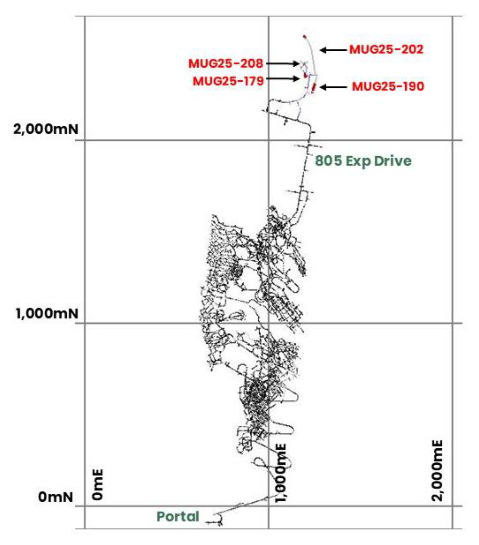
Plan view of drilling in this announcement