
GRAND FALLS-WINDSOR, Newfoundland and Labrador, July 16, 2026 (GLOBE NEWSWIRE) -- First Atlantic Nickel & Cobalt Corp. (TSXV: FAN) (OTCQB: FANCF) (FSE: P210) ("First Atlantic" or the "Company") is pleased to announce that drill hole XL-26-16, the second drill hole completed at the Alloy Max Zone, intersected large-grain, visibly disseminated awaruite over its entire 525-meter drilled length. It is the deepest hole drilled to date at the Company's wholly owned Pipestone XL Nickel-Cobalt (Ni-Fe-Co) Alloy Project in central Newfoundland. XL-26-16 was drilled approximately 445 meters south of the Alloy Max discovery hole, XL-26-15, announced on June 15, 20261 and ended in mineralization. Alloy Max is the Company's second large-scale awaruite zone at Pipestone XL, in addition to the RPM Zone. XL-26-16 returned a higher visual abundance of awaruite and a greater frequency of coarser grains than the Alloy Max discovery hole, XL-26-15, with abundance and grain size increasing downhole.
XL-26-16 intersected visibly disseminated awaruite continuously, starting after only approximately 9 meters of overburden down to the end of the hole at 525 meters, where awaruite remained clearly visible in the final interval of core. The zone remains open at depth, indicating potential for further mineralization below the deepest drilling completed to date at Pipestone XL. Together with XL-26-15, drilling has now confirmed approximately 445 meters of strike length within the approximately 4 km Alloy Max target area outlined by surface sampling, geological mapping, and geophysics2, representing roughly 11% of the target strike length and leaving the large majority of the zone untested along strike and at depth.
First Atlantic welcomes calls directly from shareholders and prospective investors. For questions about the Company, the Pipestone XL Project, or this news release, or simply to learn more, investors are invited to call Rob Guzman, Investor Relations, at +1-844-592-6337 or email [email protected].
KEY HIGHLIGHTS
- 445-Meter Step-Out South Extends the Alloy Max Zone: XL-26-16 was drilled approximately 445 meters south of the Alloy Max discovery hole, XL-26-15, intersected large-grain, visibly disseminated awaruite over the 525-meter drilled length and ended in mineralization. Drilling has now confirmed approximately 445 meters of strike within the approximately 4 km target area, representing roughly 11%, and approximately 285 meters of lateral width within a zone mapped as being up to approximately 1.5 km wide.
- Higher Visual Abundance and Coarser Grains Than the Alloy Max Discovery Hole: Company geologists observed a higher visual abundance of awaruite grains in XL-26-16 compared to the first hole at Alloy Max, discovery hole XL-26-15, together with an increased frequency of larger grain sizes that increased with depth downhole.
- Deepest Drill Hole to Date at Pipestone XL: At 525 meters downhole, and drilled at a dip of -60 degrees to the east, XL-26-16 is the deepest hole drilled on the project. It intersected large-grained, visibly disseminated awaruite over more than half-a-kilometre of drilled length, with awaruite still clearly visible in the final core interval and potential for further mineralization at depth.
- Second Hole Confirms Continuity and Scale of the Alloy Max Zone: Back-to-back mineralized holes at Alloy Max confirm the continuity of widely disseminated awaruite between XL-26-15 and XL-26-16 and support the scale of a second large-scale zone within the Pipestone XL Project, with the potential for equal or greater tonnage at Alloy Max relative to the RPM Zone based on geophysics, geological mapping, and surface sampling.
- Minimal Overburden, Near-Surface Mineralization at Alloy Max: XL-26-16 encountered only approximately 9 meters of overburden before entering mineralized bedrock, consistent with the shallow cover across Alloy Max that has allowed Company geologists to expose and sample bedrock directly at drill pad locations.
- Refined Magnetic Interpretation Signals Expansion Potential: Company geologists observed that awaruite abundance, consistency, and grain size increased where magnetite decreased, indicating that prior geological interpretations focused on the most magnetically intense areas may understate the size potential of both Alloy Max and the RPM Zone. The Company is reinterpreting its regional magnetic surveys on this basis.
DEEPEST HOLE TO DATE: XL-26-16 EXTENDS ALLOY MAX 445 METERS SOUTH OF DISCOVERY HOLE XL-26-15
XL-26-16 was designed to expand the Alloy Max Zone southward and test the continuity of the visible awaruite mineralization observed in discovery hole XL-26-15. It did both, intersecting large-grain, visibly disseminated awaruite over its entire 525-meter drilled length. Drilled at a dip of -60 degrees to the east, the hole ended in mineralization at a downhole depth of 525 meters, where awaruite remained clearly visible in the final interval of core, indicating potential for further mineralization at depth. Hole 16 was collared into a significant fault zone that Company geologists believe may be regional in scale and correlates to a differentiation in alteration and magnetic intensity on either side.
After approximately 9 meters of overburden, XL-26-16 intersected visibly disseminated awaruite from the top of bedrock. Awaruite became more common, abundant and consistent from approximately 80 meters, and from approximately 175 meters to the end of the hole, it became consistently coarser grained, with grains commonly exceeding 100 microns and easily visible to the naked eye. Visual abundance and grain size improved down hole through the deepest core intervals.
Drilling at Alloy Max commenced in spring 20263, following the surface sampling and geophysics that outlined the approximately 4 km by up to 1.5 km target area. Additional drill holes are underway at Alloy Max from additional drill pads, where Company geologists identified visible awaruite in exposed bedrock prior to drilling.
COARSER AWARUITE WITH LESS MAGNETITE: REFINED MAGNETIC INTERPRETATION SIGNALS EXPANSION POTENTIAL
XL-26-16 provided a key geological insight. Geologists logging the core observed a transition from magnetite-rich, green serpentinized ultramafic rock to a dark-grey to tan-colored, altered ultramafic with a lower magnetic signature and noted that the abundance, consistency and grain size of awaruite increased where magnetite decreased. Higher density magnetite stringers and veinlets throughout the green serpentinized core produce very high magnetic intensity associated with smaller awaruite grain sizes, while the coarser awaruite is associated with the lower-magnetic, dark-grey to tan-colored alteration.
This correlation indicates that prior interpretations, which focused drill targeting on the most magnetically intense areas, may understate the size potential of the mineralized zones. The magnetic transition observed in the core may also serve as a regional target for the mineralized system. The Company is reinterpreting its regional magnetic surveys accordingly, with the potential to expand the interpreted footprint of both the Alloy Max and RPM Zones into areas of moderate magnetic intensity.
THE ALLOY MAX ZONE: A SECOND LARGE-SCALE AWARUITE DISCOVERY
The Alloy Max Zone was first announced in spring 2026, following district-wide surface work that integrated field geological mapping, surface rock sampling with DTR analysis and geophysics, outlining a major new area of magnetically recoverable awaruite mineralization up to approximately 7 km north of the RPM Zone. The target area measures approximately 4 km in length and up to approximately 1.5 km in width, with geophysical processing indicating the potential for a mineralized area larger than the RPM Zone.
Surface DTR sampling at Alloy Max has returned magnetically recoverable nickel grades comparable to surface values at the RPM Zone, where drill core has consistently returned significantly higher DTR grades than weathered surface samples. This established relationship between surface and drill-core grades forms the basis for the Company’s expectation of higher grades at depth and was a factor in Alloy Max being selected as a priority drill target for 2026.
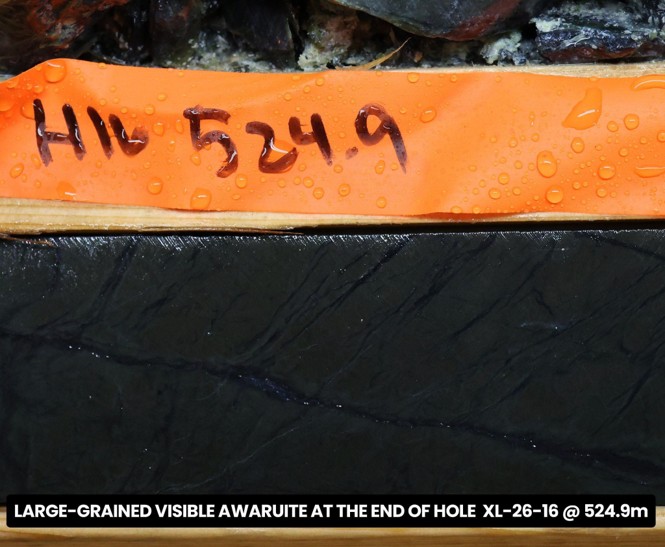
Figure 1: Visible awaruite nickel-cobalt (Ni-Fe-Co) alloy grains disseminated and concentrated along magnetite veins, within serpentinized peridotite (ultramafic) rock at the end of drill hole XL-26-16 - 525 metre total depth, Alloy Max Zone, Pipestone XL Project.
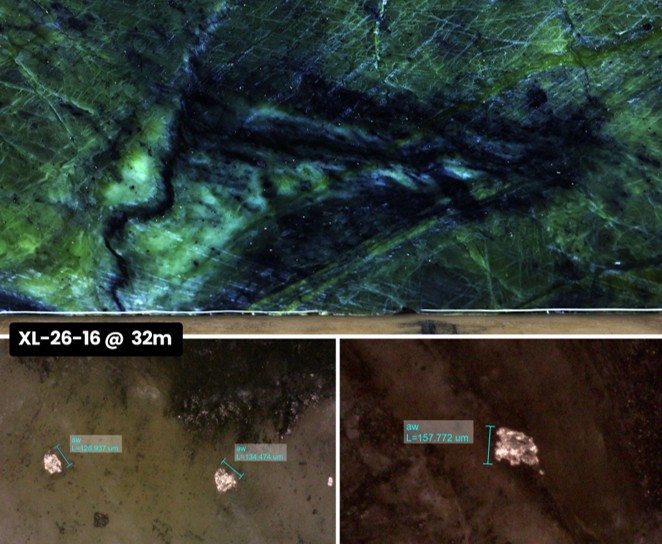
Figure 2: Visible awaruite grains measuring up to 158 microns in drill core from hole XL-26-16 at 32 meters downhole, within the upper interval near the top of bedrock, Alloy Max Zone, Pipestone XL Project.
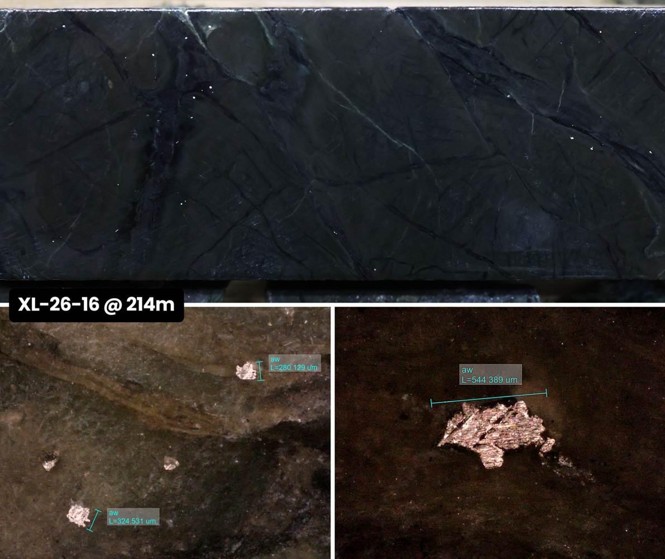
Figure 3: Visible awaruite grains measuring up to 544 microns in drill core from hole XL-26-16 at 214 meters downhole, within the coarser-grained interval that begins at approximately 175 meters, Alloy Max Zone, Pipestone XL Project.
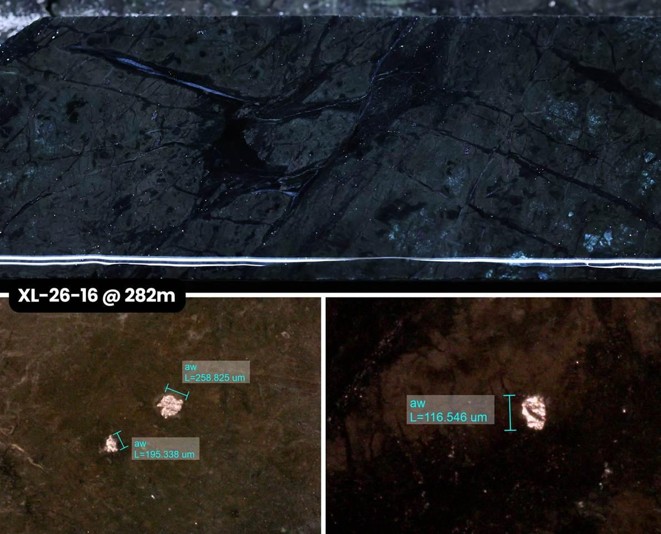
Figure 4: Visible awaruite grains measuring up to 259 microns in drill core from hole XL-26-16 at 282 meters downhole, showing the consistent awaruite visible to the naked eye that continues to the end of the hole, Alloy Max Zone, Pipestone XL Project.
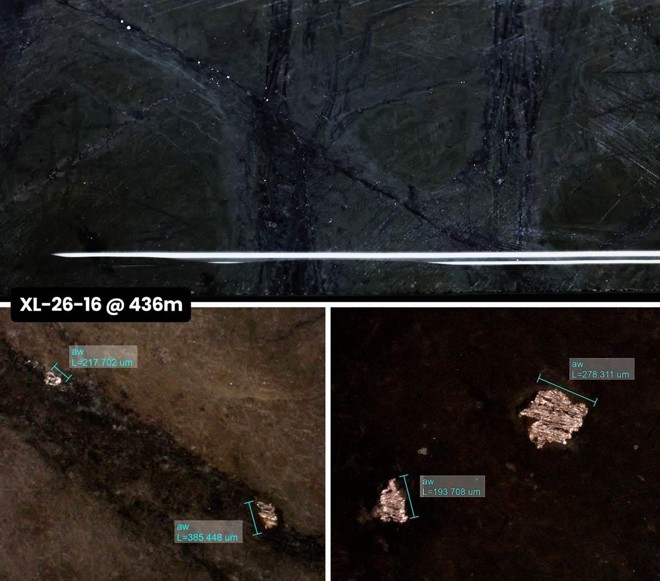
Figure 5: Visible awaruite grains measuring up to 385 microns in drill core from hole XL-26-16 at 436 meters downhole, approaching the deepest interval drilled to date at Pipestone XL. The hole ended in mineralization at 525 meters downhole.
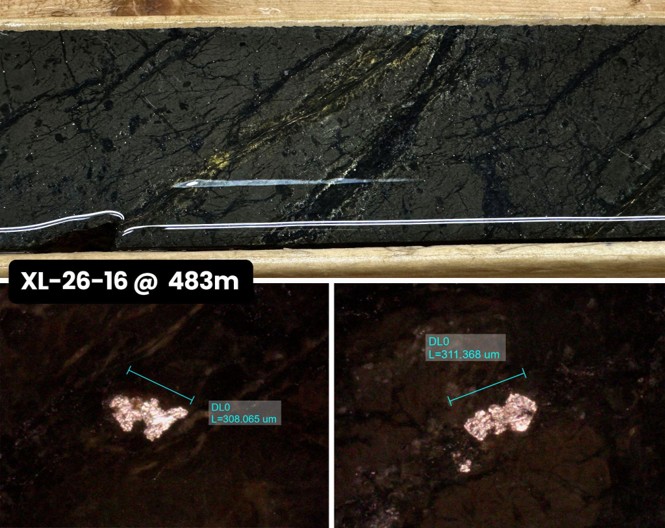
Figure 6: Visible awaruite grains measuring up to 311 microns in drill core from hole XL-26-16 at 483 meters downhole, hosted in dark-grey to tan colored altered ultramafics, the alteration associated with coarser awaruite throughout the hole.
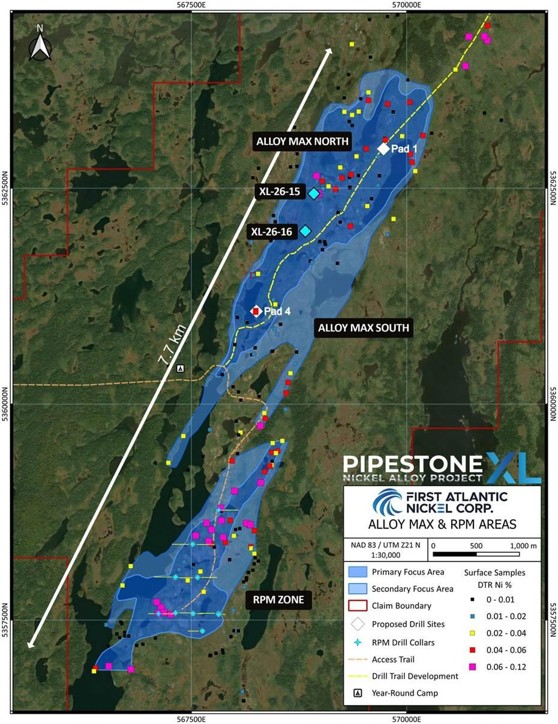
Figure 7: Map of the Alloy Max and RPM Zone areas showing DTR nickel (%) results from surface rock samples, together with the location of the 2026 Alloy Max drill holes, XL-26-15 and XL-26-16, the Alloy Max North and Alloy Max South areas, and the 2025 RPM drill holes.
PIPESTONE XL: A DISTRICT-SCALE NICKEL-COBALT ALLOY PROJECT
Pipestone XL is First Atlantic’s wholly owned, district-scale project spanning the entire 30-kilometre Pipestone Ophiolite Complex in central Newfoundland, a belt of ultramafic rock enriched in nickel, cobalt, and chromium. The Project hosts multiple zones of awaruite (Ni₃Fe) mineralization, including RPM, Alloy Max, Super Gulp, Atlantic Lake, and Chrome Pond. The RPM Zone is the most advanced, with drilling having outlined magnetically recoverable awaruite over more than 1.2 kilometres of strike and more than 800 metres of width. Drilling is ongoing at Alloy Max, a second large-scale zone spanning approximately 4 kilometres of strike and up to 1.5 kilometres in width, making it larger than the RPM Zone.
Awaruite at Pipestone XL is the product of serpentinization, which drives sulphur out of the system and leaves a sulphur-free alloy that carries no acid mine drainage risk and can be concentrated by the Company’s ONSHORE MAX™ process without smelting, roasting, or high-pressure acid leaching. This smelter-free pathway addresses the midstream bottleneck in North America, where the United States has no operating nickel smelters and only two remain in Canada, and supports a vertically integrated supply chain moving directly from mine to downstream battery refining, stainless steel and specialty alloy production. The Company is also evaluating secondary chromium mineralization as a potential co-product, along with low-carbon Engineered Mineral Hydrogen (EMH) in partnership with VEMA Hydrogen4.
Pipestone XL is located in an established infrastructure corridor with year-round road access, nearby high-voltage transmission and clean hydroelectric power from the Bay d’Espoir generating station. It is also located approximately 200 kilometres from Gander International Airport and Vale’s Long Harbour nickel processing plant. This positioning aligns with growing U.S. and allied policy focus on critical mineral supply chains, including nickel’s addition to the U.S. critical minerals list in 2022, the January 2026 White House proclamation on processed critical minerals5, the Company’s acceptance into the U.S. Defense Industrial Base Consortium6, and the June 2026 G7 Leaders’ Declaration naming nickel one of two pilot critical minerals for allied investment and offtake7.
Newfoundland and Labrador is consistently recognized as one of the world’s leading mining jurisdictions in the Fraser Institute’s Annual Survey of Mining Companies, ranking 7th globally on the Policy Perception Index in the most recent survey, published in February 2026, and placing in the global top 10 for overall investment attractiveness in each of the three prior surveys. Pipestone XL is positioned to become a secure and reliable North American source of nickel and cobalt for the stainless steel, electric vehicle, aerospace, and defense industries.
AWARUITE AT PIPESTONE XL: A SMELTER-FREE NICKEL-COBALT ALLOY (Ni₃Fe)
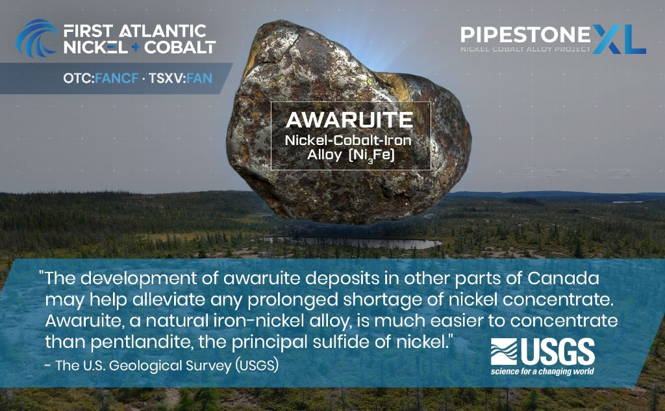
Figure 8: United States Geological Survey (USGS) commentary on awaruite nickel-iron-cobalt alloy, Mineral Commodity Summaries 2012.
Awaruite is a naturally occurring, magnetic, sulphur-free nickel-iron-cobalt alloy (Ni₃Fe) containing approximately 77% nickel. Because it already exists in a metallic state, awaruite can be concentrated without smelting, roasting, or high-pressure acid leaching. Mineralogical and electron microprobe analysis at the Company’s RPM Zone has confirmed the awaruite averages 77.62% nickel and 1.69% cobalt, with grades as high as 86.68% nickel and 6.05% cobalt8.
Initial metallurgical test work using the Company’s ONSHORE MAX™ (Magnetic Alloy eXtraction) process upgraded rock samples from the project’s RPM Zone into a high-grade alloy concentrate averaging 67.4% nickel and grading up to 71.9% nickel and 1.76% cobalt9. Low-intensity magnetic separation first produced a magnetic concentrate grading approximately 1.6% nickel, which flotation then upgraded to the final concentrate. By comparison, a typical nickel concentrate grades 10% to 15% nickel, according to the Nickel Institute. This concentrate can move directly to downstream battery chemical refining or the manufacture of specialty alloys and stainless steel.
As stated in the August 2025 report From Rocks to Power: Strategies to Unlock Canada’s Critical Minerals for Global Leadership in Energy Storage, EVs, & Beyond from the Battery Metals Association of Canada10:
"Awaruite is not a sulfide nor an oxide nickel ore but a high-content native nickel-iron ore. Simple beneficiation processes after mining could provide 60% Ni concentrate, ready for leaching for battery cathode purposes and would yield MHP as a by-product. This process would bypass pyrometallurgy or early hydrometallurgy stages and be among the lowest carbon-intensive nickel production sites in the global nickel market."
The U.S. Geological Survey highlighted awaruite’s potential in its Mineral Commodity Summaries 201211, stating:
"The development of awaruite deposits in other parts of Canada may help alleviate any prolonged shortage of nickel concentrate. Awaruite, a natural iron-nickel alloy, is much easier to concentrate than pentlandite, the principal sulfide of nickel."
The absence of sulphur reduces acid mine drainage risk and related permitting challenges, positioning Pipestone XL to supply North American industries including stainless steel, electric vehicles, aerospace, and defence.
INVESTOR INFORMATION
The Company’s common shares trade on the TSX Venture Exchange under the symbol "FAN", on the OTCQB under the symbol "FANCF", and on several German exchanges, including Frankfurt and Tradegate, under the symbol "P210". Investors can get updates about First Atlantic by signing up to receive news via email and SMS text at www.fanickel.com.
FOR MORE INFORMATION
First Atlantic Investor Relations, Robert Guzman. Tel: +1-844-592-6337 | Email: [email protected]
QUALIFIED PERSON
Adrian Smith, P.Geo., a director and the Chief Executive Officer of the Company, is a qualified person as defined by NI 43-101. The qualified person is a member in good standing of the Professional Engineers and Geoscientists Newfoundland and Labrador (PEGNL) and is a registered professional geoscientist (P.Geo.). Mr. Smith has reviewed and approved the technical information disclosed herein.
ABOUT FIRST ATLANTIC NICKEL & COBALT CORP.
First Atlantic Nickel & Cobalt Corp. (TSXV: FAN | OTCQB: FANCF | FSE: P210) is a critical mineral exploration company in Newfoundland and Labrador developing the Pipestone XL Nickel-Cobalt (Ni-Fe-Co) Alloy Project. The project spans the entire 30-kilometre Pipestone Ophiolite Complex, where multiple zones, including RPM, Alloy Max, Super Gulp, Atlantic Lake and Chrome Pond, contain awaruite (Ni₃Fe), a naturally occurring magnetic nickel-iron-cobalt alloy of approximately 77% nickel with no sulphur and no sulphides, along with secondary chromium mineralization. Awaruite’s sulphur-free composition removes acid mine drainage risk, while its magnetic properties enable processing through magnetic separation and flotation, eliminating the electricity requirements, emissions and environmental impacts of conventional smelting, roasting or high-pressure acid leaching, while reducing dependence on overseas nickel processing infrastructure.
The U.S. Geological Survey recognized awaruite’s strategic importance in its 2012 Annual Report on Nickel, noting that these deposits may help alleviate prolonged nickel concentrate shortages since the natural alloy is much easier to concentrate than typical nickel sulphide. In 2026, initial metallurgical test work using the Company’s ONSHORE MAX™ (Magnetic Alloy eXtraction) process upgraded RPM Zone material into a high-grade alloy concentrate averaging 67.4% nickel and grading up to 71.9% nickel and 1.76% cobalt, demonstrating a smelter-free, mine-to-refinery pathway. First Atlantic is a member of the U.S. Defense Industrial Base Consortium. The Company is also advancing a parallel geologic hydrogen initiative at Pipestone XL, where the same serpentinization process that formed awaruite also generates natural hydrogen, and has signed a letter of intent with VEMA Hydrogen to jointly develop low-carbon Engineered Mineral Hydrogen (EMH) through a proposed 50/50 joint venture. The Pipestone XL project is located near existing infrastructure with year-round road access and proximity to hydroelectric power, providing favorable logistics for exploration and future development and strengthening First Atlantic’s role to establish a secure and reliable source of North American nickel and cobalt production for the stainless steel, electric vehicle, aerospace, and defense industries. This mission gained importance when the U.S. added nickel to its critical minerals list in 2022, recognizing it as a non-fuel mineral essential to economic and national security with a supply chain vulnerable to disruption.
Neither the TSX Venture Exchange nor its Regulation Services Provider (as that term is defined in policies of the TSX Venture Exchange) accepts responsibility for the adequacy or accuracy of this release.
Forward-Looking Statements
This news release contains certain forward-looking information and forward-looking statements within the meaning of applicable securities laws. Forward-looking statements are frequently identified by words such as "expects", "intends", "plans", "anticipates", "believes", "may", "will", "would", "could", "potential", "proposed", "target", "prospective", "indicates", "designed to", "expected to" and similar expressions, as well as statements that events, conditions or results "will", "may", "could", "would" or "should" occur or be achieved.
Forward-looking information in this news release includes, but is not limited to, statements regarding the Company’s exploration plans, anticipated results, expectations and objectives at the Pipestone XL Nickel-Cobalt Alloy Project; the interpretation of visual mineralization and the potential implications of the awaruite abundance and grain size observed in drill core, including comparisons between drill holes; the potential scale, continuity, geometry, width, strike length, depth extent and expansion potential of the Alloy Max Zone and the RPM Zone; the potential for Alloy Max to represent a second large-scale mineralized zone with greater tonnage potential than the RPM Zone; the interpretation and reinterpretation of magnetic surveys, including the potential for mineralization in areas of lower magnetic intensity and the use of magnetic transitions as marker horizons; the potential for the Pipestone XL Project to host multiple deposits or support a future nickel-cobalt mining district; the potential future use and development of onshore processing; the expectation that mineralization may continue or improve at depth; the Company’s plans for additional drilling at Alloy Max, RPM and elsewhere within the Pipestone Ophiolite Complex; the submission of core samples for DTR and assay analysis and the timing of the results; the expectation that drill-core DTR grades may be higher than surface sample grades; the geological interpretation of the Pipestone Ophiolite Complex, including the role of serpentinization, regional structures, fluids, hydrogen generation and awaruite formation; the Company’s plans to evaluate geologic hydrogen potential; and the proposed joint venture with VEMA Hydrogen and the potential development of low-carbon EMH.
Forward-looking information is based on a number of assumptions that management considers reasonable as of the date of this news release, including assumptions regarding the accuracy of visual observations, geological mapping, geophysical interpretations, DTR sampling and other exploration data; the continuity and geometry of mineralization; the relationship between surface sampling and drill-core results; the Company’s ability to complete planned drilling, sampling, assaying, metallurgical, hydrogen and other technical work; the availability of financing, equipment, personnel, contractors, permits and road access; the continued validity of the Company’s geological model; and general business, market, commodity price and regulatory conditions.
Forward-looking information is subject to known and unknown risks, uncertainties and other factors that may cause actual results, performance or achievements to differ materially from those expressed or implied by such forward-looking information. These risks and uncertainties include, but are not limited to, risks associated with early-stage mineral exploration; the risk that visual observations of mineralization may not correlate with assay results, DTR results, recoverability, grade, tonnage or economic viability; the risk that future drilling may not confirm the expected continuity, scale, grade, width or depth extent of mineralization; the risk that surface sampling, geophysical data, magnetic reinterpretations and geological interpretations may not accurately predict subsurface mineralization; uncertainty regarding metallurgical recoverability and processing characteristics; uncertainty regarding the potential generation, recovery, storage, commerciality or development of geologic hydrogen; risks relating to the negotiation and completion of definitive agreements with VEMA Hydrogen; permitting, environmental, access, title, regulatory and community-related risks; the availability of capital and financing on acceptable terms; changes in commodity prices, market conditions and investor sentiment; operational risks; weather and seasonal access limitations; and the other risks described in the Company’s public disclosure documents.
The Company is an exploration-stage issuer and has not established mineral resources or mineral reserves at the Pipestone XL Nickel-Cobalt Alloy Project. There can be no assurance that further exploration or technical work will result in the delineation of mineral resources or mineral reserves, or that the project will be advanced to production. Readers should not place undue reliance on forward-looking information. The forward-looking information contained in this news release is made as of the date of this news release, and the Company undertakes no obligation to update or revise such information except as required by applicable law.
___________________________
1 https://fanickel.com/20260615-first-atlantic-nickel-drills-second-large-scale-awaruite-ni-fe-co-alloy-discovery-at-alloy-max-north-pipestone-xl-project-5-2-km-north-of-rpm-zone-visible-awaruite-over-414-meter-drill-hole-ending-in-open-mineralization
2 https://fanickel.com/20260318-first-atlantic-nickel-announces-new-alloy-max-zone-discovery---a-second-large-scale-awaruite-nife-target-area-extending-7-km-north-from-the-rpm-zone-at-the-pipestone-xl-nickel-cobalt-alloy-project
3 https://fanickel.com/20260408-first-atlantic-nickel-commences-drilling-at-new-alloy-max-zone-discovery-7-km-north-of-rpm-zone-at-the-pipestone-xl-nickel-cobalt-alloy-project
4 https://fanickel.com/20260608-vema-hydrogen-and-first-atlantic-nickel-cobalt-sign-loi-to-develop-engineered-mineral-hydrogen-at-pipestone-xl-awaruite-project-in-newfoundland
5 https://fanickel.com/20260115-first-atlantic-nickel-highlights-relevance-of-pipestone-xl-awaruite-nickel-cobalt-alloy-discovery-to-address-u-s--critical-mineral-supply-chain-vulnerabilities-identified-in-january-14-2026-white-house-proclamation
6 https://fanickel.com/20260331-first-atlantic-nickel-announces-acceptance-into-defense-industrial-base-consortium-dibc---pipestone-xl-smelter-free-nickel-cobalt-alloy-project-addresses-midstream-smelting-bottleneck-in-u-s--defense-supply-chain
7 https://fanickel.com/20260619-first-atlantic-nickel-cobalt-highlights-g7-leaders-declaration-on-critical-minerals-g7-names-nickel-one-of-only-two-pilot-minerals-for-a-new-allied-traceability-framework-moves-to-mobilize-equity-investment-and-offtake-and-establishes-a-critical-
8 https://fanickel.com/20260521-first-atlantic-nickel-cobalt-reports-electron-microprobe-analysis-returning-77-62-nickel-and-1-69-cobalt-in-awaruite-at-the-rpm-zone-pipestone-xl-project-a-rare-naturally-magnetic-ni-fe-co-high-grade-alloy-mineralogically-capable-of-bypassing-mid
9 https://fanickel.com/20260624-first-atlantic-nickel-cobalt-produces-high-grade-alloy-concentrate-up-to-71-9-nickel-and-1-76-cobalt-from-its-pipestone-xl-nickel-cobalt-alloy-project-using-its-first-ever-onshore-max-magnetic-alloy-extraction-recovery-concentration-process-unvei
10 https://transitionaccelerator.ca/wp-content/uploads/2025/08/From-Rocks-to-Power-Nickel.pdf
11 https://d9-wret.s3.us-west-2.amazonaws.com/assets/palladium/production/mineral-pubs/nickel/mcs-2012-nicke.pdf
Photos accompanying this announcement are available at
https://www.globenewswire.com/NewsRoom/AttachmentNg/9115d4a1-b666-4c27-955c-65d37427093e
https://www.globenewswire.com/NewsRoom/AttachmentNg/98a549d4-3ac8-45bb-befb-e0dc7fce15fe
https://www.globenewswire.com/NewsRoom/AttachmentNg/1a1bce44-4796-4ba7-a224-fc1ade95c310
https://www.globenewswire.com/NewsRoom/AttachmentNg/2f063049-1d32-4bda-87d3-70aa8508747f
https://www.globenewswire.com/NewsRoom/AttachmentNg/3b3bf158-79c2-4c94-a1e4-fe25223537a7
https://www.globenewswire.com/NewsRoom/AttachmentNg/11b7668f-244b-448d-a14b-cf1328af34ef
https://www.globenewswire.com/NewsRoom/AttachmentNg/bafd1cc1-e859-4d92-be22-1f27ba7772ec
https://www.globenewswire.com/NewsRoom/AttachmentNg/d581363d-565a-4eb0-a781-3ffa18be961a
