
Copper Fox Announces Porphyry Copper Discovery and Strong Vectors Toward Core at Mineral Mountain
Calgary, Alberta--(Newsfile Corp. - June 11, 2026) - Copper Fox Metals Inc. (TSXV: CUU) (OTCQX: CPFXF) (FSE: HPU) ("Copper Fox" or the "Company") and its wholly owned subsidiary, Desert Fox Mineral Mountain Co. ("Desert Fox"), are pleased to report preliminary results from diamond drillhole (DDH) MM-02-2025 at its 100% owned Mineral Mountain porphyry copper project in Arizona. DDH MM-02-2025 has confirmed the presence of a large, evolved porphyry copper-molybdenum system and intersected the outer portion of a mineralized copper shell, with multiple geological indicators suggesting increasing mineralization at depth and proximity to the core of the system. DDH MM-01-2025 intersected the "shoulder" of the system approximately 1.3 kilometers (km) southwest of DDH MM-02-2025.
Elmer B. Stewart, President and CEO of Copper Fox, stated, "DDH MM-02-2025 intersected a classic porphyry alteration and mineralization sequence and indicates vectoring toward a potential higher-grade potassic core below that marks an important advance in our understanding of the Mineral Mountain porphyry copper system. The distribution and increase in copper-molybdenum mineralization, quartz veining, high-temperature alteration minerals, magnetite sulphidization and appearance of bornite rimming chalcopyrite at depth indicate that drilling has not yet reached the core of this large porphyry system. Intersecting the outer, lower grade part of the copper shell, together with increased molybdenum values provides clear targets for follow-up drilling and supports our view that higher-grade mineralization may lie below the current drill depth."
Highlights
- Porphyry copper system confirmed, with multi-phase alteration and mineralization.
- DDH MM-02-2025 intersected the outer copper shell, with grades increasing downhole.
- Strong vectoring indicators toward a higher-grade core at depth.
- Significant quartz-sulphide veining and sulphide content increase with depth.
- Copper-molybdenum mineralization hosted in quartz veins, fractures, and disseminations in vein alteration envelopes.
- DDH MM-02-2025 terminated early at 1,697.35 meters (m) due to drilling conditions, leaving system open at depth.
- Located six mineral claims to cover extension of recently identified porphyry copper target.
The Mineral Mountain project is located in a prolific Laramide-age porphyry copper belt in Arizona, approximately 25km southwest of Rio Tinto and BHP's giant Resolution porphyry copper-molybdenum deposit and approximately 20km northeast of the recently commissioned Florence ISCR copper mine reinforces the porphyry potential of the property (Figure-1).
A schematic representation of the lithologies, alteration, approximate sulphide content, and main sulphide vein types are shown in Figure-2.
DDH MM-02-2025 can be re-entered to deepen the drillhole to test the core of the porphyry system below 1,700m and used for step-out drilling to define the lateral extent of the copper shell. The location and drill collar co-ordinates for drillholes MM-01-2025 and MM-02-2025 are shown in Figure-3 and Table-1.
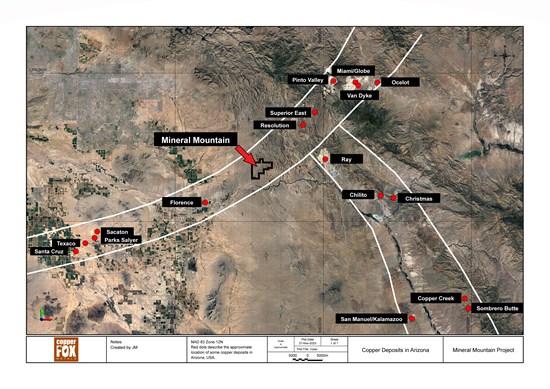
Figure-1: Regional setting of the Mineral Mountain porphyry copper project on NE trending porphyry copper belt in Arizona.
To view an enhanced version of this graphic, please visit:
https://images.newsfilecorp.com/files/2177/300952_6f5df9e084200915_001full.jpg
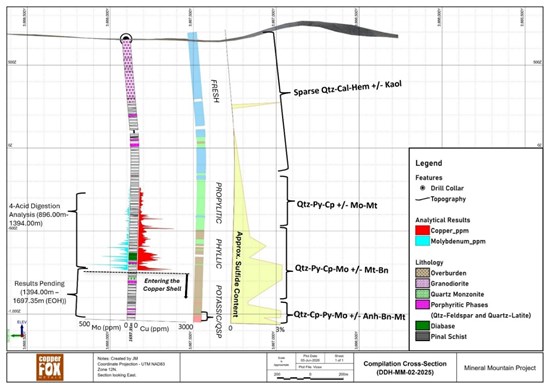
Figure-2: Schematic representation of lithologies, alteration, sulphide content and major vein types encountered in DDH MM-02-2025. Notes: Cu=copper, Mo=molybdenum, ppm=parts per million, m=meters. True thickness/widths of mineralization are unknown. The measurements of the alteration and sulphide boundaries are approximated.
To view an enhanced version of this graphic, please visit:
https://images.newsfilecorp.com/files/2177/300952_6f5df9e084200915_002full.jpg
Lithologies
DDH MM-02-2025 intersected a fine-grained granodiorite from surface to a depth of 380.09m and PreCambrian Pinal Schist from 380.09m to the end of the hole at 1,697.35m. These lithologies are intruded by a series of synchronous and post mineralization rhyolite porphyry, quartz monzonite porphyry, and quartz latite porphyry dikes of variable thickness.
Alteration
DDH MM-02-2025 intersected early potassic (hydrothermal biotite, anhydrite, magnetite veins, and K-spar envelopes) overprinted by propylitic (epidote-chlorite-actinolite) followed by strong phyllic ((quartz-sericite-pyrite or "QSP") and locally late intermediate argillic (fresh K-spar & plagioclase altered to sericite) like that observed in porphyry copper systems. Beginning at approximately 600m below surface, the drillhole intersected propylitic altered Pinal Schist to a depth of approximately 1,140m. The QSP alteration (1140-1697.35m) shows increasing pyrite content (up to 3%) coarse-grained sericite, quartz veining (up to 41%) and obliterates the original fabric of the Pinal Schist associated with increasing molybdenite and trace bornite concentrations toward the end of the hole. The localized late-stage intermediate argillic alteration is associated with a weakly mineralized "quartz eye" quartz monzonite porphyry. The drillhole is interpreted to have penetrated the outer portion of the "copper shell" and indicates vectoring toward an expected higher-grade potassic core typically seen in porphyry systems.
Analytical Results
Sampling of DDH MM-02-2025 began at a core depth of 896m within propylitic altered Pinal Schist. characterized by crackle texture, chlorite-epidote alteration envelopes, scattered thin veinlets of vuggy K-spar-quartz-chlorite-epidote-pyrite-chalcopyrite-scheelite and thin red-fluorescent calcite veinlets. Analytical results for the sampling between 896m and 1,394m have been received and returned the following metal concentrations: copper: from 12.9 to 2,032 ppm (0.203%), molybdenum: from 1.0 to 515 ppm (0.051%) and silver: from 0.1 to 4.5 ppm (Figure-2). The analytical results show an increasing trend in copper-molybdenum values at depth associated with strong phyllic alteration and quartz-chalcopyrite ± molybdenite veining.
The core interval 1,365 to 1,394m exhibits intense quartz-sericite-pyrite alteration and elevated copper, (58.9 to 2,032 ppm (0.203%), molybdenum 22.0 to 515.0 ppm (0.051%) and 0.1 to 0.9 ppm silver values. Upon receipt of all analytical results, selected samples containing elevated copper content will be analyzed for gold concentration.
Mineral Zonation
DDH MM-02-2025 exhibits progressively higher temperature sulphide mineralization and associated alteration at increasing depth in the hole. The outer portion of the porphyry system is characterized by propylitic alteration containing variable concentrations of pyrite in the core interval 600-1,140m below surface. The "pyrite shell" is interpreted to have been intersected at an estimated depth of 1,140m associated with the transition to QSP alteration.
The increase in copper content in DDH MM-02-2025 exhibits a crude correlation to transition from propylitic to QSP alteration (Figure-2). Typically, the outer copper enriched pyritic portion of a porphyry system contains low copper content in the order of 0.10%-0.20%. The central potassic core of a porphyry system at depth is typically enriched in bornite and chalcopyrite.
The increase in molybdenum concentrations in DDH MM-02-2025 show a moderate correlation to the QSP/outer potassic zone. Porphyry copper systems typically exhibit a broad, annular molybdenum "halo" that extends outward and upward from the higher copper concentrations typically observed in the inner potassic zone.
Vein Assemblages
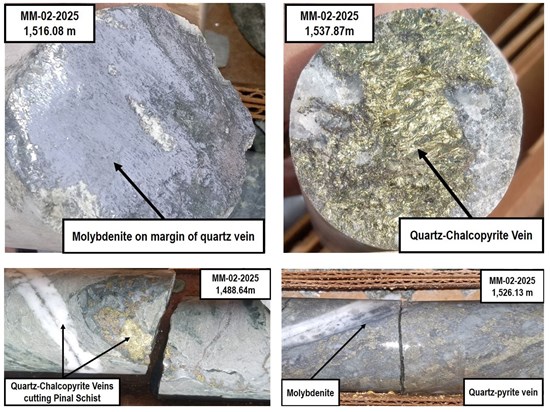
The sulphide veins intersected in DDH MM-02-2025 displays with depth, the transition from the outer lower temperature propylitic (qtz-cal-hem veining) to the inner higher temperature potassic alteration overprinted by intense QSP alteration. The outer portion of the system exhibit abundant classic D veins (quartz- pyrite +/- chalcopyrite with distinct QSP envelopes). Chalcopyrite is the main copper sulphide with molybdenite and trace amounts of bornite appearing in the lower portions of the drillhole. The copper-molybdenum mineralization occurs primarily in quartz veins with subordinate amounts occurring on fractures and as disseminations in quartz vein alteration envelopes. The cross-cutting relationships of the veins indicate several episodes of mineralization and alteration. Photographs of Cu-Mo mineralization in DDH MM-02-2025 are shown below.
To view an enhanced version of this graphic, please visit:
https://images.newsfilecorp.com/files/2177/300952_copperfox.jpg
Notes: qtz=quartz, cpy=chalcopyrite, bn=bornite, mo=molybdenite, kspar=hydrothermal potassium feldspar, hem=hematite (after magnetite), mag=magnetite, py=pyrite, epi=epidote, cal=calcite, chl=chlorite).
DDH Locations
Figure-3 shows the locations of DDH MM-02-2025, DDH MM-01-2025 and the recently located mineral claims.
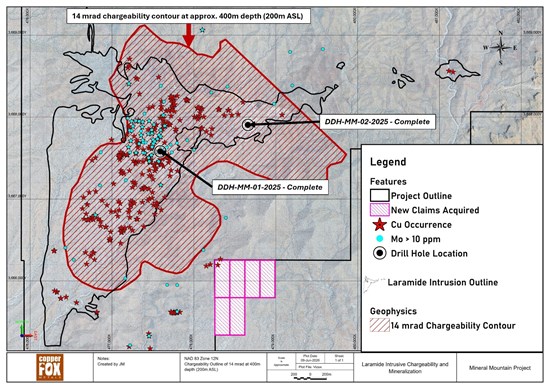
Figure-3: Mineral Mountain project drillhole location map superimposed on copper-molybdenum mineralization and 400m depth slice (below surface) of the 14mrad chargeability anomaly.
To view an enhanced version of this graphic, please visit:
https://images.newsfilecorp.com/files/2177/300952_6f5df9e084200915_007full.jpg
DDH Information
Table-1: Drillhole information, Mineral Mountain 2025 drilling program.
| DDH ID | Easting | Northing | Elev (masl) | Dip (deg) | Azi (deg) | Depth (m) |
| MM-01-2025 | 477590 | 3667582 | 619 | -75 | 290 | 860.7 |
| MM-02-2025 | 478660 | 3667905 | 663 | -85 | 180 | 1,697.35 |
Drilling and Sampling Procedures
The upper 517m portion of DDH-02-2025 was completed using HQ rods before reducing to NQ diameter rods. Overall core recovery was estimated to be greater than 95%. After cutting with a diamond saw, one half of the core was collected for sample preparation and analysis, and the other half was retained onsite for future reference. Sample intervals selected do not cross lithological boundaries and ranged from 1.00 to 3.00m in length depending on the presence of Cu and/or Mo mineralization.
Quality Control (QA/QC)
Copper Fox follows a rigorous Quality Assurance/Quality Control program. A total of 352 core samples were submitted as part of the drill core analysis including 11 split-core duplicates, 30 commercial certified reference material (CRM) standards, and 34 blanks. The matrix material of the CRM's matches the Mineral Mountain geology. All standards are certified for 4-acid digestion.
Skyline Assayers and Laboratories Inc. (Accreditation 2953.01 and Standard ISO/IEC 17025:2017) located in Tucson, Arizona completed the sample preparation and analysis for the Mineral Mountain samples. Samples were prepared using preparation code SP-1 - Crush to plus 75% -10 mesh, split and pulverize with standard steel to plus 95% -150 mesh. Analytical code TE-7 - was used for Trace Elements by Multi Acid (with HF), Ag, As, Hg, Sb, Se, Te concentrations were determined by Aqua Regia, ICP-OES/ICP-MS (49 elements).
Qualified Person
Elmer B. Stewart, MSc. P.Geo., President, and CEO of Copper Fox, is the Company's non-independent, nominated Qualified Person pursuant to National Instrument 43-101, Standards for Disclosure for Mineral Projects, and has reviewed and approves the scientific and technical information disclosed in this news release.
About Copper Fox
Copper Fox is a Canadian resource company focused on copper development and exploration in the United States and Canada. Copper Fox and its subsidiaries own 100% of the Van Dyke ISCR project, a development stage, potential near term, mid-size copper mine in Arizona and a 25% interest in the Schaft Creek Joint Venture with Teck Resources Limited (75% interest and Operator) which hosts the Schaft Creek copper-gold-molybdenum-silver project in British Columbia's Golden Triangle. In addition, Copper Fox owns 100% of the resource stage Eaglehead polymetallic porphyry copper project in northwestern British Columbia and the Sombrero Butte and Mineral Mountain advanced exploration stage porphyry copper projects located in the prolific Laramide age copper province in Arizona. For more information on Copper Fox's mineral properties and investments visit the Company's website at www.copperfoxmetals.com.
On behalf of the Board of Directors
Elmer B. Stewart
President and Chief Executive Officer
For additional information contact: Lynn Ball at 1-844-464-2820 or [email protected].
Neither the TSX Venture Exchange nor its Regulation Services Provider (as that term is defined in the policies of the TSX Venture Exchange) accepts responsibility for the adequacy or accuracy of this release.
Cautionary Note Regarding Forward-Looking Information
This news release contains forward-looking statements within the meaning of the Section 27A of the Securities Act of 1933 and Section 21E of the Securities Exchange Act of 1934, and forward-looking information within the meaning of the Canadian securities laws (collectively, "forward-looking information"). Forward-looking information is generally identifiable by use of the words "believes," "may," "plans," "will," "anticipates," "intends," "budgets," "could", "estimates", "expects", "forecasts", "projects" and similar expressions, and the negative of such expressions. Forward-looking information in this news release includes statements regarding; MM-02-2025 intersecting a classic porphyry alteration and mineralization sequence indicating vectoring toward a potential higher-grade potassic core; follow-up drilling; and, higher-grade mineralization lying below the current drill depth.
In connection with the forward-looking information contained in this news release, Copper Fox and its standards have made numerous assumptions regarding, among other things: the geological advice that Copper Fox has received is reliable and is based upon practices and methodologies which are consistent with industry standards; and the reliability of historical reports. While Copper Fox considers these assumptions to be reasonable, these assumptions are inherently subject to significant uncertainties and contingencies.
Additionally, there are known and unknown risk factors which could cause Copper Fox's actual results, performance, or achievements to be materially different from any future results, performance or achievements expressed or implied by the forward-looking information contained herein. Known risk factors include among others: the results of DDH MM-02-2025 may not represent a porphyry copper system; the porphyry style mineralization and alteration may not be indicative of or represent a porphyry copper system; further drilling may not locate additional porphyry style mineralization, the financial markets and the overall economy may deteriorate; the need to obtain additional financing and uncertainty as to effects of threatened tariffs, timely availability of permits and other governmental approvals.
A more complete discussion of the risks and uncertainties facing Copper Fox is disclosed in Copper Fox's continuous disclosure filings with Canadian securities regulatory authorities at www.sedarplus.ca. All forward-looking information herein is qualified in its entirety by this cautionary statement, and Copper Fox disclaims any obligation to revise or update any such forward-looking information or to publicly announce the result of any revisions to any of the forward-looking information contained herein to reflect future results, events, or developments, except as required by law.
To view the source version of this press release, please visit https://www.newsfilecorp.com/release/300952
Source: Copper Fox Metals Inc.