
Caprock Announces Consistent High-Grade Intercepts from the Final Three Deep Drill Holes at Destiny, Including 8.32 g/t Au over 2.6m
Toronto, Ontario--(Newsfile Corp. - May 12, 2026) - Caprock Mining Corp. (CSE: CAPR) ("Caprock", or the "Company") is pleased to announce high-grade assay results for the final three drill holes from the recently concluded deep drilling campaign at its flagship Destiny gold property ("Destiny", or the "Property", or the "Project"), located near Val d'Or, Quebec.
Key Assay Highlights from the Final 3 Deep Drill Holes:
DES-26-184W1: Intersected 8.32 g/t Au over 2.6m and 6.43 g/t Au over 1.8m.
DES-26-184: Intersected 4.58 g/t Au over 2.5m and 2.68 g/t Au over 3.9m.
DES-26-183W1: Intersected 10.90 g/t Au over 0.8m.
Assay Highlights from Previously Released Drill Hole DES-26-183:
38.48 g/t Au over 1.6m, included within 2.84 g/t Au over 23.2m;
6.24 g/t Au over 1.0m and 2.78 g/t Au over 2.7m, included within 1.65 g/t Au over 5.3m; and
4.39 g/t Au over 0.5m.
Historical Assay Highlights from Deep Drilling at Destiny:
DES-01-60: Intersected 26.6 g/t Au over 1.1m, 16.75 g/t Au over 0.7m, 7.5 g/t Au over 1.1m, and 6.34 g/t Au over 0.7m.
DES-01-59: Intersected 17.55 g/t Au over 0.5m, 5.11 g/t Au over 0.6m, and 2.54 g/t Au over 1.1m.
Caprock's President & CEO, Mr. Vishal Gupta, stated, "Every one of the eight holes drilled in our fall and winter campaigns has intersected high-grade mineralization at 500m to 600m depth below surface. This not only validates our structural model for Destiny, but also corroborates our predictions for how the high-grade mineralization projects itself at depth. These eight drill holes have provided us with valuable data points in a previously untested vast area located approximately 200m to 300m below the near-surface, open pit-constrained Mineral Resource Estimate ("Mineral Resource" or "MRE") at Destiny. We believe these results significantly increase the potential for underground resources. While our technical team conducts an in-depth analysis of these deep drilling results, we plan to focus our efforts on the expansion of the Mineral Resource westward by conducting a limited 10-hole drill program that was designed by our resource consultants at BBA E&C Inc. We plan to commence this resource expansion drill program immediately after receiving our drill permits, which are expected in the next few weeks."
Description of Deep Drilling Program & Summary of Latest Assay Results
Caprock's deep drilling program at Destiny consisted of eight NQ-sized diamond drill holes totaling 5,224 metres spread across two separate campaigns - the first was conducted in December 2025, and the second was conducted in February / March 2026. The program was designed as four pairs of two drill holes each, whereby every pair included one pilot hole and one wedged hole. Assay results for drill holes DES-25-181, DES-25-181W1, DES-25-182, DES-25-182W2 and DES-26-183 were announced by the Company in previous press releases. Today's announcement discusses the assay results for drill holes DES-26-184W1, DES-26-184 and DES-26-183W1. All drill holes intersected high-grade mineralization at 500m to 600m depth below surface.
The projection of the mineralized pierce points for all eight holes stated above, relative to pierce points for historical deep drill holes DES-01-59 and DES-01-60, along with historical shallow pierce points at Destiny, is provided in Figure 1 below.
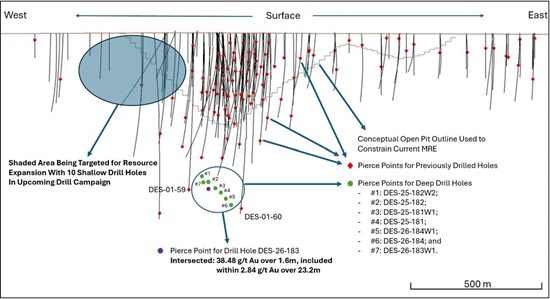
Figure 1: North-looking longitudinal section illustrating the location of the mineralized pierce points for all eight recently drilled deep holes, relative to previously drilled holes at Destiny.
To view an enhanced version of this graphic, please visit:
https://images.newsfilecorp.com/files/8515/296990_caprock.jpg
Assay results and drill collar information for drill holes DES-26-184W1, DES-26-184 and DES-183W1 are summarized in the tables below.
Table 1: Summarized assay results for DES-26-184W1, DES-26-184 and DES-26-183W1. Reported widths represent downhole core lengths. True widths are estimated to be approximately 80-85% of core lengths.
| DDH No. | From (m) | To (m) | Core Length (m) | Grade (g/t Au) |
| DES-26-184W1 | 544.15 | 548.00 | 3.85 | 0.80 |
| 560.00 | 560.50 | 0.50 | 1.04 | |
| 568.50 | 582.50 | 14.00 | 0.57 | |
| including | 573.00 | 574.00 | 1.00 | 2.23 |
| 667.00 | 668.75 | 1.75 | 6.43 | |
| 673.50 | 674.00 | 0.60 | 1.94 | |
| 717.00 | 717.80 | 0.80 | 3.91 | |
| 737.00 | 739.50 | 2.50 | 1.45 | |
| 748.00 | 753.00 | 5.00 | 1.63 | |
| 758.50 | 760.70 | 2.20 | 1.69 | |
| 774.10 | 776.65 | 2.55 | 8.32 | |
| including | 774.60 | 776.10 | 1.50 | 12.00 |
| DES-26-184 | 551.80 | 553.00 | 1.20 | 0.51 |
| 589.20 | 591.65 | 2.45 | 4.58 | |
| including | 590.05 | 590.85 | 0.80 | 9.84 |
| 597.50 | 602.65 | 5.15 | 1.18 | |
| 606.60 | 609.50 | 2.90 | 0.63 | |
| 626.95 | 627.75 | 0.80 | 0.63 | |
| 674.50 | 678.35 | 3.85 | 2.68 | |
| 778.25 | 779.85 | 1.60 | 0.80 | |
| DES-26-183W1 | 543.75 | 547.50 | 3.75 | 0.56 |
| 630.35 | 631.10 | 0.75 | 10.90 | |
| 651.80 | 652.30 | 0.50 | 0.96 | |
| 706.05 | 706.55 | 0.50 | 2.10 | |
| 740.85 | 741.35 | 0.50 | 1.82 |
Table 2: Drill collar information for DES-26-184W1, DES-26-184 and DES-26-183W1. Collar locations in NAD 83 coordinates.
| DDH No. | Northing | Easting | Azimuth | Dip | Elevation (m) |
| DES-26-184W1 | 5401985 | 317466.4 | 175.10 | -64.78 | -287.37 |
| DES-26-184 | 5402104 | 317445 | 161.00 | -70.00 | At Surface |
| DES-26-183W1 | 5401977.4 | 317375.5 | 163.80 | -58.10 | -233.26 |
Discussion of Latest Assay Results
All three drill holes announced today intersected a network of intrusive dykes interlayered with deformation zones, continuing along the down-dip extension of the mineralized domains included within the near-surface Mineral Resource at Destiny.
High-grade gold mineralization is mainly located at the contact with the intermediate and felsic dykes, and is typically hosted in sub-parallel quartz veins (0.1m to 0.5m wide) with a higher percentage of disseminated sulfides (pyrite, pyrrhotite and sphalerite).
Hole DES-26-184W1 was wedged from DES-26-184 at a downhole depth of 312.0m, and was designed to target a specific pierce point located approximately 50m above the mineralized pierce point for historical drill hole DES-01-60. Gold distribution in hole DES-26-184W1 is very closely related to contacts with an intermediate dyke swarm, along with increased sulphide content (pyrite, pyrrhotite and sphalerite), silicification, biotite alteration and carbonate alteration at downhole depths between 667.0m and 777.0m. High-grade intercepts include:
- 12.0 g/t Au over 1.5m included within 8.32 g/t Au over 2.6m; and
- 6.43 g/t Au over 1.8m.
Hole DES-26-184 was collared at the same location as DES-26-183 but with a slightly different azimuth and dip in order to target a specific pierce point located approximately 40m to the west of, and 50m above, the mineralized pierce point for historical drill hole DES-01-60. Gold distribution in hole DES-26-184 is closely associated with numerous cross-cutting intermediate dykes, along with biotite and carbonate alteration zones at downhole depths between 551.8m and 779.9m. High-grade intercepts include:
- 4.58 g/t Au over 2.5m;
- 2.68 g/t Au over 3.9m.
Hole DES-26-183W1 was wedged from DES-26-183 at a downhole depth of 276.0m. Mineralization in this hole is hosted within a fine-grained grey concordant volcanic unit that is silicified and possibly albitized, and is criss-crossed by white quartz veinlets. High-grade results were intersected at downhole depths between 630.4m and 741.4m:
- 10.9 g/t Au over 0.75m;
- 2.1 g/t Au over 0.50m; and
- 1.82 g/t Au over 0.50m.
Key Geological Observations
The completion of the program and detailed core logging have led to several critical geological observations that refine the Destiny deposit model:
- Extensive Gold Halos: High-grade intersections are nested within significant envelopes of lower-grade mineralization (halos). These halos indicate a large-scale hydrothermal system where gold fluids permeated well beyond the main structural conduits.
- Intrusive Control: Gold mineralization is spatially associated with a complex swarm of intermediate intrusive dykes. The contact zones between these competent dykes and the sheared volcanic host rocks acted as primary traps for gold deposition.
- Structural Conduit: The Despinassy fold and shear system is confirmed as the primary control, with mineralization remaining open at depth and along strike, following quartz gabbro contacts.
The results announced today confirm that Destiny remains open at depth, well below the floor of the conceptual open pit used to constrain the Mineral Resource. Our continued intersection of high-grade mineralization at depths exceeding 500 metres significantly strengthens the potential for underground resources to complement the near-surface MRE.
Description of Upcoming Resource Expansion Drill Program
Caprock plans to commence a shallow drill program designed to expand the current open pit-constrained Mineral Resource in the coming weeks, pending receipt of requisite permits. The planned drill program has been designed to include 10 NQ-sized diamond drill holes totaling approximately 3,200m of drilling. The 10 holes will be drilled from four drill pads, and will test the extension of the mineralized domains at Destiny to the west of the current limits of the open-pit constrained Mineral Resource.
Mineral Resource Estimate at Destiny
Destiny hosts an open pit-constrained MRE completed in March 2025 with the following gold inventory:
| Classification | Constraints | Cut-Off Grade (Au g/t) | Tonnage | Grade (Au g/t) | Contained Gold Oz |
| Indicated | OP | 0.30 | 6,752,000 | 0.91 | 196,549 |
| Inferred | OP | 0.30 | 28,560,000 | 0.87 | 794,886 |
- CIM definition standards were followed for the resource estimate.
- The 2025 resource model used ordinary kriging (OK) grade estimation within a three-dimensional block model with mineralized domains defined by wireframed solids.
- Mineral resources are constrained within pit shells (OP).
- An exchange rate of 1.35 is utilized in calculations ($CAD/$USD).
- Open pit cut-off of 0.30 g/t Au milled is based on the cost/tonne ($CAD/t) milled for incremental mining, processing, and G&A based on the following:
- Long term metal prices of US$2,100/oz of gold;
- Metallurgical recoveries are based on metallurgical testing recovery of 94%;
- Average Bulk density (specific gravity) was determined for each lithology and/or mineralized domain within the deposit;
- Total ore-based cost of CAD$22.50/t;
- Processing costs of CAD$18.00/t and G&A costs of CAD$4.50/t milled;
- Dilution of 10%; and
- Pit Slope angle of 45 degrees.
- Mineral Resources that are not mineral reserves do not have economic viability.
- Numbers may not add due to rounding.