
Golden Cross Identifies Gold-Bearing Vein System at Aurora East, Intersects Gold in All Seven Aurora Holes Drilling returns up to 15.95 g/t Au at Aurora East and refines structural targets across the Reedy Creek Goldfield
Vancouver, British Columbia--(Newsfile Corp. - October 27, 2026) - Golden Cross Resources (TSXV: AUX) (OTCQB: ZCRMF) (FSE: ZMLO) ("Golden Cross" or the "Company") has intersected gold in all seven holes drilled at its Aurora prospect within the Reedy Creek Goldfield in Victoria, Australia, including a high-grade interval of 0.32 m @ 15.95 g/t Au at Aurora East, where drilling has identified a distinct gold-bearing vein system with potential to open up new exploration targets.
Located approximately 200 m northeast of the primary shear, Aurora East hosts gold-bearing quartzvein arrays within corridors bounded by faults trending approximately 340°. The vein system has a different orientation from the principal shear and tension-vein structures identified elsewhere at Reedy Creek, highlighting a new style of gold mineralization for the Company to investigate.
At Aurora, drilling has identified priority intersections between the primary shear and younger faults for follow-up testing. The Company is also applying these geological insights through its six-hole, 1,250 m drilling program at Welcome Reef and Prince of Wales, while a soil survey at Aurora East investigates the potential for additional occurrences of the newly identified vein structures.
Highlights
New gold-bearing vein system identified at Aurora East: Drilling has intersected a distinct style of gold mineralization approximately 200 m northeast of the primary shear, hosted in parallel reefs within corridors bounded by 340° faults.
High-grade gold at Aurora East: Hole AUD010 returned 0.32 m @ 15.95 g/t Au from 133.12 m, with visible gold, and a separate interval of 0.44 m @ 5.08 g/t Au from 7.4 m, highlighting local high-grade mineralization within the newly identified vein system.
Gold in all seven Aurora drill holes: Every hole in the program intersected gold mineralization, demonstrating the effectiveness of the Company's approach of targeted drilling beneath historic workings and the application of lidar scanning.
Gold mineralization confirmed at depth: AUD005 returned 8.25 m @ 1.32 g/t Au from 368.25 m downhole, including 1.5 m @ 4.4 g/t Au from 368.25 m, confirming mineralization at depth within the primary shear.
New structural targets defined: AUD007 intersected multiple gold-bearing intervals across 27 m of drill core, interpreted as a dilational zone at the intersection of the primary shear and a 340° stepover fault.
Exploration footprint spans more than 5 km: Gold mineralization has now been intersected over a strike extent of more than 5 km of the approximately 7 km Reedy Creek Goldfield, supporting continued testing of the broader system.
Follow-up exploration advancing: An approximately 1,100-sample soil survey is underway at Aurora East to identify potential repetitions of the vein structures, while six holes totalling 1,250 m are underway across Welcome Reef and Prince of Wales.
"We're particularly encouraged by the results at Aurora East, where drilling has identified a distinct gold-bearing vein system in a new structural setting. This gives us an additional style of mineralization to explore and the opportunity to investigate whether similar structures occur elsewhere across the project."
"Combined with gold intersected in all seven Aurora holes and the structural targets emerging from our drilling, these results are helping us build a more comprehensive picture of the broader gold system. Our focus now is to advance the Aurora East soil survey, refine follow-up drill targets and apply what we've learned to exploration at Welcome Reef and Prince of Wales," said Matthew Roma,
CEO.
Aurora East: New Gold-Bearing Vein System Opens Additional Exploration Targets
Drilling at Aurora East has identified a distinct gold-bearing vein system approximately 200 m northeast of the primary shear, highlighting a new structural setting for gold mineralization within the Reedy Creek Goldfield.
The first three holes at Aurora East (AUD009-AUD011) intersected quartz-vein arrays within corridors bounded by paired faults trending approximately 340°. All three holes intersected multiple parallel quartz veins, including the two sub-parallel veins mined in the historic workings. The vein orientation differs from the principal shear and tension-vein sets identified elsewhere at Reedy Creek. The multiple parallel reefs seen at Aurora East may represent part of a tension vein array, highlighting the potential for additional gold-bearing structures beyond those seen in the current round of drilling.
Results included 1.0 m @ 3.17 g/t Au from 17 m in AUD009; 0.44 m @ 5.08 g/t Au from 7.4 m, 0.32 m @ 15.95 g/t Au from 133.12 m in AUD010; and 3.3 m @ 1.39 g/t Au from 114.05 m in AUD011.
Golden Cross is undertaking an approximately 1,100-sample soil survey across the Aurora East structural corridor shown in figure 2. The geochemical survey aims to identify arsenic anomalies indicating additional, potentially mineralized, tension vein repetitions within the corridor. The results will help prioritize targets for follow-up drilling, with the extent and continuity of the mineralization yet to be established.
Geological Interpretation
Drilling at Aurora intersected gold-bearing veins associated with a primary shear running parallel to the Reedy Creek anticline (Figure 1). The 2026 program tested the shear at depth and followed up targets identified by a pilot induced-polarization (IP) survey. Holes were designed to test beneath historic underground workings that the Company has mapped using lidar scanning. Lidar scanning of the historic mine workings, completed earlier this year, provides invaluable insight into the geometry and structure of the gold mineralization. The 3D scans produced were utilized most recently in the design of the Aurora East drilling.
Figure 1: Aurora block diagram showing the primary shear, stepover faults and the distinct vein arrays identified at Aurora East.
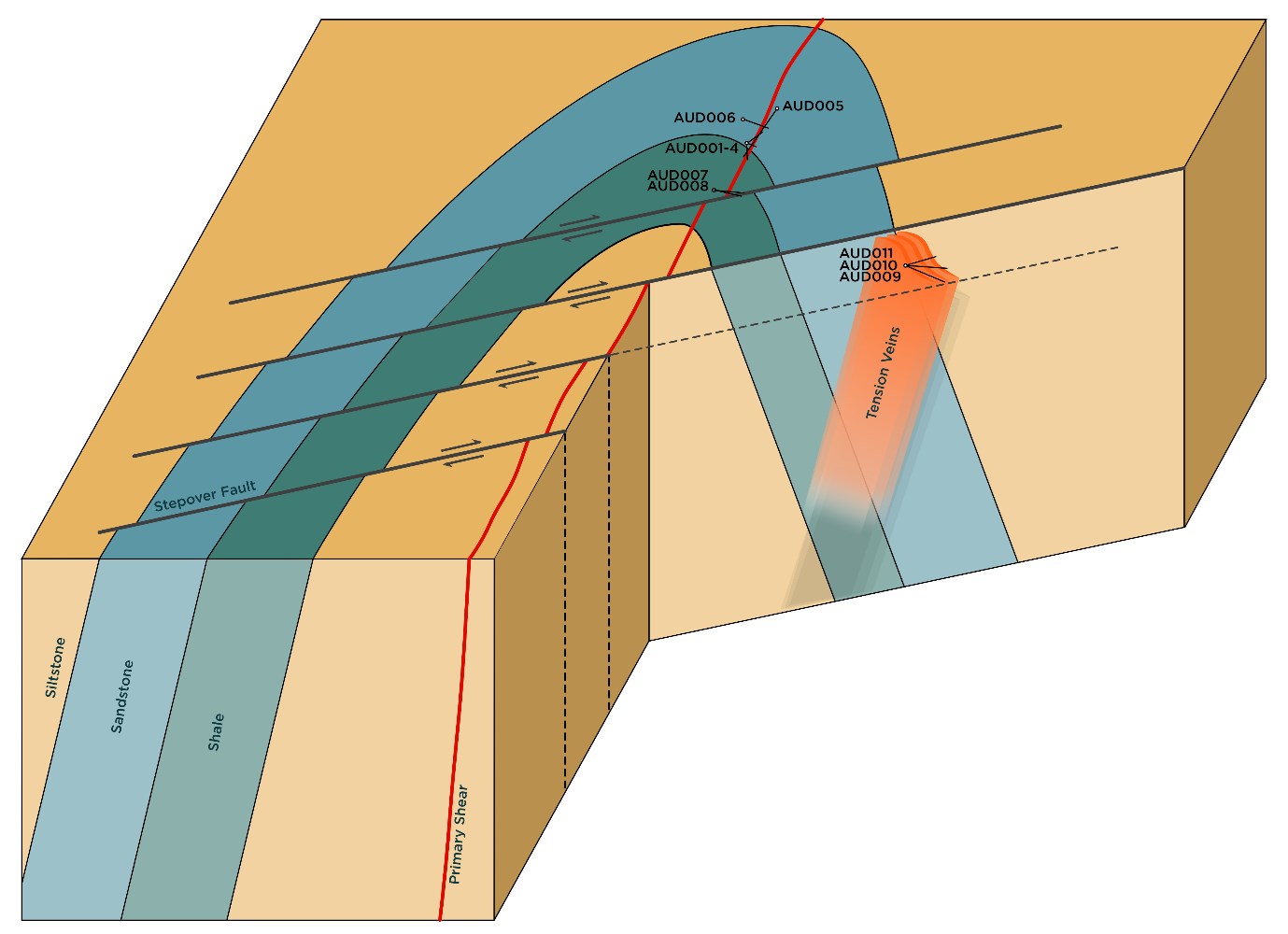
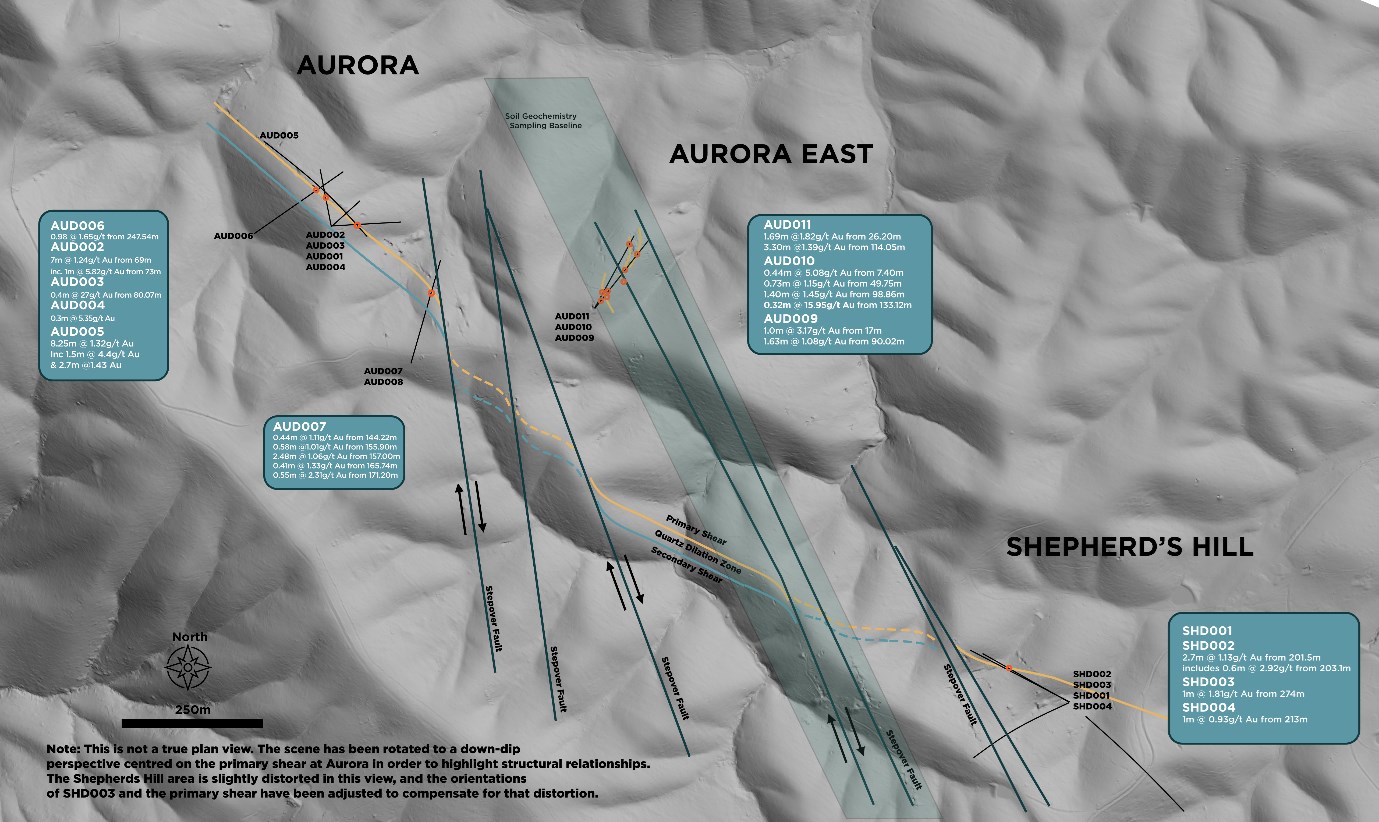
The results suggest that gold mineralization is locally concentrated where the primary shear intersects younger faults trending approximately 340°. These faults offset the shear in a series of stepovers between Aurora and Shepherd's Hill (Figure 2). The Company interprets these intersections as potential zones of dilation that may have provided pathways for gold-bearing fluids.
The IP survey identified a resistivity high at Aurora, which was tested by AUD006. The hole intersected a quartz-rich zone in the hanging wall of the shear and returned 0.98 m @ 1.65 g/t Au from 247.54 m in the shear. This result suggests that quartz veining alone is not a reliable indicator of gold mineralization and that structural context remains important when prioritizing geophysical targets.
AUD007 returned multiple gold intersections over 27 m of drill core in an interpreted dilational zone near the northernmost stepover. Grades were lower in AUD008, drilled beneath AUD007, with mineralization decreasing away from the structure. Several other mapped stepovers remain untested where they intersect the primary shear, providing additional targets for evaluation.
The results refine the Company's structural model and support further testing of shear-fault intersections at Aurora. The interpretation remains preliminary and will be assessed through additional drilling.
Figure 2: Schematic down-dip view of the primary shear between Aurora and Shepherd's Hill, showing the 340° stepover faults that offset the shear, the quartz-rich zone on its hanging wall, and drill intercepts. Gold is focused where the shear is dragged into the stepover faults (shear-fault dilation). This is not a true plan view; refer to the note on the figure.
Structural intersections are recognized controls on gold mineralization in Victoria's orogenic goldfields. At Fosterville, for example, gold mineralization is associated with intersections between the Fosterville Fault, its splays and folded bedding, with ore shoots plunging broadly parallel to the host fold (Leader et al., 2010, Australian Journal of Earth Sciences). This provides a geological context for testing structural intersections at Reedy Creek.
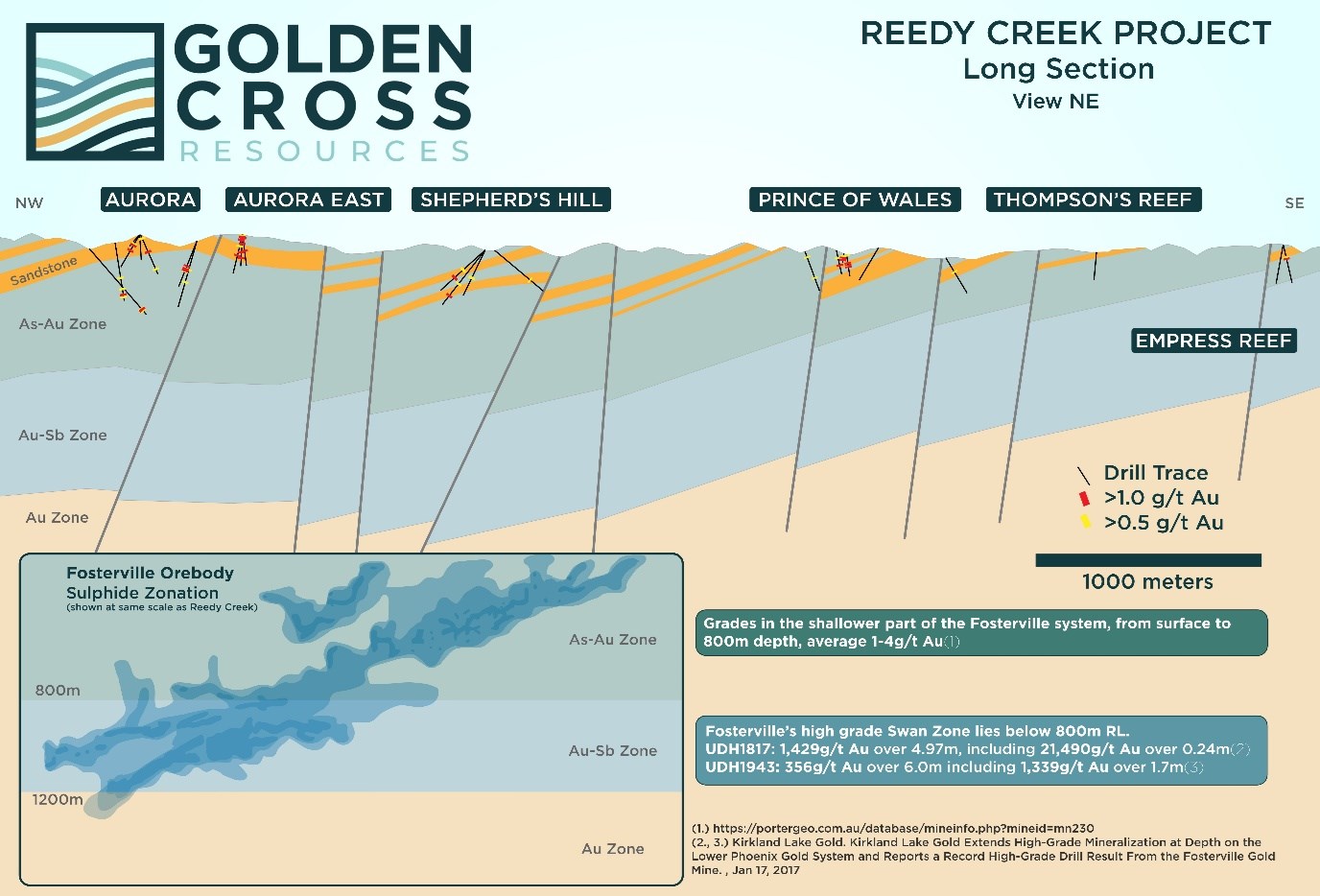
Figure 3 compares the sulphide zonation observed at Reedy Creek with that of the Fosterville gold deposit, shown at the same scale. At Fosterville, gold grades in the shallower portion of the deposit averaged 1 to 4 g/t Au from surface down to approximately 800 m depth, with the high-grade, antimonyassociated Swan Zone situated below this level. Drilling to date has tested only the upper As-Au zone of the Reedy Creek Goldfield, which is characterized by strong arsenic halos and gold grades consistent with the zonation present at Fosterville.
Structural mapping of the Reedy Creek anticline, and the presence of stibnite at Empress Reef indicate the Au-Sb zone may lie closer to surface toward the southeast. The Company considers the deeper, untested portions of the system prospective for higher-grade mineralization, although Fosterville is not necessarily indicative of the style, extent or economic potential of mineralization at Reedy Creek.
Figure 3: Long section through the Reedy Creek Goldfield showing sulphide zonation. The inset image shows the comparison to Fosterville's orebody and its sulphide zonation at the same scale as Reedy Creek.
Aurora: AUD005-AUD008
AUD005 tested the primary shear at depth and returned 8.25 m @ 1.32 g/t Au from 368.25 m downhole, including 1.5 m @ 4.4 g/t Au from 368.25 m. The result confirms gold mineralization at the tested depth.
AUD006 intersected the primary shear with 0.98 m @ 1.65 g/t Au from 247.54 m. A resistivity anomaly identified in the IP program is seen in the core as a quartz-rich zone on the hanging-wall side of the shear.
AUD007 and AUD008 tested the intersection of the primary shear and a 340° stepover fault. AUD007 returned multiple gold intersections across 27 m of drill core in an interpreted dilational corridor, including 2.48 m @ 1.06 g/t Au from 157 m, and 0.55 m @ 2.31 g/t Au from 171.2 m. AUD008 returned 0.49 m @ 0.83 g/t Au from 149.09 m in an interval containing visible gold. These results support further testing of the structural intersection.
Geophysics
A pilot magnetic and induced-polarization (IP) survey by Fender Geophysics assessed the use of geophysics for targeting structurally controlled gold. Magnetic data outlined the primary shear but was limited by low host-rock susceptibility, noise and terrain. IP identified a chargeability high near the Reedy Creek anticline hinge and resistive zones interpreted as quartz veining. One of these zones was tested by AUD006, which intersected intense quartz veining in the hanging wall of the shear (see Geological Interpretation). The survey shows IP can help identify prospective features, but structural context remains key when ranking drill targets.
2026 Exploration Program
Welcome Reef and Prince of Wales
A six-hole, 1,250 m drilling program is underway, with three holes planned at each prospect. The program draws on lidar surveys of historic workings, and the structural interpretation developed through drilling at Aurora.
Welcome Reef: Three holes totalling 600 m will test beneath previous drilling, including 0.7 m @ 3.65 g/t Au in WMD002 (see news release dated March 31st 2026), and historic workings interpreted to represent potential reef systems. The scale of the historic workings, which include a large vertical shaft and substantial mullock, tailings and crusher sands, reflects significant past production: records indicate at least 9,000 oz of gold was produced from the Ah Mouy mine between 1874 and 1891, from approximately 10,500 t of ore at an average grade of 25 g/t Au (Corlett, 1996; see news release dated August 25, 2025). These historical production figures have not been independently verified by the Company's Qualified Person.
Prince of Wales: Three holes totalling 650 m will test beneath previous intercepts and historic ore shoots, guided by lidar scans of a large stope. The Prince of Wales line of reef comprises approximately 600 m of historic workings, featuring a 60 m long open cut. Previous drilling returned 10.8 m @ 2.08 g/t Au from 28 m, including 0.49 m @ 24.4 g/t Au, in PWD004 (see news release dated September 29, 2025).
Aurora East
Approximately 1,100 soil samples are being collected along east-west lines across the corridor hosting the Aurora East veins. Sampling is spaced at 25 m between lines and 10 m between samples, with coverage extending across the primary shear, bounding 340° faults and tension-vein structures.
The survey is designed to identify arsenic anomalies associated with mineralization and help prioritize potential repetitions of the vein corridors for follow-up drilling which will aim to extend the known targets to depth and test any veins identified from the soil sampling program currently underway.
Aurora
Aurora: Follow-up drilling will target untested intersections between the primary shear and 340° stepover faults, as well as the intersection tested by AUD007 and AUD008, which remains open at depth.
Table 1: Drill Collar Data
| Hole ID | Easting (GDA94 Zone 55) | Northing (GDA94 Zone 55) | RL | Azimuth | Dip | Total Depth |
|---|---|---|---|---|---|---|
| AUD005 | 331834 | 5875532 | 427 | 147.3 | -50 | 399.10 |
| AUD006 | 331844 | 5875354 | 447 | 058.0 | -75 | 269.70 |
| AUD007 | 332131 | 5875129 | 497 | 359.5 | -58 | 248.80 |
| AUD008 | 332131 | 5875129 | 497 | 345.0 | -70 | 319.70 |
| AUD009 | 332459 | 5875214 | 477 | 046.0 | -50 | 179.61 |
| AUD010 | 332459 | 5875214 | 477 | 033.0 | -50 | 179.87 |
| AUD011 | 332456 | 5875212 | 477 | 020.0 | -50 | 228.30 |
The complete set of drill results, including collar and assay data, is available HERE.
QA/QC and Analytical Procedures
Drilling completed to date has been exploratory in nature and as such it is irregularly spaced in order to test various aspects of the mineralized systems. Holes are directionally surveyed utilizing a North Seeking Gyro direction tool. Drill collars are subsequently surveyed utilizing a high-accuracy RTK DGPS. Diamond drilling is usually cased, then cored utilizing HQ diameter before reducing at shallow depth in stable ground to NQ2 diameter drill core.
Mineralized intersections quoted herein are reported as interval widths and not true width. Where possible, drilling is conducted perpendicular to the interpreted mineralization trend.
All drill core is marked up, then geological, geotechnical, and structural logging is undertaken. Core is photographed prior to sampling. Sections of core selected for sampling are cut in half using a core saw equipped with a diamond blade. The upper half is submitted for analysis and the lower half of core is retained for reference.
Certified Reference Materials (CRMs), duplicates (quarter core) & blank media are inserted into the sampling sequence at a nominal sampling rate of at least 1 in 20 samples in order to monitor both the Laboratory and core-yard processes.
Samples are submitted to the ALS Global (Australia) prep facility in Adelaide. Samples presented in this release were crushed to 70% less than 2mm before pulverizing to better than 85% passing <75 microns. Assay pulps are then transported by ALS to their Perth facility to be analyzed. Samples were analyzed by ALS method Me-ICP61 (34 Element by HF-HNO3-HClO4 acid digestion with ICP-AES finish). Gold content is determined via ALS method Au-ICP22 (Ore Grade Au 50g Fire Assay ICP-AES Finish). Any sample intervals reporting over 2ppm Au values are subsequently resubmitted for analysis via Screen Fire Assay (ALS method Au-SCR24) to assess coarse vs fine fraction gold. ALS Global is an independent entity from the company.
The QA/QC meets the current required standards under reporting instruments, such as National Instrument 43-101. At this point, AUX regards the data collected from this exercise as reliable for the purposes of identifying future exploration targets and may be used to inform future drilling and exploration campaigns.
Qualified Person
All scientific and technical information in this news release has been prepared or reviewed and approved by Alan Till, the Company's Vice President Exploration, a "qualified person" as defined by NI 43-101.
About Golden Cross Resources
Golden Cross Resources (TSXV: AUX) (OTCQB: ZCRMF) is a Canadian mineral exploration company focused on advancing the Reedy Creek gold project in Victoria, Australia. Located just 7 km from Southern Cross Gold's Sunday Creek discovery, the project covers three contiguous tenements in one of Australia's most active epizonal gold corridors.
For more information:
Matt Roma, Director & CEO +1-778-736-3356 [email protected]
Additional information about Golden Cross can be found on its website:
www.goldencrossresources.com and at www.sedarplus.ca.
CAUTIONARY STATEMENT REGARDING FORWARD-LOOKING INFORMATION: This news release includes certain "forward-looking statements" under applicable Canadian securities legislation relating plans for future exploration and drilling and the timing of same, the merits of the Company's mineral projects and other plans of the Company. Forward-looking statements are statements that are not historical facts; they are generally, but not always, identified by the words "encouraging", "expects", "plans", "anticipates", "believes", "interpret", "intends", "estimates", "projects", "aims", "suggests", "often", "target", "future", "likely", "pending", "potential", "goal", "objective", "prospective", "possibly", "preliminary" and similar expressions, or that events or conditions "will", "would", "may", "can", "could" or "should" occur, or other statements, which, by their nature, refer to future events. The Company cautions that forward-looking statements are based on the beliefs, estimates and opinions of the Company's management on the date the statements are made, and that such statements are subject to risks and uncertainties that may cause actual results, performance or developments to differ materially from those contained in the statements.
Consequently, there can be no assurances that such statements will prove to be accurate and actual results and future events could differ materially from those anticipated in such statements.
Accordingly, readers should not place undue reliance on forward-looking statements.
Factors that could cause future results to differ materially from those anticipated in forward-looking statements include risks associated with exploration and drilling; the timing and content of upcoming work programs; geological interpretations based on drilling that may change with more detailed information; possible accidents; the possibility that the Company may not be able to secure permitting and other governmental approvals necessary to carry out the Company's plans; the risk that the Company will not be able to raise sufficient funds to carry out its business plans; the possibility that future exploration results will not be consistent with the Company's expectations; increases in costs; environmental compliance and changes in environmental and other local legislation and regulation; interest rate other risks associated with mineral exploration operations, the risk that the Company will encounter unanticipated geological factors and exchange rate fluctuations; changes in economic and political conditions; and other risks involved in the mineral exploration industry. The reader is urged to refer to the Company's Management's Discussion and Analysis, publicly available through the Canadian Securities Administrators' System for Electronic Document Analysis and Retrieval (SEDAR+) at www.sedarplus.ca for a more complete discussion of risk factors and their potential effects.
Forward-looking statements are based on a number of assumptions, including management's assumptions about the following: the availability of financing for the Company's exploration activities; operating and exploration costs; the Company's ability to attract and retain skilled staff; timing of the receipt of necessary regulatory and governmental approvals; market competition; and general business and economic conditions. The Company disclaims any intention or obligation to update or revise any forward-looking statements, whether as a result of new information, future events or otherwise, except as required by law.
Neither TSX Venture Exchange nor its Regulation Service Provider (as that term is defined in policies of the TSX Venture Exchange) accepts responsibility for the adequacy or accuracy of this release.
To view the source version of this press release, please visit https://www.newsfilecorp.com/release/321090