
Atlantico Highlights Pegmatite Field Observations and Hand-Dug Artisanal Mine Tunnels at Novo Cruzeiro in Brazil's Lithium Valley
Vancouver, British Columbia--(Newsfile Corp. - June 30, 2026) - Atlantico Energy Metals Corp. (CSE: ATLA) (FSE: 1CJ1) (WKN: A42CRT) (the "Company" or "Atlantico") is highlighting documented field observations from its flagship Novo Cruzeiro Lithium and Rare Earth Elements Project in Minas Gerais, Brazil, including multiple inactive hand-dug artisanal mine tunnels, exposed rock, weathered profiles, light-coloured pegmatitic material and UV-light response.
The Company's previous news release dated June 26, 2026, highlighted first-pass assay results showing rare earth oxide enrichment, elevated magnetic rare earth oxide content and lithium pathfinder indicators from selected stream-sediment and rock-sampling information disclosed in the Company's NI 43-101 Technical Report dated February 9, 2026. Atlantico is now adding field-level context through exposed tunnels, documented pegmatite material, weathered profiles and UV-light response, helping explain where its technical team is focusing the next stage of work.
Atlantico's field team has identified multiple inactive hand-dug artisanal mine tunnels at Novo Cruzeiro, commonly referred to as garimpo galleries, including one within its tenement that is reported to extend approximately 40 metres into the hillside. Field reports from these inactive workings document pegmatite material in exposed tunnel areas, providing the technical team with direct access for geological mapping and sampling.
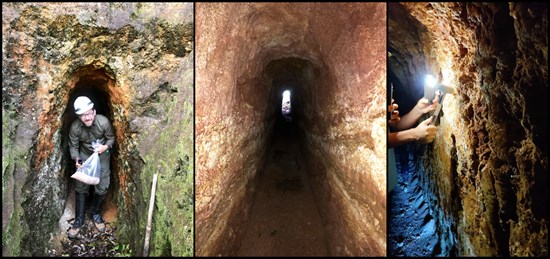
Figure 1. Field team member at the entrance of one inactive garimpo gallery (hand-dug artisanal mine tunnel) at Novo Cruzeiro, showing the scale of the exposed rock face (left image). Interior view of the same approximately 40-metre garimpo gallery located within Atlantico's tenement near its border, showing physical access into the weathered rock profile (centre image). Field team members inspect the tunnel wall with a handheld light, showing the close-up field observation process (right image).
To view an enhanced version of this graphic, please visit:
https://images.newsfilecorp.com/files/4290/303461_f6b49c84d4bce878_001full.jpg
"The clean energy transition depends on the world finding and developing new sources of critical minerals," said Bonn Smith, President & CEO of Atlantico. "At Novo Cruzeiro, these field observations add important ground-level context to our previously announced first-pass results. They show documented pegmatitic material, exposed tunnel workings and weathered profiles that our geologists can map, sample and test systematically. Our role in the clean-energy transition starts with disciplined fieldwork: getting into the ground, documenting geological relationships and following the evidence carefully."
Why Exposed Rock Matters: Direct Access Below the Surface
Exposed rock matters at Novo Cruzeiro because much of the ground is covered by soil, vegetation and deeply weathered material. In plain terms, exposed faces and inactive hand-dug tunnels let geologists step past the cover and see rock relationships directly. In Minas Gerais, earlier prospectors often followed visible minerals such as quartz, feldspar, mica, tourmaline, beryl and other gemstone or industrial-mineral indicators. For modern exploration teams, those same exposed areas provide direct access to rock relationships, structures, weathering patterns and alteration features that are otherwise hidden at surface.
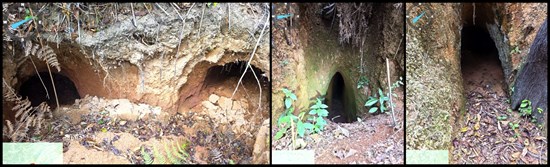
Figure 2. Multiple inactive hand-dug artisanal mine tunnels identified at Novo Cruzeiro. These locally known garimpo galleries show exposed openings in weathered ground, including adjacent openings in the exposed bank (left image), a narrow vegetation-covered entrance (centre image), and a separate tunnel-style opening with visible weathered rock along the walls and floor (right image). These gallery exposures provide physical access for mapping, sampling and follow-up exploration.
To view an enhanced version of this graphic, please visit:
https://images.newsfilecorp.com/files/4290/303461_f6b49c84d4bce878_002full.jpg
Field reports from the gallery area document schist, a layered host rock, and thin veins of light-coloured pegmatitic material. Pegmatite is a coarse-grained rock that commonly contains minerals such as quartz, feldspar and mica. In hard-rock lithium exploration, certain pegmatite systems can be important because they may host lithium-bearing minerals, although pegmatite by itself does not confirm lithium mineralization.
Field reports describe some of the pegmatite material as thin, sheet-like or lens-shaped bodies occurring with schist. This matters because the field team is documenting not only the presence of pegmatitic material, but also its shape, orientation and relationship to the surrounding rock. In covered terrain, these gallery exposures provide a field basis for mapping, sampling and follow-up targeting.
Pegmatitic Material and UV Light: Field Evidence for Follow-Up
At Novo Cruzeiro, light-coloured pegmatite material, feldspar-rich zones and the exposed areas associated with inactive garimpo galleries are documented as part of Atlantico's broader exploration review. These observations are being used to focus the next stage of mapping and sampling.
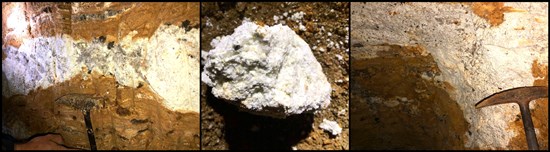
Figure 3. Light-coloured pegmatitic material exposed in a weathered wall, shown in place against the surrounding reddish-brown rock (left image). Close-up of light-coloured pegmatitic material showing texture and coarse-grained appearance (centre image). Light-coloured pegmatitic material exposed in the wall with hammer for scale, showing field context and relative size (right image).
To view an enhanced version of this graphic, please visit:
https://images.newsfilecorp.com/files/4290/303461_f6b49c84d4bce878_003full.jpg
UV fluorescence was observed during field review of the tunnel exposure and is visible in the field imagery. In the field, UV light is used to flag features that warrant closer inspection and sampling decisions. However, UV fluorescence is not diagnostic by itself, lithium was not confirmed by assay, and samples from the tunnel did not return significant lithium results. Accordingly, UV fluorescence should be treated as an exploration indicator, not as proof of spodumene, lithium mineralization or economic potential. Analytical methods and QA/QC procedures for these samples are described in the February 9, 2026 NI 43-101 Technical Report.
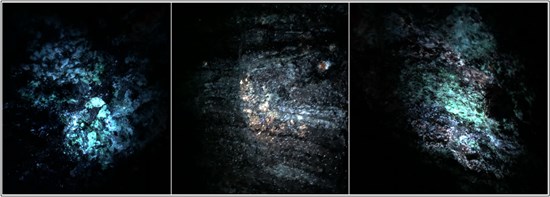
Figure 4. UV light response observed on pegmatitic material inside the tunnel, showing a localized blue-green fluorescence effect under field lighting (left image). Additional UV light response observed on a separate wall exposure of pegmatitic material (centre image). Green-blue fluorescence response on weathered pegmatitic material under UV light, showing the field response that guided follow-up discussion (right image).
To view an enhanced version of this graphic, please visit:
https://images.newsfilecorp.com/files/4290/303461_f6b49c84d4bce878_004full.jpg
Based on these observations, Atlantico expects to prioritize the gallery and exposed-rock area for the next stage of mapping and sampling, while continuing regional stream-sediment sampling to identify additional targets across Novo Cruzeiro.
Weathered Rock: Reading Covered Ground
Saprolite is the technical term for bedrock that has been deeply weathered in place. It is not ordinary soil. It can look like softer clay-rich, iron-stained or bleached material, but it can still preserve evidence of the original rock below. In tropical regions such as Minas Gerais, this weathered layer can be thick enough to hide fresh rock at surface. For hard-rock lithium exploration, these weathered profiles help field teams read the surface expression of the underlying system and guide future fieldwork.
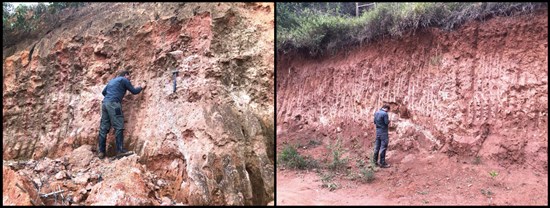
Figure 5. Field team member examining a deeply weathered rock exposure with visible colour and textural variation, showing hands-on field review of the profile (left image). Person-scale view of a vertical reddish weathered profile, showing the depth and texture of the exposed material at the outcrop scale (right image). Weathered rock provides field context for mapping, sampling and technical review.
To view an enhanced version of this graphic, please visit:
https://images.newsfilecorp.com/files/4290/303461_f6b49c84d4bce878_005full.jpg
At Novo Cruzeiro, roadcuts, hand-dug openings and weathered profiles are being documented as part of Atlantico's early-stage field program. Together, they help the technical team read covered ground and prioritize the next stage of fieldwork.
Why These Geological Observations Matter
The importance of this work is that exposed rock, weathered profiles and documented field observations give Atlantico practical access to geological information that is often hidden in tropical terrains. Rather than presenting exploration as an abstract lab exercise, the photos show fieldwork in practical terms: finding exposures, recording geological relationships, sampling where appropriate and building an evidence-based case for follow-up exploration.
Next-stage work is expected to remain systematic and evidence-led. Planned priorities include continued field mapping, targeted sampling of exposed light-coloured pegmatitic material, source-area follow-up from earlier stream-sediment and pathfinder results, ridge and spur soil sampling where appropriate, geophysical work where cover or weathered ground limits surface visibility, and trenching where warranted by earlier field results.
Important Early-Stage Disclosure
Novo Cruzeiro is located in Minas Gerais, Brazil, within the broader Lithium Valley region, an established hard-rock lithium district. While regional activity does not indicate mineralization at Novo Cruzeiro, the setting helps explain why Atlantico is focused on documented field observations, exposed rock and systematic follow-up work.
Novo Cruzeiro remains at an early stage of exploration. The Technical Report notes that there is no known mineralization on the property, no historic drilling, and no mineral resources or mineral reserves. It also notes that the risk remains high that economic mineralization may not occur on the property. The field observations described in this release should not be interpreted as confirmation of lithium mineralization.
Exposed rock, light-coloured pegmatitic material, weathered profiles, alteration, UV fluorescence and recommended follow-up work are exploration observations only. They are exploration indicators, but they are not proof of lithium mineralization or an economic mineral deposit, and they do not confirm grade, tonnage, continuity, resources, reserves, recoveries, mineability or economic potential. More work is required, and there can be no assurance that future exploration will result in the discovery or definition of mineral resources or mineral reserves.
The inactive artisanal workings described in this release predate the Company's activities and do not constitute evidence of lithium mineralization or of the presence of an economic mineral deposit on the Novo Cruzeiro Project.
Qualified Person Statement
Andrew Lee Smith, P.Geo., a Qualified Person as defined by National Instrument 43-101 - Standards of Disclosure for Mineral Projects, has reviewed and approved the scientific and technical information contained in this news release. Mr. Smith is not independent of the Company within the meaning of National Instrument 43-101 due to his role as a member of the Company's Advisory Board.
Unless otherwise indicated, the field observations described in this release are summarized from the Company's NI 43-101 Technical Report dated February 9, 2026 and related field documentation reviewed by the Qualified Person.
Atlantico Energy Metals Corp. is a Canadian mineral exploration company built around a simple belief: a cleaner energy future needs critical minerals. Atlantico's flagship asset is Novo Cruzeiro, a lithium and rare earth elements exploration project located in Lithium Valley, Minas Gerais, Brazil. Atlantico is advancing Novo Cruzeiro with a focus on disciplined technical work, transparent disclosure, responsible exploration and long-term value creation for shareholders, local communities and the regions where the Company operates.
For more information, please contact:
Bonn Smith, President & CEO
Tel: +1 (855) 258-6463
Email: [email protected]
Website: www.atlantico.energy
The CSE has neither approved nor disapproved the contents of this news release.
Forward-Looking Information
This news release contains "forward-looking information" and "forward-looking statements" within the meaning of applicable securities legislation. Forward-looking information in this news release includes, without limitation, statements regarding the Company's plans for further exploration at the Novo Cruzeiro Lithium and Rare Earth Elements Project, the potential significance of exposed rock, hand-dug openings, light-coloured pegmatitic material, weathered profiles, UV fluorescence observations, mapping, sampling, field verification, technical review, recommended follow-up work, the Company's exploration strategy, and the Company's objective of advancing Novo Cruzeiro through disciplined technical work and transparent disclosure.
Forward-looking information is based on assumptions that management considers reasonable as of the date of this news release, including assumptions regarding the availability of financing, the ability to obtain required permits and approvals, continued access to the project area, the availability of qualified personnel and contractors, the reliability of historical and current technical information, and the Company's ability to complete planned exploration activities. Forward-looking information is subject to known and unknown risks, uncertainties and other factors that may cause actual results to differ materially from those expressed or implied, including risks related to mineral exploration, early-stage project development, commodity prices, capital markets, permitting, environmental and regulatory matters, political and economic conditions in Brazil, title and access matters, technical interpretation, and the risk that future exploration may not result in the discovery or definition of mineral resources or mineral reserves.
No undue reliance should be placed on forward-looking information. The Company undertakes no obligation to update forward-looking information except as required by applicable law.
To view the source version of this press release, please visit https://www.newsfilecorp.com/release/303461
Source: Atlantico Energy Metals Corp.